
We read your photo as:
Solve the following equations using Cramer's rule (determinant) a) x-3y=-3, 2x+5y=8 b) x−2y−z=3, 3x−6y−5z=3, 2X−y+z=0 c) x+2y+3z=17, 3x+2y+z=11, x-5y+3z=-5
ScanSolve AI Answer
Step-by-step solution
7 stepsHere's the solution for question 9:
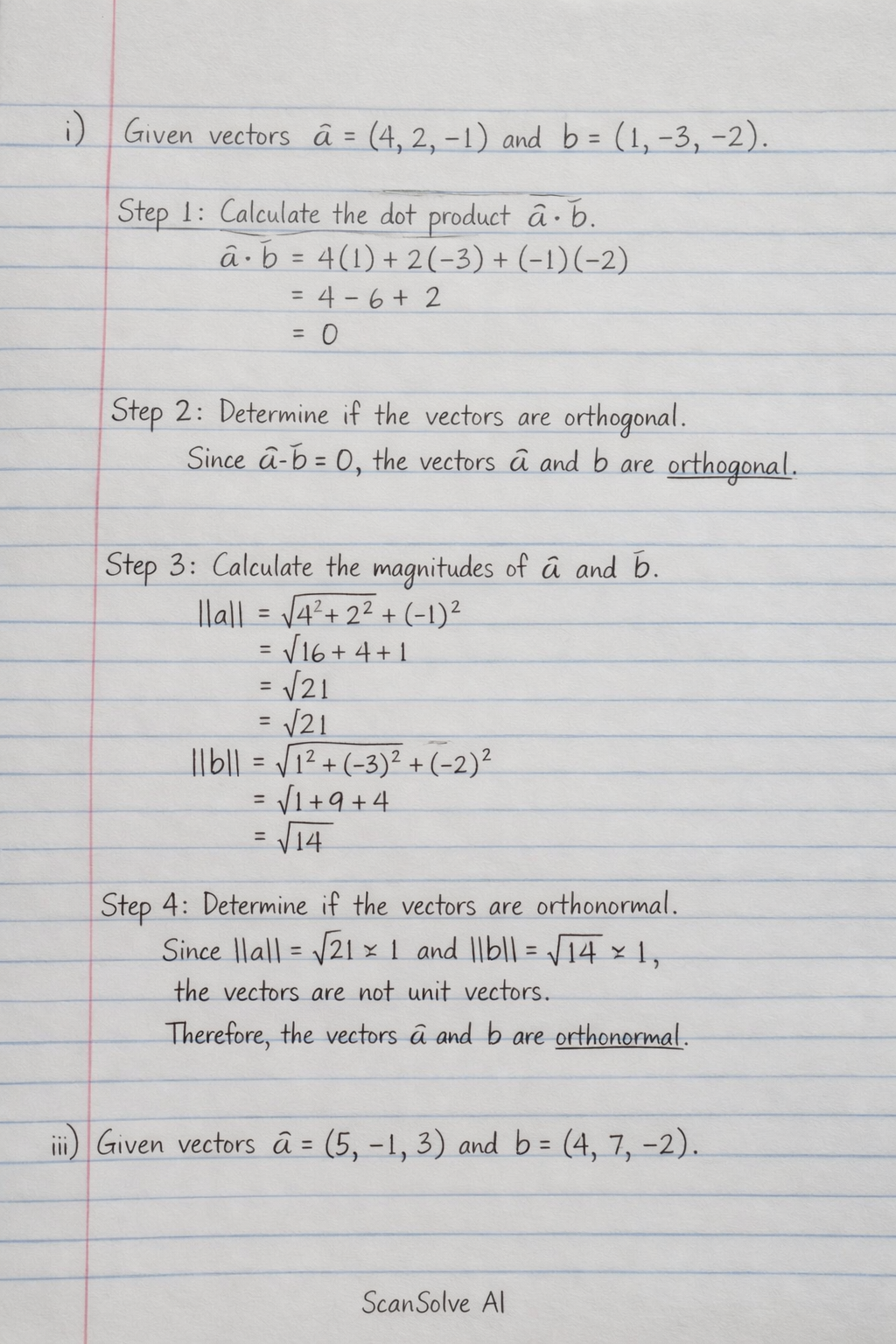
To determine if vectors are orthogonal, we check if their dot product is zero. If they are orthogonal, we then check if they are orthonormal by verifying if both vectors are unit vectors (i.e., their magnitudes are 1).
i) Given vectors and .
Calculate the dot product .
Determine if the vectors are orthogonal.
Since , the vectors and are orthogonal.
Calculate the magnitudes of and .
Determine if the vectors are orthonormal.
Since and , the vectors are not unit vectors.
Therefore, the vectors and are not orthonormal.ii) Given vectors and .
Calculate the dot product .
Determine if the vectors are orthogonal.
Since , the vectors and are not orthogonal.
Determine if the vectors are orthonormal.
Since the vectors are not orthogonal, they cannot be orthonormal.
Final Answer:
i) The vectors and are orthogonal but not orthonormal.
ii) The vectors and are not orthogonal and therefore not orthonormal.
Still stuck on this one?
Ask a follow-up, and the answer starts from this question.
More Mathematics Questions
Handwritten Step-by-Step Solution
Get this as a handwritten image on WhatsApp — like a tutor wrote it for you.
Try on WhatsApp