
We read your photo as:
Evaluate the following limits: 1. lim (x3 - 27)/(x2 - 9) as x approaches 3. 2. lim (sqrt(x+2) - 3)/(x-7) as x approaches 7.
ScanSolve AI Answer
Step-by-step solution
30 stepsHere are the solutions to the limit problems.
- We need to evaluate the limit:
Substitute into the expression.
$$ \frac{3^3 - 27}{3^2 - 9} = \frac{27 - 27}{9 - 9} = \frac{0}{0} $$ This is an indeterminate form, so we need to simplify the expression.Factor the numerator and the denominator.
Use the difference of cubes formula and the difference of squares formula .
Rewrite the limit with the factored expressions and cancel out the common term .
$$ \lim_{x \to 3} \frac{(x-3)(x^2 + 3x + 9)}{(x-3)(x+3)} = \lim_{x \to 3} \frac{x^2 + 3x + 9}{x+3} $$Substitute into the simplified expression.
$$ \frac{3^2 + 3(3) + 9}{3+3} = \frac{9 + 9 + 9}{6} = \frac{27}{6} $$Simplify the fraction.
$$ \frac{27}{6} = \frac{9}{2} $$ The limit is $\boxed{\frac{9}{2}}$.2. We need to evaluate the limit:
Substitute into the expression.
$$ \frac{\sqrt{7+2} - 3}{7-7} = \frac{\sqrt{9} - 3}{0} = \frac{3-3}{0} = \frac{0}{0} $$ This is an indeterminate form, so we need to simplify the expression.Multiply the numerator and denominator by the conjugate of the numerator, which is .
$$ \lim_{x \to 7} \frac{\sqrt{x+2} - 3}{x-7} \times \frac{\sqrt{x+2} + 3}{\sqrt{x+2} + 3} $$Simplify the numerator using the difference of squares formula .
$$ (\sqrt{x+2})^2 - 3^2 = (x+2) - 9 = x-7 $$Rewrite the limit with the simplified numerator.
$$ \lim_{x \to 7} \frac{x-7}{(x-7)(\sqrt{x+2} + 3)} $$Cancel out the common term .
$$ \lim_{x \to 7} \frac{1}{\sqrt{x+2} + 3} $$Substitute into the simplified expression.
$$ \frac{1}{\sqrt{7+2} + 3} = \frac{1}{\sqrt{9} + 3} = \frac{1}{3+3} = \frac{1}{6} $$ The limit is $\boxed{\frac{1}{6}}$.3. We need to evaluate the limit:
Identify the highest power of in the denominator.
Inside the square root, the highest power is , so .
Divide every term in the numerator and the denominator by .
For terms inside the square root, divide by .
Simplify the terms.
$$ \lim_{x \to \infty} \frac{4 - \frac{5}{x} + \frac{1}{x^2}}{\sqrt{9 + \frac{2}{x^2} - \frac{6}{x^4}}} $$Apply the limit.
As , terms of the form approach 0.
Simplify the expression.
$$ \frac{4}{3} $$ The limit is $\boxed{\frac{4}{3}}$.4. We need to evaluate the limit:
Rewrite in terms of and .
$$ \lim_{x \to 0} \frac{\sin(5x)}{\frac{\sin(3x)}{\cos(3x)}} = \lim_{x \to 0} \frac{\sin(5x) \cos(3x)}{\sin(3x)} $$Rearrange the terms to use the special limit .
$$ \lim_{x \to 0} \left( \frac{\sin(5x)}{5x} \cdot \frac{3x}{\sin(3x)} \cdot \frac{5x}{3x} \cdot \cos(3x) \right) $$Simplify the expression and apply the limit properties.
$$ \lim_{x \to 0} \left( \frac{\sin(5x)}{5x} \right) \cdot \lim_{x \to 0} \left( \frac{3x}{\sin(3x)} \right) \cdot \lim_{x \to 0} \left( \frac{5}{3} \right) \cdot \lim_{x \to 0} \left( \cos(3x) \right) $$Evaluate each limit.
$$ 1 \cdot 1 \cdot \frac{5}{3} \cdot \cos(0) = 1 \cdot 1 \cdot \frac{5}{3} \cdot 1 = \frac{5}{3} $$ The limit is $\boxed{\frac{5}{3}}$.5. There are two problems labeled '5'. I will solve both.
* First : $$ \lim_{x \to 0} \frac{1 - \cos x}{x^2} $$This is a standard limit.
We can use the identity .
Rearrange the terms to use the special limit .
$$ \lim_{x \to 0} 2 \cdot \frac{\sin\left(\frac{x}{2}\right)}{x} \cdot \frac{\sin\left(\frac{x}{2}\right)}{x} $$Multiply and divide by for each term.
$$ \lim_{x \to 0} 2 \cdot \frac{\sin\left(\frac{x}{2}\right)}{\frac{x}{2} \cdot 2} \cdot \frac{\sin\left(\frac{x}{2}\right)}{\frac{x}{2} \cdot 2} $$Simplify and apply the limit.
$$ \lim_{x \to 0} 2 \cdot \frac{1}{2} \cdot \frac{1}{2} \cdot \left( \frac{\sin\left(\frac{x}{2}\right)}{\frac{x}{2}} \right) \cdot \left( \frac{\sin\left(\frac{x}{2}\right)}{\frac{x}{2}} \right) = 2 \cdot \frac{1}{4} \cdot 1 \cdot 1 = \frac{1}{2} $$ Alternatively, using L'Hôpital's Rule (since substituting $x=0$ gives $\frac{0}{0}$):Apply L'Hôpital's Rule.
$$ \lim_{x \to 0} \frac{\frac{d}{dx}(1 - \cos x)}{\frac{d}{dx}(x^2)} = \lim_{x \to 0} \frac{\sin x}{2x} $$Rearrange the terms.
$$ \lim_{x \to 0} \frac{1}{2} \cdot \frac{\sin x}{x} $$Apply the special limit .
$$ \frac{1}{2} \cdot 1 = \frac{1}{2} $$ The limit is $\boxed{\frac{1}{2}}$. * Second : $$ \lim_{x \to 0} \frac{1 - \cos x}{x} $$Substitute into the expression.
$$ \frac{1 - \cos 0}{0} = \frac{1 - 1}{0} = \frac{0}{0} $$ This is an indeterminate form, so we can use L'Hôpital's Rule.Apply L'Hôpital's Rule.
$$ \lim_{x \to 0} \frac{\frac{d}{dx}(1 - \cos x)}{\frac{d}{dx}(x)} = \lim_{x \to 0} \frac{\sin x}{1} $$Substitute into the simplified expression.
    $$
    \sin(0) = 0
    $$
    The limit is $\boxed{0}$.
Still stuck on this one?
Ask a follow-up, and the answer starts from this question.
More Mathematics Questions
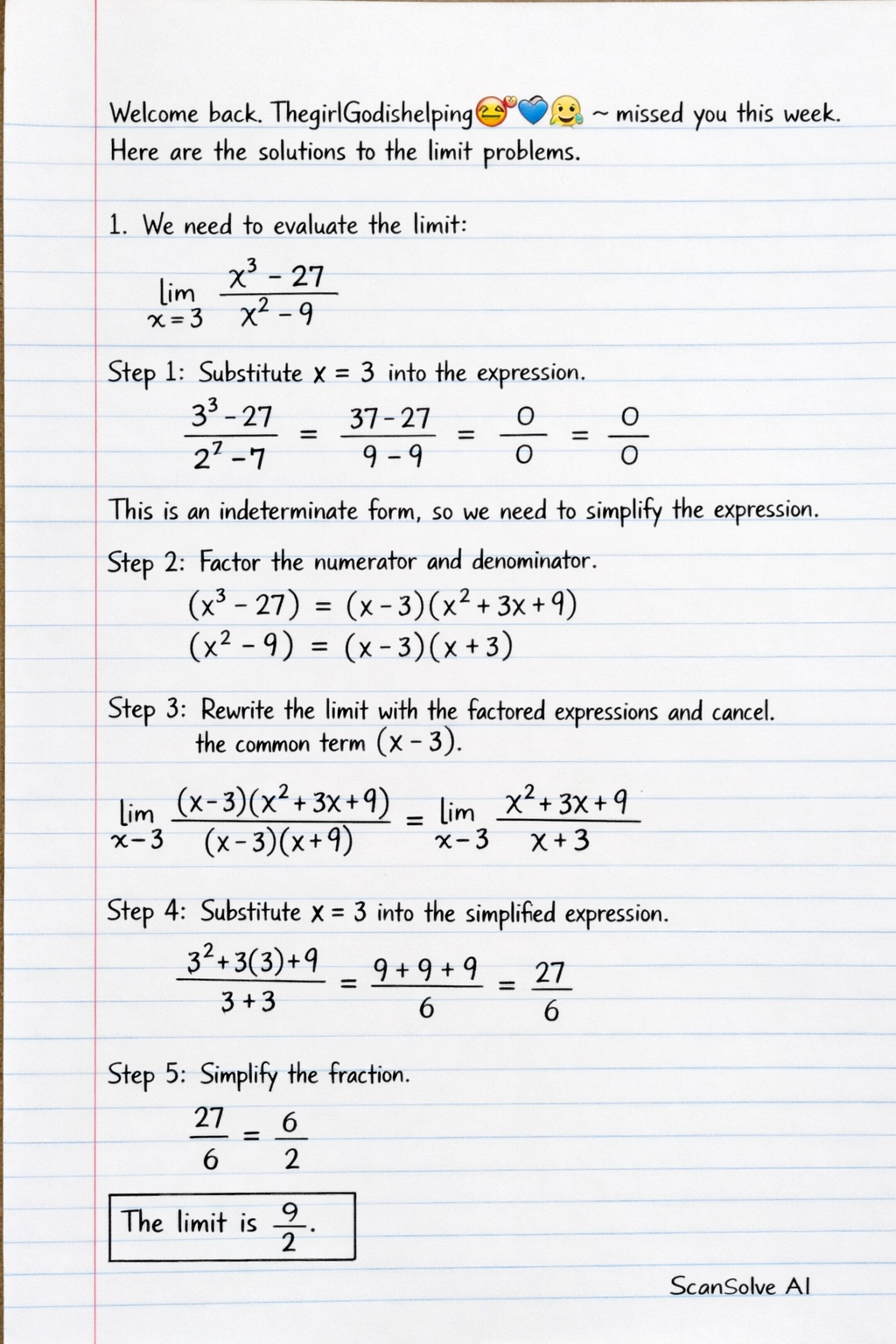
Handwritten Step-by-Step Solution
Get this as a handwritten image on WhatsApp — like a tutor wrote it for you.
Try on WhatsApp