Evaluate the following limits: x 1 (7x2 - 4x - 3)/(3x2 - 4x + 1) and x -2 (x4 + 5x3 + 6x2)/(x2(x+1) - 4(x+1))
|Mathematics
Evaluate the following limits: x 1 (7x2 - 4x - 3)/(3x2 - 4x + 1) and x -2 (x4 + 5x3 + 6x2)/(x2(x+1) - 4(x+1))
ScanSolve AI Answer
Answer
5
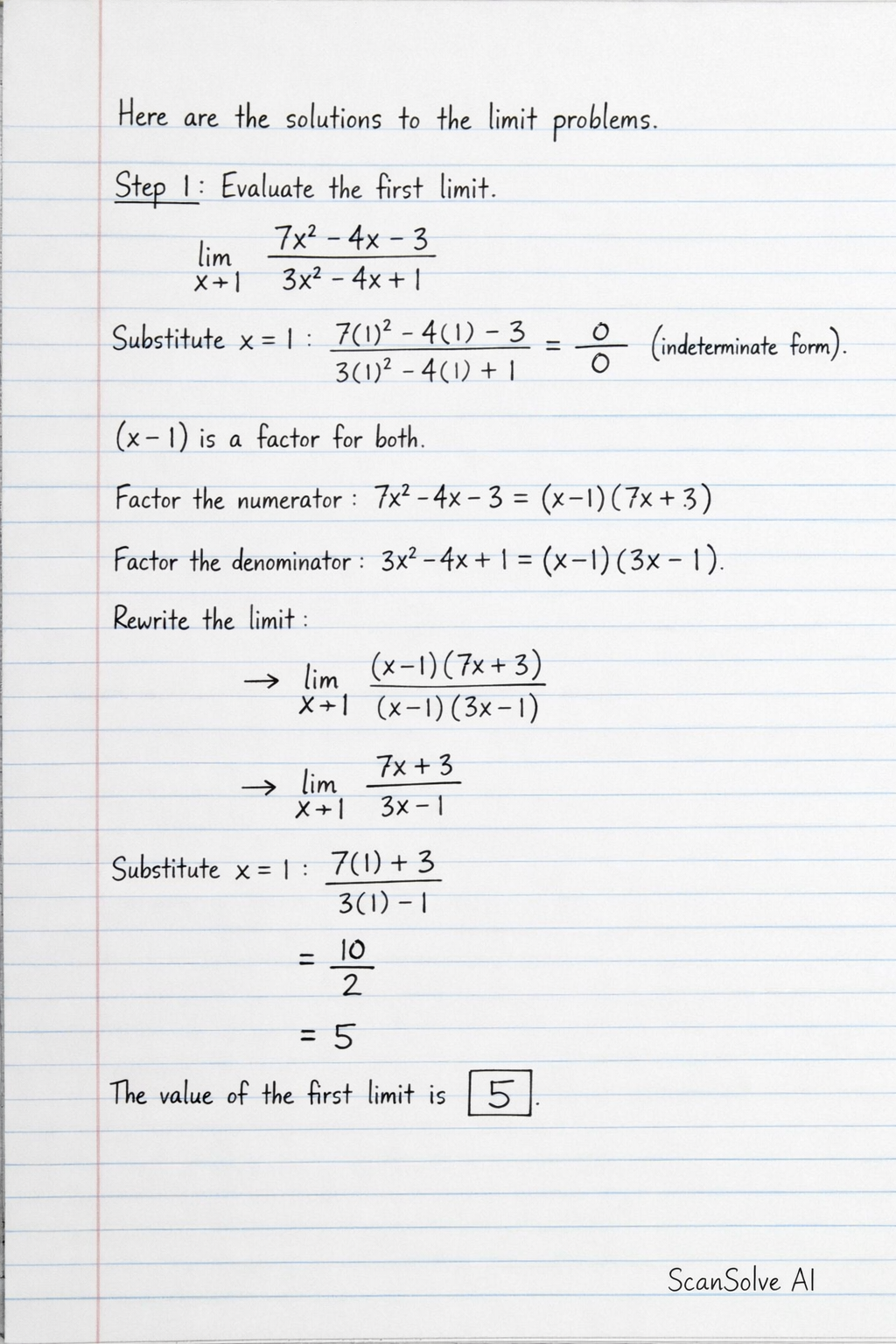
Here are the solutions to the limit problems.
Step 1: Evaluate the first limit.
limx→13x2−4x+17x2−4x−3
Substituting x=1 directly gives 3(1)2−4(1)+17(1)2−4(1)−3=3−4+17−4−3=00, which is an indeterminate form. We factor the numerator and the denominator.
Since x=1 is a root for both, (x−1) is a factor.
Factor the numerator: 7x2−4x−3=(x−1)(7x+3).
Factor the denominator: 3x2−4x+1=(x−1)(3x−1).
Now, substitute these factored forms into the limit expression:
limx→1(x−1)(3x−1)(x−1)(7x+3)
Cancel out the common factor (x−1) (since x=1 as x→1):
limx→13x−17x+3
Now, substitute x=1:
3(1)−17(1)+3=3−17+3=210=5
The value of the first limit is 5.
Step 2: Evaluate the second limit.
limx→−2x2(x+1)−4(x+1)x4+5x3+6x2
Substituting x=−2 directly gives (−2)2(−2+1)−4(−2+1)(−2)4+5(−2)3+6(−2)2=4(−1)−4(−1)16−40+24=00, which is an indeterminate form. We need to simplify the expression.
Factor the numerator:
x4+5x3+6x2=x2(x2+5x+6)=x2(x+2)(x+3).
Factor the denominator:
x2(x+1)−4(x+1)=(x+1)(x2−4)=(x+1)(x−2)(x+2).
Now, substitute these factored forms into the limit expression:
limx→−2(x+1)(x−2)(x+2)x2(x+2)(x+3)
Cancel out the common factor (x+2) (since x=−2 as x→−2):
limx→−2(x+1)(x−2)x2(x+3)
Now, substitute x=−2:
(−2+1)(−2−2)(−2)2(−2+3)=(−1)(−4)4(1)=44=1
The value of the second limit is 1.
Step 3: Evaluate the third limit.
limx→1x−13x−1
Substituting x=1 directly gives 1−131−1=1−11−1=00, which is an indeterminate form.
To simplify, let x=t6. As x→1, t→1.
Then 3x=3t6=t2 and x=t6=t3.
Substitute these into the limit expression:
limt→1t3−1t2−1
Factor the numerator using the difference of squares formula a2−b2=(a−b)(a+b):
t2−1=(t−1)(t+1).
Factor the denominator using the difference of cubes formula a3−b3=(a−b)(a2+ab+b2):
t3−1=(t−1)(t2+t+1).
Now, substitute these factored forms into the limit expression:
limt→1(t−1)(t2+t+1)(t−1)(t+1)
Cancel out the common factor (t−1) (since t=1 as t→1):
limt→1t2+t+1t+1
Now, substitute t=1:
12+1+11+1=1+1+12=32
The value of the third limit is 32.
Send me the next one 📸
Was this helpful?
Need help with your own homework?
Get instant step-by-step solutions to any question. Free to start.
This mathematics problem involves applying core mathematical principles and formulas. Below you will find a complete step-by-step solution with detailed explanations for each step, helping you understand not just the answer but the method behind it.
ScanSolve AI Answer
Here are the solutions to the limit problems. Step 1: Evaluate the first limit. _x 1 (7x^2 - 4x - 3)/(3x^2 - 4x + 1) Substituting x=1 directly gives (7(1)^2 - 4(1) - 3)/(3(1)^2 - 4(1) + 1) = (7-4-3)/(3-4+1) = (0)/(0), which is an indeterminate form. We factor the numerator and the denominator. Since x=1 is a root for both, (x-1) is a factor. Factor the numerator: 7x^2 - 4x - 3 = (x-1)(7x+3). Factor the denominator: 3x^2 - 4x + 1 = (x-1)(3x-1). Now, substitute these factored forms into the limit expression: _x 1 ((x-1)(7x+3))/((x-1)(3x-1)) Cancel out the common factor (x-1) (since x ≠ 1 as x 1): _x 1 (7x+3)/(3x-1) Now, substitute x=1: (7(1)+3)/(3(1)-1) = (7+3)/(3-1) = (10)/(2) = 5 The value of the first limit is 5. Step 2: Evaluate the second limit. _x -2 (x^4 + 5x^3 + 6x^2)/(x^2(x+1) - 4(x+1)) Substituting x=-2 directly gives ((-2)^4 + 5(-2)^3 + 6(-2)^2)/((-2)^2(-2+1) - 4(-2+1)) = (16 - 40 + 24)/(4(-1) - 4(-1)) = (0)/(0), which is an indeterminate form. We need to simplify the expression. Factor the numerator: x^4 + 5x^3 + 6x^2 = x^2(x^2 + 5x + 6) = x^2(x+2)(x+3). Factor the denominator: x^2(x+1) - 4(x+1) = (x+1)(x^2-4) = (x+1)(x-2)(x+2). Now, substitute these factored forms into the limit expression: _x -2 (x^2(x+2)(x+3))/((x+1)(x-2)(x+2)) Cancel out the common factor (x+2) (since x ≠ -2 as x -2): _x -2 (x^2(x+3))/((x+1)(x-2)) Now, substitute x=-2: ((-2)^2(-2+3))/((-2+1)(-2-2)) = (4(1))/((-1)(-4)) = (4)/(4) = 1 The value of the second limit is 1. Step 3: Evaluate the third limit. _x 1 [3]x - 1sqrt(x) - 1 Substituting x=1 directly gives [3]1 - 1sqrt(1) - 1 = (1-1)/(1-1) = (0)/(0), which is an indeterminate form. To simplify, let x = t^6. As x 1, t 1. Then [3]x = [3]t^6 = t^2 and sqrt(x) = sqrt(t^6) = t^3. Substitute these into the limit expression: _t 1 (t^2 - 1)/(t^3 - 1) Factor the numerator using the difference of squares formula a^2-b^2=(a-b)(a+b): t^2 - 1 = (t-1)(t+1). Factor the denominator using the difference of cubes formula a^3-b^3=(a-b)(a^2+ab+b^2): t^3 - 1 = (t-1)(t^2+t+1). Now, substitute these factored forms into the limit expression: _t 1 ((t-1)(t+1))/((t-1)(t^2+t+1)) Cancel out the common factor (t-1) (since t ≠ 1 as t 1): _t 1 (t+1)/(t^2+t+1) Now, substitute t=1: (1+1)/(1^2+1+1) = (2)/(1+1+1) = (2)/(3) The value of the third limit is (2)/(3). Send me the next one 📸