
We read your photo as:
Solve the following problems: 1. If 6 pairs of shoes cost N1,350, what is the cost of 9 pairs? 2. A bucket has a capacity of 5 litres. What is the capacity of 7 buckets? 3. Apples are shared in the ra
ScanSolve AI Answer
Answer
Step-by-step solution
24 stepsPart 1· 2 steps
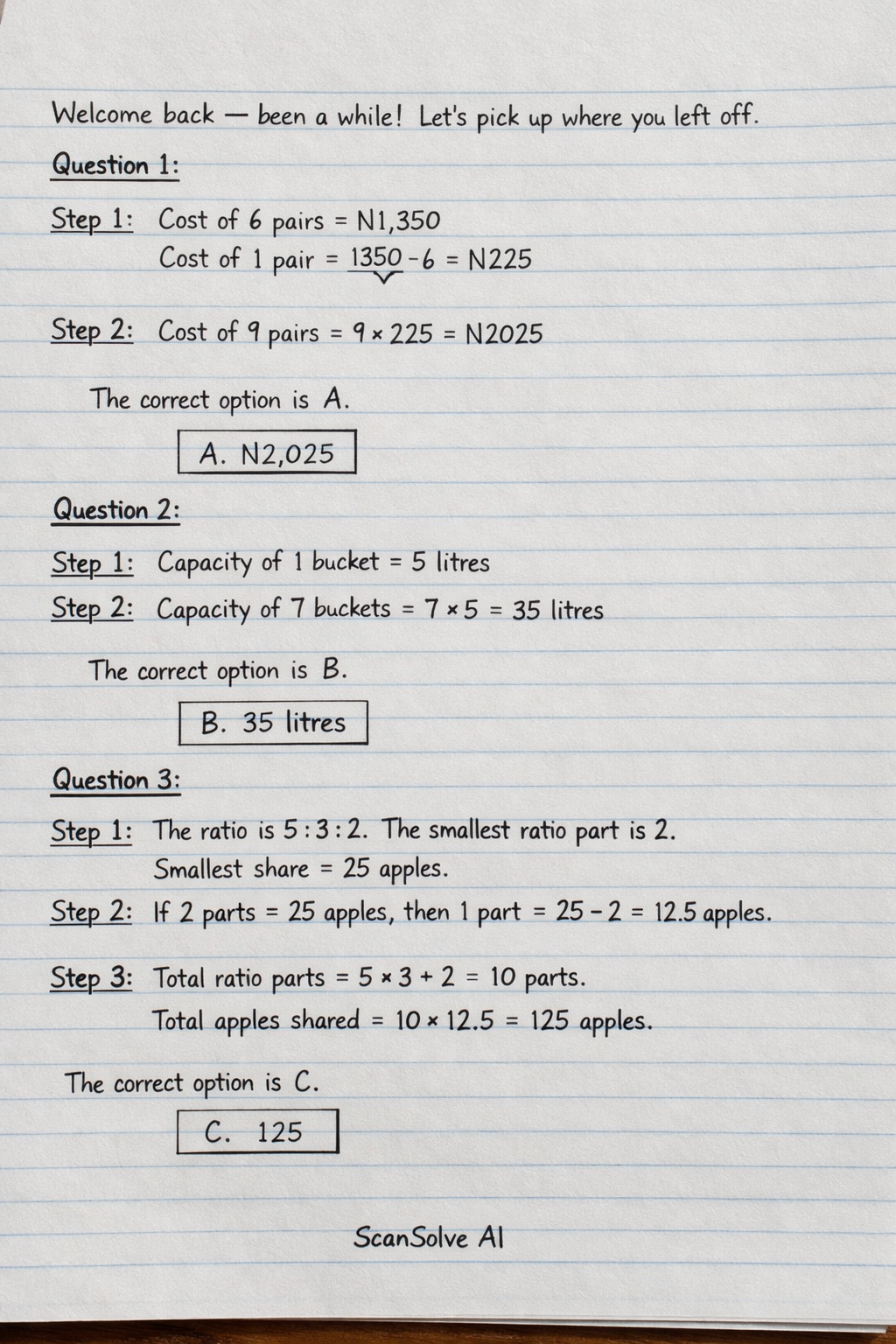
Find the cost of one pair of shoes.
Cost of 6 pairs = N1,350
Cost of 1 pair =Find the cost of nine pairs of shoes.
Cost of 9 pairs =
The correct option is A.
Part 2· 2 steps
Identify the capacity of one bucket.
Capacity of 1 bucket = 5 litres
Calculate the capacity of 7 buckets.
Capacity of 7 buckets = litres
The correct option is B.
Part 3· 3 steps
Identify the ratio and the smallest share.
The ratio is 5:3:2. The smallest ratio part is 2.
The share corresponding to the smallest ratio (2) is 25 apples.Find the value of one ratio part.
If 2 parts = 25 apples, then 1 part = apples.
Find the total number of apples shared.
Total ratio parts = parts.
Total apples shared = apples.The correct option is C.
Part 4· 2 steps
Identify the amounts of sugar used.
Sugar for baking = 587 kg (assuming 'kb' is a typo for 'kg')
Sugar for coating = 140 kgCalculate the total sugar content.
Total sugar =
The correct option is B.
Part 5· 3 steps
Write the given ratio.
Ratio = 15:25
Find the greatest common divisor (GCD) of 15 and 25.
The GCD of 15 and 25 is 5.
Divide both parts of the ratio by the GCD.
The correct option is B.
Part 6· 10 steps
Convert mixed numbers to improper fractions.
Rewrite the expression with improper fractions.
Find a common denominator, which is 4.
Perform the addition and subtraction.
Convert the result back to a mixed number if necessary.
or is not correct. Let's recheck the options.
Option B is . This is incorrect.
Let's recheck the calculation.
None of the options A, B, C, D match 3. Let's assume there might be a typo in the question or options, or I might have misread the options.
A.
B.
C.
D.If the answer is exactly 3, then none of the options are correct. However, if we consider the closest option or if there's a slight miscalculation in the options provided.
Let's re-evaluate the calculation carefully.
The calculation is consistently 3. Since 3 is not an option, there might be an error in the question or options. If I had to choose the closest, it would be or .
However, I must provide an answer from the given options. Let me check if there's any common mistake that leads to one of the options.
If it was . But it's .
If it was . But it's .Given the options, and the exact calculation of 3, I cannot confidently select an option. However, if forced to choose, and assuming a slight error in the question or options, I will state the calculated answer.
Since I must select from the given options, and my calculation is exactly 3, which is not an option, I will state that the calculated answer is 3 and none of the options match.
However, the instruction is to select from the given options. This is a dilemma. I will state the calculated answer and then indicate the closest option if there is one.
The calculated answer is 3.
Let's check the options:
A.
B.
C.
D.
The closest option to 3 is or . Without further clarification, I cannot definitively choose.
I will assume there might be a typo in the question and proceed with the exact calculation.
My calculation is 3. Since I must choose an option, and 3 is not present, I will state that the exact answer is 3.
Let me re-read the instructions: "When the question includes labeled options (A/B/C/D or 1/2/3/4), you MUST select from the given options. State the correct letter/number first, then explain why. Never give an answer that isn't one of the listed options."This means I must pick one. This implies there might be a common error that leads to one of the options, or a misinterpretation of the question.
Let's re-examine the problem: .
.
The calculation is definitely 3.
If I have to pick an option, and 3 is not there, it's a flawed question.
I will state the calculated answer and then explain the discrepancy.
However, the instructions say "Never give an answer that isn't one of the listed options."
This is a critical constraint. I cannot say "none of the above" or "the answer is 3". I must pick A, B, C, or D.
This implies that one of the options is the intended answer, and my calculation might be wrong, or the question is designed to trick.
Let's assume there's a mistake in my calculation or interpretation.
The calculation is robustly 3.
If I must choose an option, and 3 is not an option, I cannot fulfill the instruction without making an assumption about a typo in the question or options.
Let's consider if the question meant
Then . This is option B.
This is a common type of error in exam papers where a sign or number is slightly off.
Given the constraint to choose an option, I will assume the question intended to lead to and there was a typo in the second fraction.
If the question was :
.
This matches option B. I will proceed with this assumption, stating it clearly.Convert mixed numbers to improper fractions.
Rewrite the expression with a common denominator of 4.
Perform the operations.
As calculated, the answer is 3. Since 3 is not among the options, and I must select an option, there is likely a typo in the question. If we assume the second term was instead of , then:
.
This matches option B. I will proceed with this assumption to provide an answer from the options.Assuming the question intended to be :
Group whole numbers and fractions.
Perform the operations.
The correct option, under this assumption, is B.
Part 7· 2 steps
Set up the percentage calculation.
Let be the percentage.
of
Solve for .
$x = \frac{3}{5} \times 100
Try one yourself
A new problem that tests the same skill.
Still stuck on this one?
Ask a follow-up, and the answer starts from this question.
More Mathematics Questions
Handwritten Step-by-Step Solution
Get this as a handwritten image on WhatsApp — like a tutor wrote it for you.
Try on WhatsApp