

This mathematics problem involves applying core mathematical principles and formulas. Below you will find a complete step-by-step solution with detailed explanations for each step, helping you understand not just the answer but the method behind it.
ScanSolve AI Answer
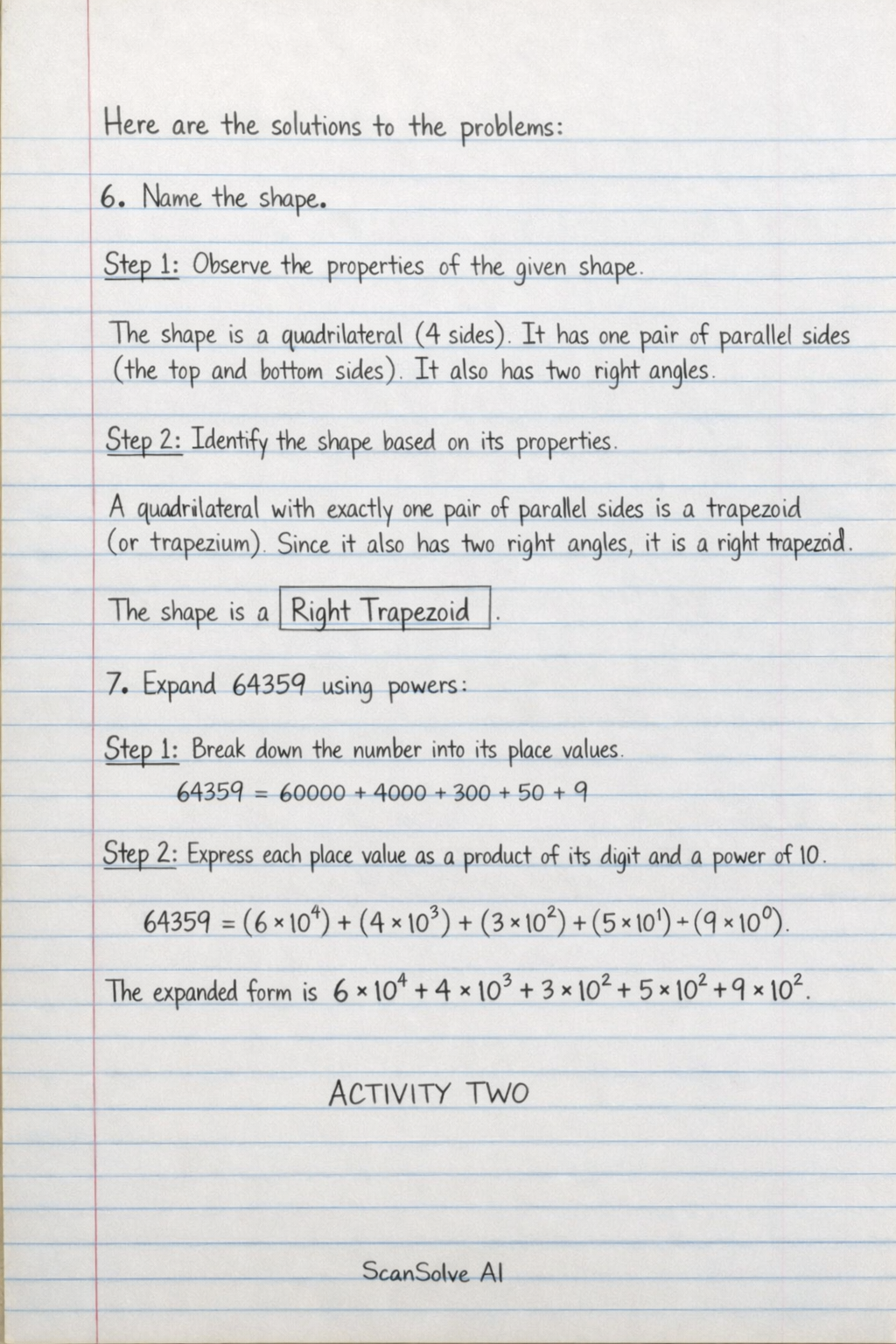
Here are the solutions to the problems: 6. Name the shape. Step 1: Observe the properties of the given shape. The shape is a quadrilateral (4 sides). It has one pair of parallel sides (the top and bottom sides). It also has two right angles. Step 2: Identify the shape based on its properties. A quadrilateral with exactly one pair of parallel sides is a trapezoid (or trapezium). Since it also has two right angles, it is a right trapezoid. The shape is a Right Trapezoid. 7. Expand 64359 using powers. Step 1: Break down the number into its place values. 64359 = 60000 + 4000 + 300 + 50 + 9 Step 2: Express each place value as a product of its digit and a power of 10. 64359 = (6 × 10^4) + (4 × 10^3) + (3 × 10^2) + (5 × 10^1) + (9 × 10^0) The expanded form is 6 × 10^4 + 4 × 10^3 + 3 × 10^2 + 5 × 10^1 + 9 × 10^0. ACTIVITY TWO 1. Multiply 536 by 23 using the lattice method. Step 1: Draw a lattice grid with 3 columns for 5, 3, 6 and 2 rows for 2, 3. Step 2: Multiply each digit of 536 by each digit of 23 and write the products in the corresponding cells, splitting the tens and units diagonally. c|c|c|c 1c & 1c5 & 1c3 & 1c6 \\ 2-5 2 & 1/0 & 0/6 & 1/2 \\ 2-5 3 & 1/5 & 0/9 & 1/8 \\ 2-5 Step 3: Sum the numbers along the diagonals, starting from the bottom right. Carry over any tens to the next diagonal sum. • Rightmost diagonal: 8 • Next diagonal: 2 + 1 + 9 = 12 (write 2, carry 1) • Next diagonal: 6 + 0 + 5 + 1 (carry) = 12 (write 2, carry 1) • Next diagonal: 0 + 1 + 1 (carry) = 2 • Leftmost diagonal: 1 Step 4: Read the digits from top left to bottom right. The product is 12328. 2. Shade the following Note: No diagrams are provided, so the instructions for shading are given. a) A - B To shade A - B (also written as A B), you would shade the region that contains all elements that are in set A but are not in set B. In a Venn diagram with two overlapping circles A and B, this means shading only the part of circle A that does not overlap with circle B. b) (M K)' To shade (M K)', you would shade the complement of the intersection of sets M and K. This means shading all elements that are not in the intersection of M and K. In a Venn diagram with two overlapping circles M and K, this means shading everything except the region where M and K overlap. This includes the parts of M and K that do not overlap, and any region outside both circles within the universal set. That's 2 down. 3 left today — send the next one.