
We read your photo as:
Please solve the following problems on whole numbers: 2.1 Write 124 as a product of its prime factors. 2.2 Find the HCF of 24 and 32. 2.3 Find the LCM of 12 and 18. 2.4 Divide R500 between Muliweli an
ScanSolve AI Answer
This answer stops before the end.
It was cut off when it was first written. Ask ScanSolve this question again for the full working.
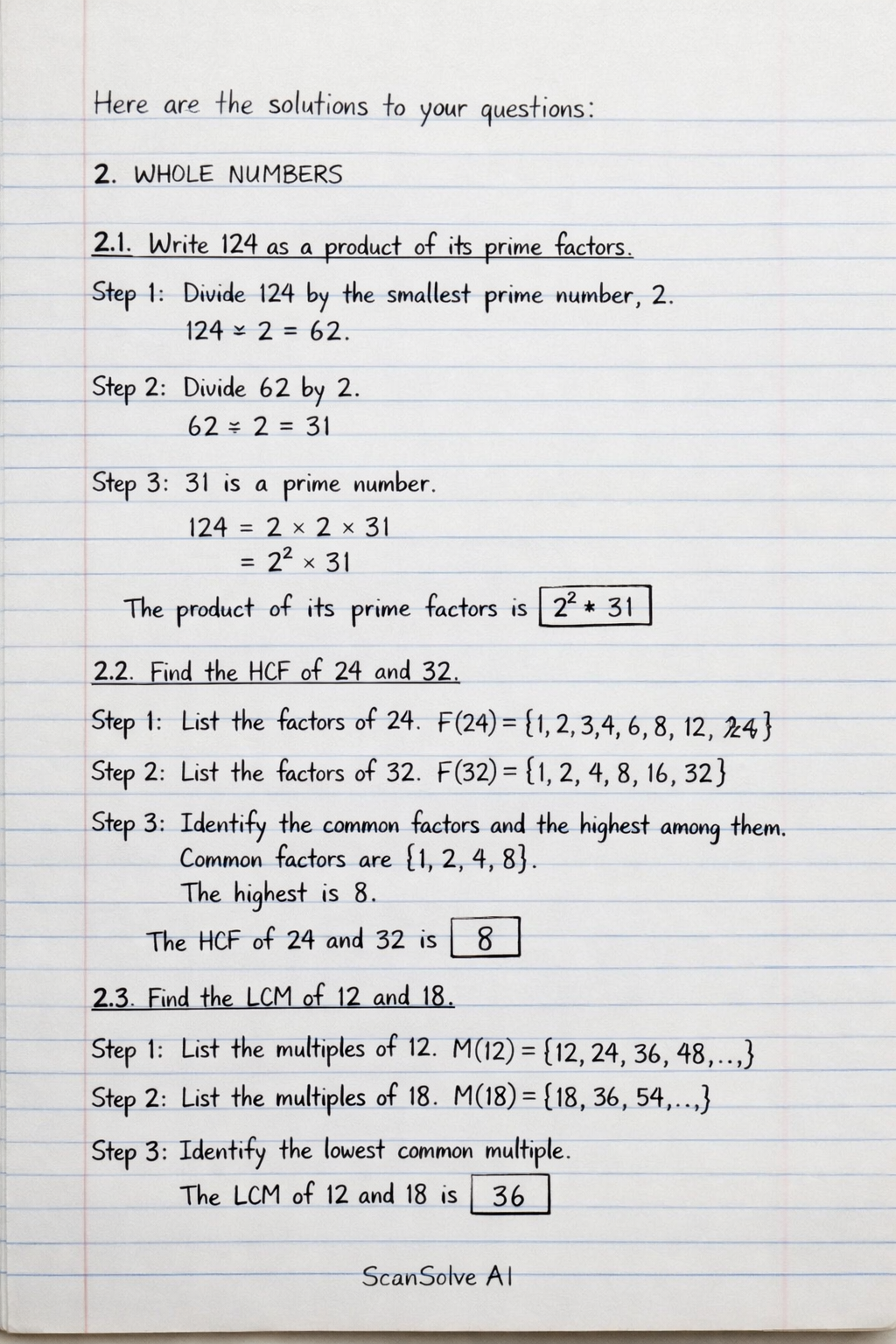
Here are the solutions to your questions:
2. WHOLE NUMBERS
2.1 Write 124 as a product of its prime factors.
Step 1: Divide 124 by the smallest prime number, 2.
Step 2: Divide 62 by 2.
Step 3: 31 is a prime number.
The product of its prime factors is .
2.2 Find the HCF of 24 and 32.
Step 1: List the factors of 24.
Step 2: List the factors of 32.
Step 3: Identify the common factors and the highest among them.
Common factors are . The highest is 8.
The HCF of 24 and 32 is .
2.3 Find the LCM of 12 and 18.
Step 1: List the multiples of 12.
Step 2: List the multiples of 18.
Step 3: Identify the lowest common multiple.
The LCM of 12 and 18 is .
2.4 Divide R500 between Muliweli and Lloyd in the ratio of 6:4.
Step 1: Find the total number of ratio parts.
Step 2: Determine the value of one ratio part.
Step 3: Calculate Muliweli's share.
Step 4: Calculate Lloyd's share.
Muliweli gets and Lloyd gets .
2.5 A packet of apples cost R22 excluding VAT. What will the price of the apples be once 14% VAT is added to the price?
Step 1: Calculate the VAT amount.
Step 2: Add the VAT to the original price.
The price of the apples with VAT will be .
3. INTEGERS
3.1 Calculate the following and show all the steps:
Step 1: Simplify the double negative.
Step 2: Perform the addition.
The result is .
3.2
Step 1: Perform the operations inside the parenthesis.
Step 2: Perform the multiplication.
The result is .
3.3
Step 1: Calculate the powers.
Step 2: Substitute the values back into the expression.
Step 3: Perform addition and subtraction from left to right.
The result is .
3.4
Step 1: Calculate the square root.
Step 2: Perform the additions from left to right.
The result is .
3.5
Step 1: Calculate the numerator.
Step 2: Calculate the denominator.
Step 3: Divide the numerator by the denominator.
The result is .
4. COMMON FRACTIONS
4.1 Calculate:
Step 1: Convert division to multiplication by the reciprocal of the fraction.
Step 2: Multiply the numbers.
Step 3: Simplify the fraction.
The result is .
4.2 Simplify:
Step 1: Take the square root of the numerator and the denominator separately.
Step 2: Calculate the square roots.
The simplified expression is .
4.3 Simplify:
Step 1: Calculate the cube root of the first term.
Step 2: Calculate the square of the second term.
Step 3: Add the two fractions. Find a common denominator, which is 12.
The simplified expression is .
4.4 Determine the percentage decrease if a chocolate that cost R10 is marked down to R7.
Step 1: Calculate the amount of decrease.
Still stuck on this one?
Ask a follow-up, and the answer starts from this question.
More Mathematics Questions
Handwritten Step-by-Step Solution
Get this as a handwritten image on WhatsApp — like a tutor wrote it for you.
Try on WhatsApp