
We read your photo as:
Solve the following questions: 1a. Add 43501, 3450, 120, and 2. 1b. Subtract 4564 from 6000. 3. Find the LCM of 6, 8, 12. 4. Find the HCF of 10, 15, 25. 5. Based on a bar chart, how much was sold on M
ScanSolve AI Answer
Answers
7 partsStep-by-step solution
5 stepsSolve Question 1a.
Add the given numbers:
The sum is .
Solve Question 1b.
Subtract 4564 from 6000:
The difference is .
Find the LCM of $6, 8, 12$.
First, find the prime factorization of each number:
To find the LCM, take the highest power of each prime factor present in any of the numbers:
Highest power of 2 is .
Highest power of 3 is .
Multiply these highest powers:
.
The LCM is .Find the HCF of $10, 15, 25$.
First, find the prime factorization of each number:
To find the HCF, identify the common prime factors and take the lowest power of each common factor:
The only common prime factor is 5. The lowest power of 5 common to all is .
.
The HCF is .Answer Question 3 based on the bar chart.
The y-axis represents the amount sold in FRS.
i) Monday: The bar for Monday reaches 5000 FRS.
He sold on Monday.ii) Tuesday: The bar for Tuesday reaches 4000 FRS.
He sold on Tuesday.iii) Wednesday: The bar for Wednesday reaches halfway between 5000 FRS and 6000 FRS, which is 5500 FRS.
He sold on Wednesday.iv) Thursday: The bar for Thursday reaches halfway between 2000 FRS and 3000 FRS, which is 2500 FRS.
He sold on Thursday.v) Friday: The bar for Friday reaches 6000 FRS.
He sold on Friday.vi) How much did he sell throughout the week?
Add the sales from Monday to Friday:He sold throughout the week.
vii) On which days did he not sell?
The bars for Saturday and Sunday are at 0 FRS, indicating no sales.
He did not sell on .
Try one yourself
A new problem that tests the same skill.
Still stuck on this one?
Ask a follow-up, and the answer starts from this question.
More Mathematics Questions
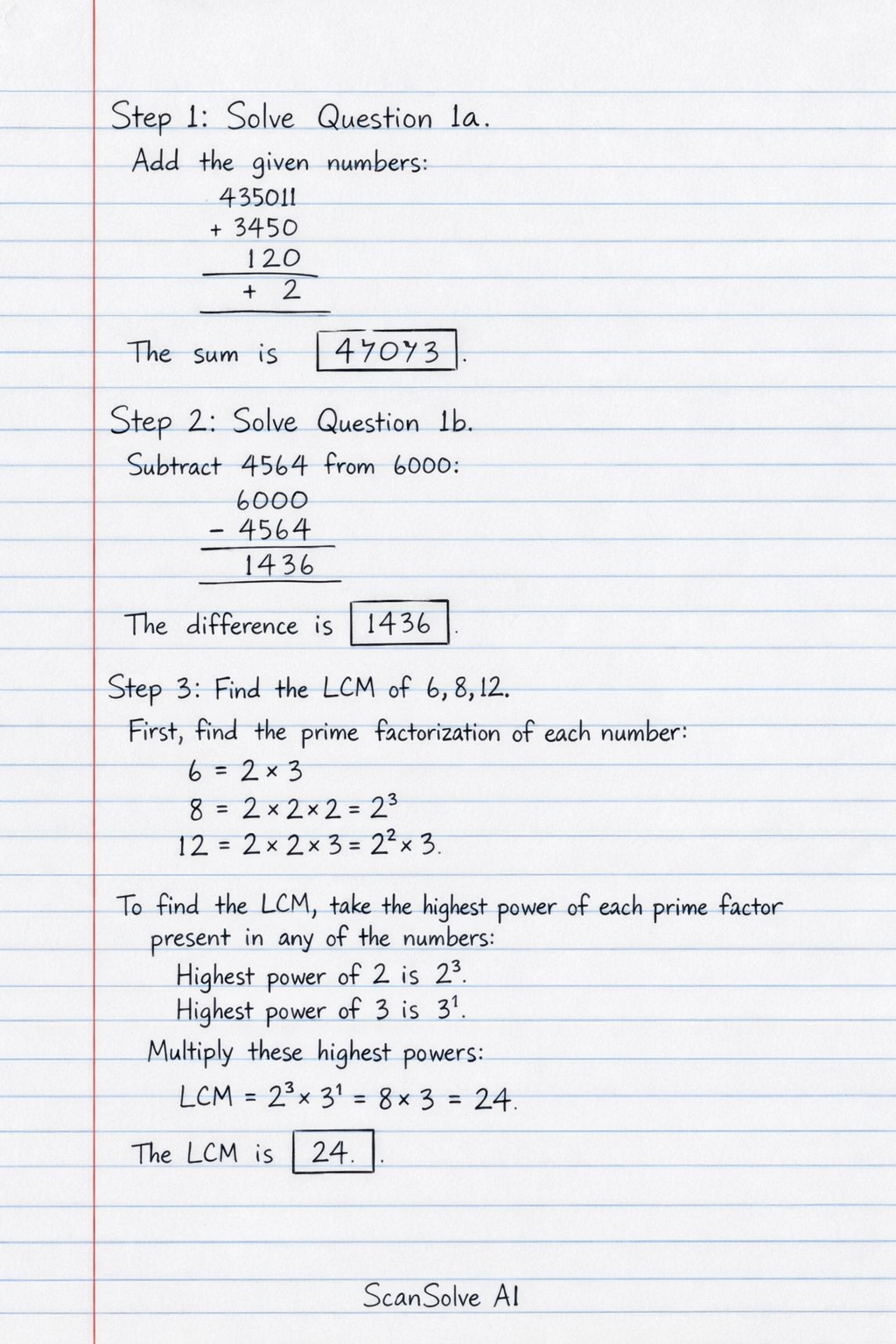
Handwritten Step-by-Step Solution
Get this as a handwritten image on WhatsApp — like a tutor wrote it for you.
Try on WhatsApp