
We read your photo as:
Solve the following systems of linear equations and determine if they are consistent and independent: 4(vii) 2x + 5y = 17, 5x + 3y = 14; 4(viii) 3x − 5y − 10 = 0, 6x − 10y = 20
ScanSolve AI Answer
Step-by-step solution
9 stepsHere are the solutions for the circled problems:
4(vii)
The given system of equations is:
Multiply equation (1) by 5 and equation (2) by 2 to eliminate .
Subtract equation (4) from equation (3).
Substitute the value of into equation (1).
The solution to the system is .
To determine if the system is consistent and independent, we compare the ratios of the coefficients.
For a system and :
Here, and .Since (), the system has a unique solution.
Therefore, the system is consistent and independent.The solution is . The system is consistent and independent.
4(viii)
The given system of equations is:To determine if the system is consistent and independent, we compare the ratios of the coefficients.
For a system and :
Here, and .Calculate the ratios of the coefficients.
Compare the ratios.
Since , the system has infinitely many solutions.
A system with infinitely many solutions is consistent but dependent.
It is not independent because the two equations represent the same line.
Therefore, the system is consistent but not independent.The system has infinitely many solutions and is consistent but dependent.
Still stuck on this one?
Ask a follow-up, and the answer starts from this question.
More Mathematics Questions
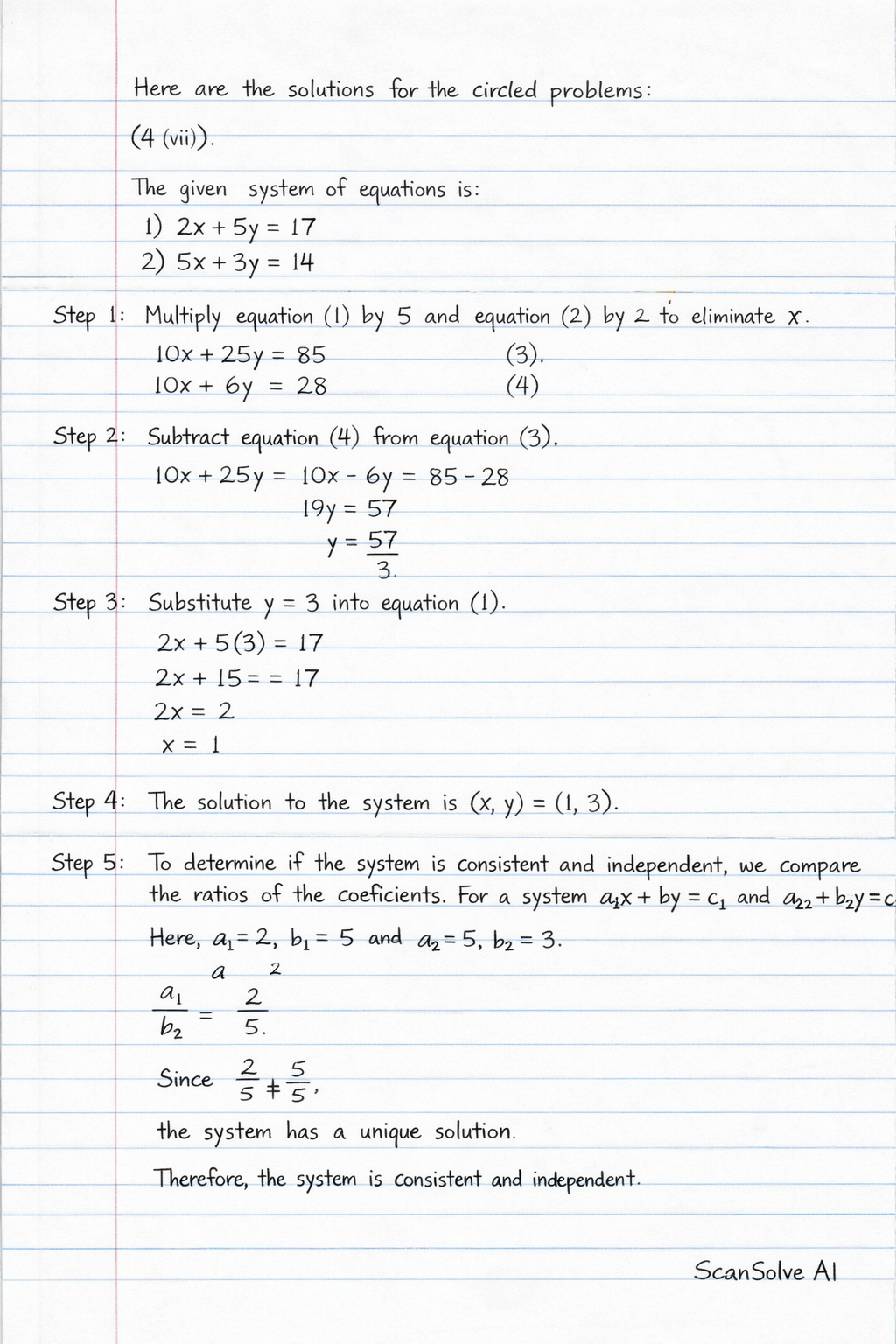
Handwritten Step-by-Step Solution
Get this as a handwritten image on WhatsApp — like a tutor wrote it for you.
Try on WhatsApp