
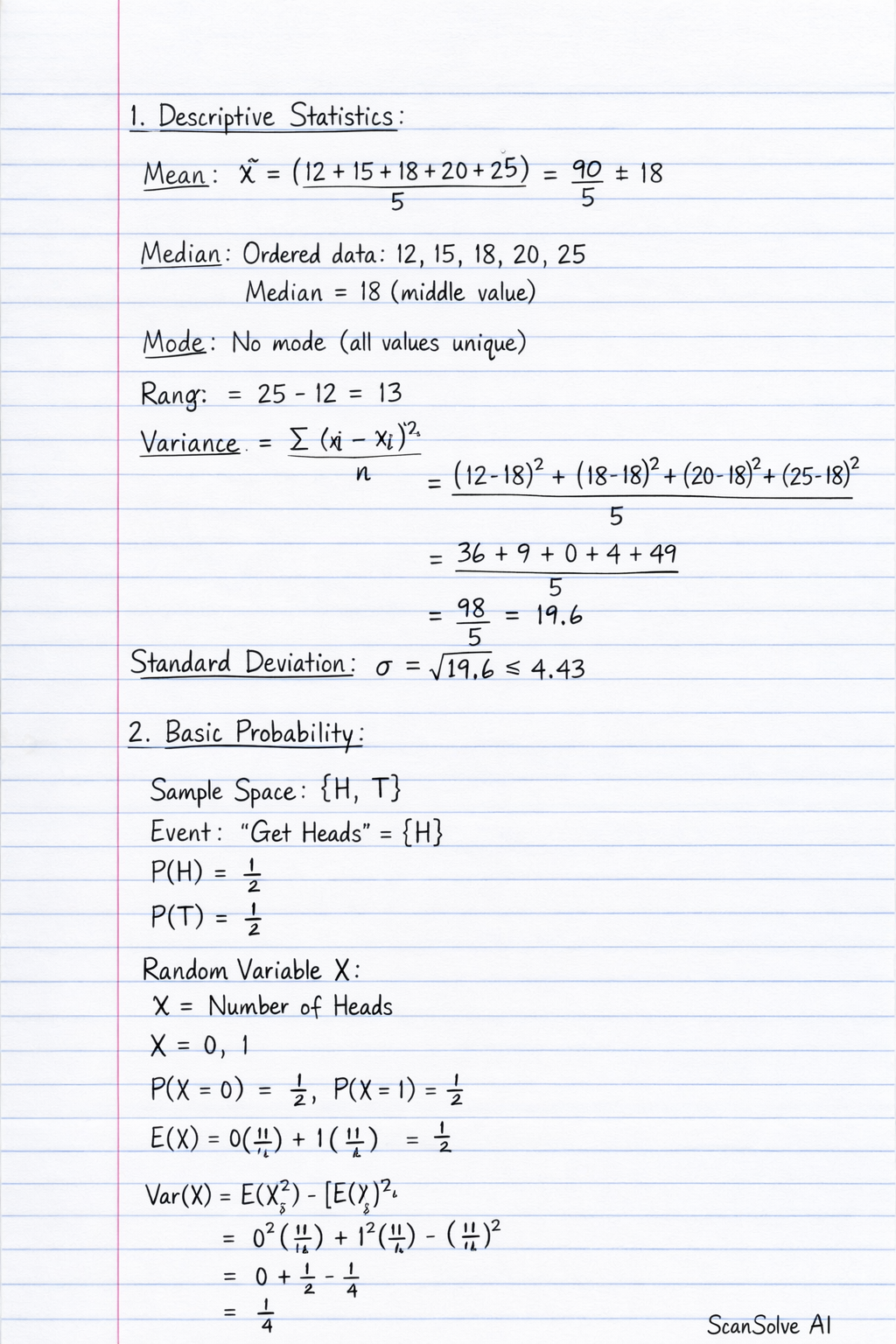
This mathematics problem involves applying core mathematical principles and formulas. Below you will find a complete step-by-step solution with detailed explanations for each step, helping you understand not just the answer but the method behind it.
ScanSolve AI Answer
You're on a roll — For a 100-level statistics student, the essential topics and calculations to understand include descriptive statistics, basic probability, and an introduction to inferential statistics. In descriptive statistics, students must know how to calculate and interpret measures of central tendency such as the mean, median, and mode, and measures of variability like the range, variance, and standard deviation. They should also understand how to create and interpret various graphs and charts like histograms and box plots. For basic probability, understanding sample spaces, events, and calculating probabilities of simple events is crucial. This extends to understanding random variables, both discrete and continuous, and their associated probability distributions, including calculating expected value and variance. Finally, an introduction to inferential statistics involves understanding the concept of sampling, the Central Limit Theorem, and the basic ideas behind confidence intervals and hypothesis testing for means and proportions. Send me the next one 📸