
Give me some basics on probability in maths
ScanSolve AI Answer
Answer
Probability is a branch of mathematics that deals with the likelihood of an event occurring. It is expressed as a number between 0 and 1, where 0 indicates impossibility and 1 indicates certainty.
The basic formula for calculating the probability of an event is:
An outcome is a single result of an experiment, and the sample space is the set of all possible outcomes. An event is a specific collection of outcomes.
For example, if you flip a fair coin, there are two possible outcomes: heads or tails. The probability of getting heads is because there is one favorable outcome (heads) out of two total possible outcomes.
Still stuck on this one?
Ask a follow-up, and the answer starts from this question.
More Mathematics Questions
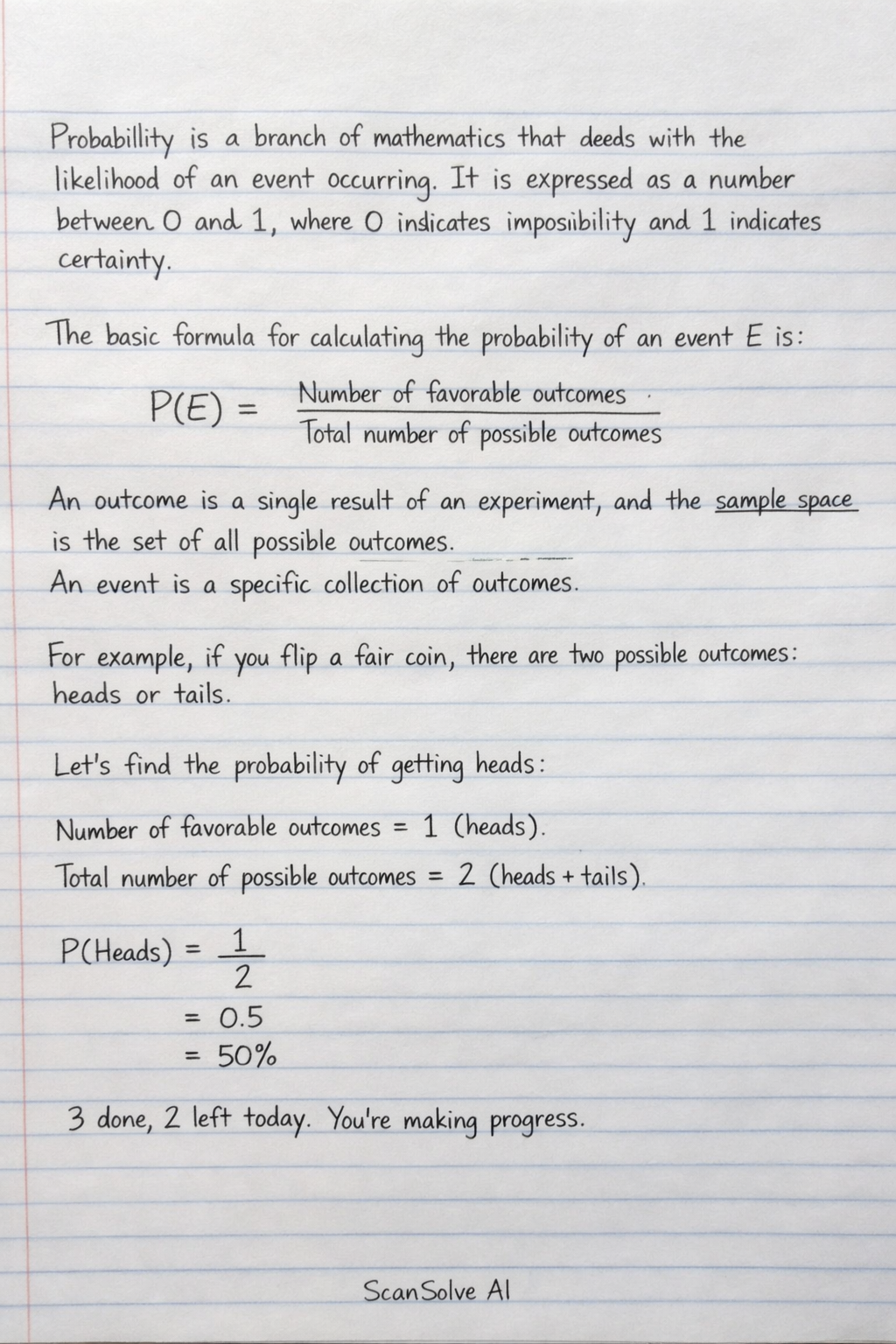
Handwritten Step-by-Step Solution
Get this as a handwritten image on WhatsApp — like a tutor wrote it for you.
Try on WhatsApp