

This mathematics problem involves applying core mathematical principles and formulas. Below you will find a complete step-by-step solution with detailed explanations for each step, helping you understand not just the answer but the method behind it.
ScanSolve AI Answer
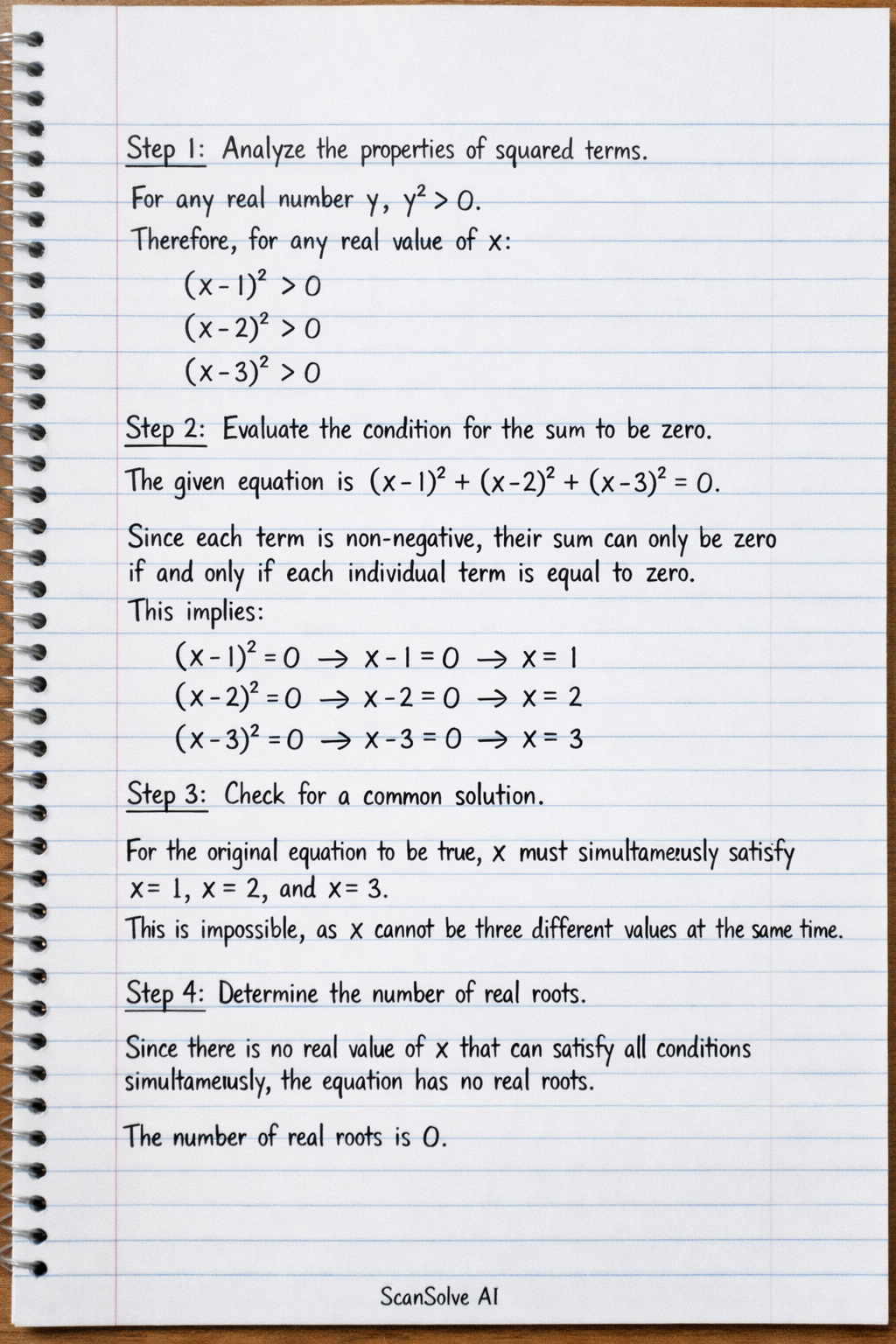
a) Step 1: Analyze the properties of squared terms. For any real number y, y^2 0. Therefore, for any real value of x: (x-1)^2 0 (x-2)^2 0 (x-3)^2 0 Step 2: Evaluate the condition for the sum to be zero. The given equation is (x-1)^2 + (x-2)^2 + (x-3)^2 = 0. Since each term is non-negative, their sum can only be zero if and only if each individual term is equal to zero. This implies: (x-1)^2 = 0 x-1 = 0 x = 1 (x-2)^2 = 0 x-2 = 0 x = 2 (x-3)^2 = 0 x-3 = 0 x = 3 Step 3: Check for a common solution. For the original equation to be true, x must simultaneously satisfy x=1, x=2, and x=3. This is impossible, as x cannot be three different values at the same time. Step 4: Determine the number of real roots. Since there is no real value of x that can satisfy all conditions simultaneously, the equation has no real roots. The number of real roots is 0. The final answer is 0.