
We read your photo as:
For emergency room receives on average 8 patients per hour. Calculate the mean and variance of Binomial and Poisson distribution.
ScanSolve AI Answer
Step-by-step solution
12 stepsHere are the solutions to the problems.
1. For emergency room receives on average 8 patients per hour. Calculate the mean and variance of Binomial and Poisson distribution.
- Poisson Distribution: The number of patients arriving in an emergency room per hour is typically modeled by a Poisson distribution, where the average rate is given. Given average rate patients per hour.
Calculate the mean of the Poisson distribution.
The mean of a Poisson distribution is equal to its rate parameter $\lambda$. $$ E(X) = \lambda $$ $$ E(X) = 8 $$Calculate the variance of the Poisson distribution.
The variance of a Poisson distribution is also equal to its rate parameter $\lambda$. $$ Var(X) = \lambda $$ $$ Var(X) = 8 $$ The mean is $\boxed{8}$ and the variance is $\boxed{8}$ for the Poisson distribution.- Binomial Distribution: To calculate the mean and variance for a Binomial distribution, we need two parameters: the number of trials () and the probability of success (). This information is not provided in the problem statement. The scenario described (average rate of events over a period) is characteristic of a Poisson process, not a Binomial one, unless further assumptions are made about fixed trials and success probabilities. Therefore, we cannot calculate the mean and variance for a Binomial distribution with the given information.
2. Use the example above to complete a line function .
The function is already a complete linear function. It represents a straight line with a slope of 2 and a y-intercept of 1. Without further instructions (e.g., to evaluate it at a specific point, graph it, or relate it to the previous problem in a defined way), there is nothing to "complete".
3. The mean serum uric acid level in a population is with a SD of 0.5. Define the normal range (mean SD).
Identify the given values.
Mean ()
Standard Deviation ()Apply the formula for the normal range.
The normal range is defined as .
Calculate the lower and upper bounds of the range.
Lower bound
Upper bound
The normal range is .4. A patient has a systolic blood pressure (SBP) of . If the population mean is and the standard deviation is , find the Z.
Identify the given values.
Patient's SBP ()
Population mean ()
Standard deviation ()Use the Z-score formula.
The Z-score is calculated as:
The Z-score is .
5. The length of stay (in days) for a specific routine procedure in a clinic is uniformly distributed between 1 and 5 days. Calculate the expected length of stay.
Identify the parameters of the uniform distribution.
For a uniform distribution , the lower bound is day and the upper bound is days.
Use the formula for the expected value of a uniform distribution.
The expected value for a uniform distribution is given by:
The expected length of stay is .
6. A hospital determines that the length of stay (in days) for a specific procedure follows PDF for . Calculate the SD of length of stay.
Identify the parameters of the uniform distribution from the PDF.
The given PDF for indicates a uniform distribution with and .
Calculate the variance of the uniform distribution.
The variance for a uniform distribution is given by:
Calculate the standard deviation (SD).
The standard deviation is the square root of the variance.
The standard deviation of the length of stay is .
Still stuck on this one?
Ask a follow-up, and the answer starts from this question.
More Mathematics Questions
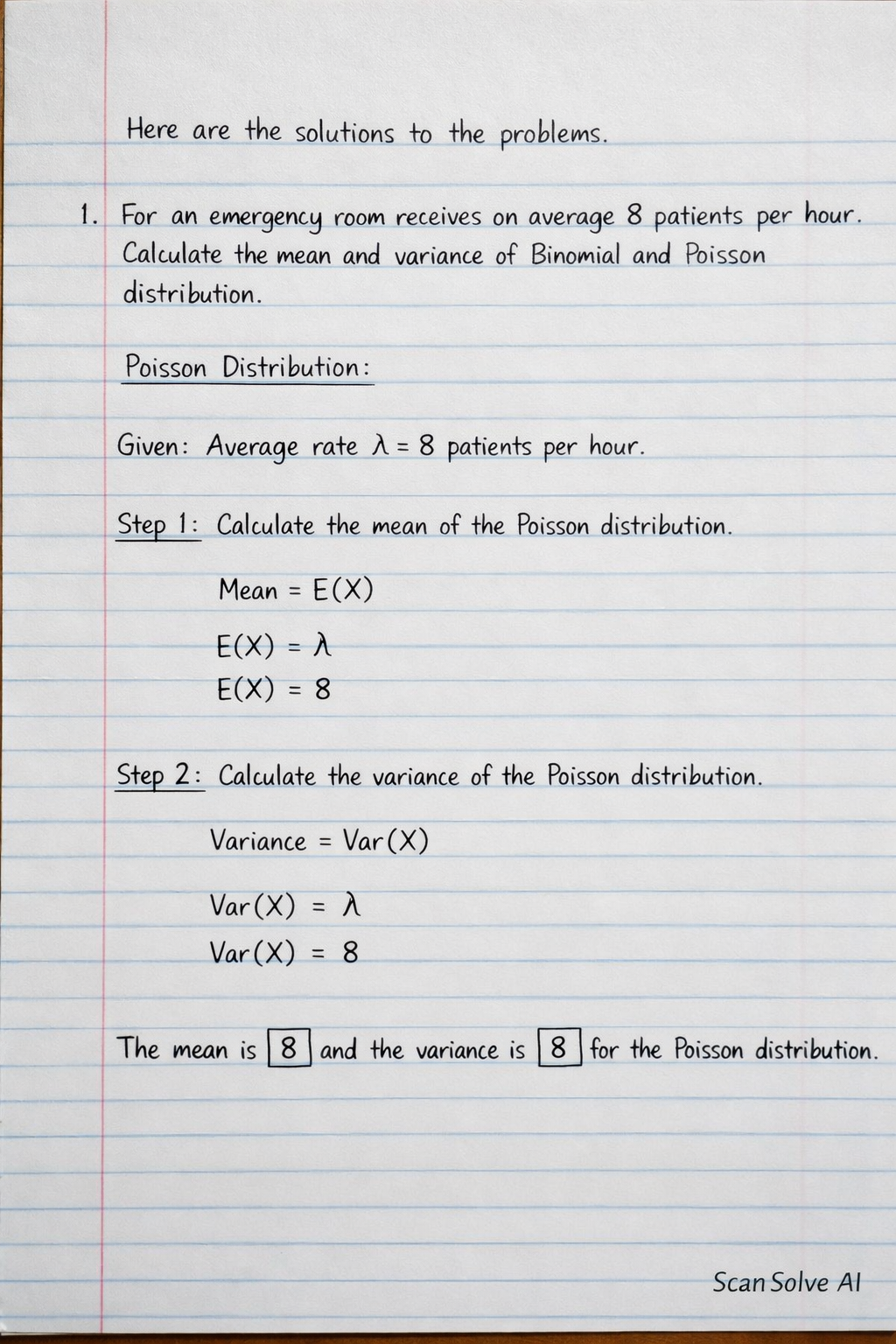
Handwritten Step-by-Step Solution
Get this as a handwritten image on WhatsApp — like a tutor wrote it for you.
Try on WhatsApp