
Solve for fraction remaining
Mathematics
ScanSolve AI Answer
Answer
Step-by-step solution
2 stepsThe fraction remaining of a radioactive substance is the ratio of the final amount () to the initial amount (). It can be calculated using the formula:
where:
- is the final amount of the substance remaining.
- is the initial amount of the substance.
- is the number of half-lives that have passed, calculated as .
- is the total time elapsed.
- is the half-life of the substance.
Example:
A radioactive sample has a half-life of 5 years. What fraction of the original sample will remain after 15 years?
Determine the number of half-lives () that have passed.
Use the formula for the fraction remaining.
After 15 years, of the original sample will remain.
Was this helpful?
Try one yourself
A new problem that tests the same skill.
Still stuck on this one?
Ask a follow-up, and the answer starts from this question.
Got a different question?Ask your own question
More Mathematics Questions
QResolve the fraction into partial fractions.QDetermine the fraction of the amount remaining each month.QComplete the following equivalent fractions by finding the missing number in each case.QSimplify the fraction on the right side.QSimplify the first fraction.
Browse by topic:Pre-Algebra
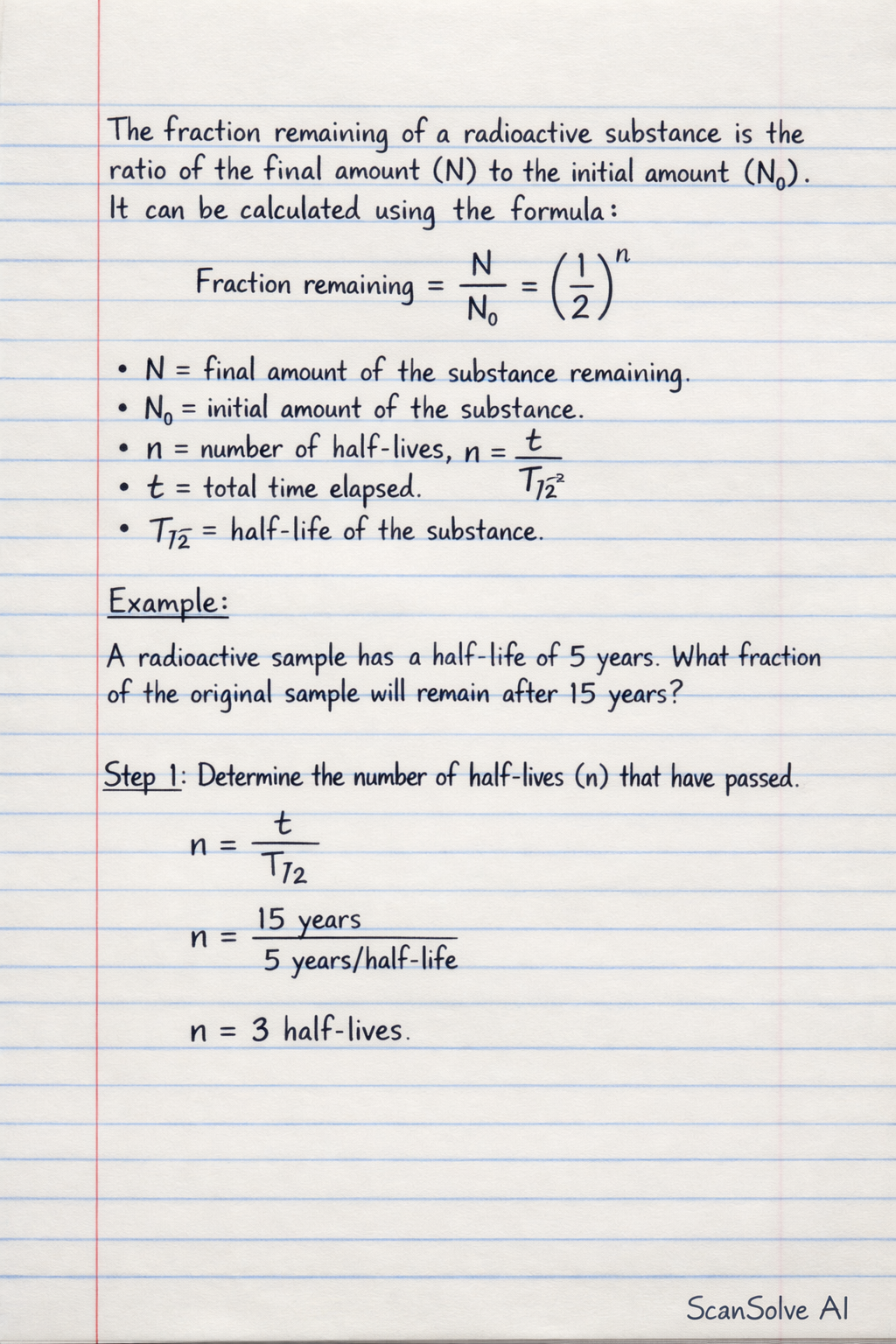
Handwritten Step-by-Step Solution
Get this as a handwritten image on WhatsApp — like a tutor wrote it for you.
Try on WhatsApp