

This mathematics problem involves applying core mathematical principles and formulas. Below you will find a complete step-by-step solution with detailed explanations for each step, helping you understand not just the answer but the method behind it.
ScanSolve AI Answer
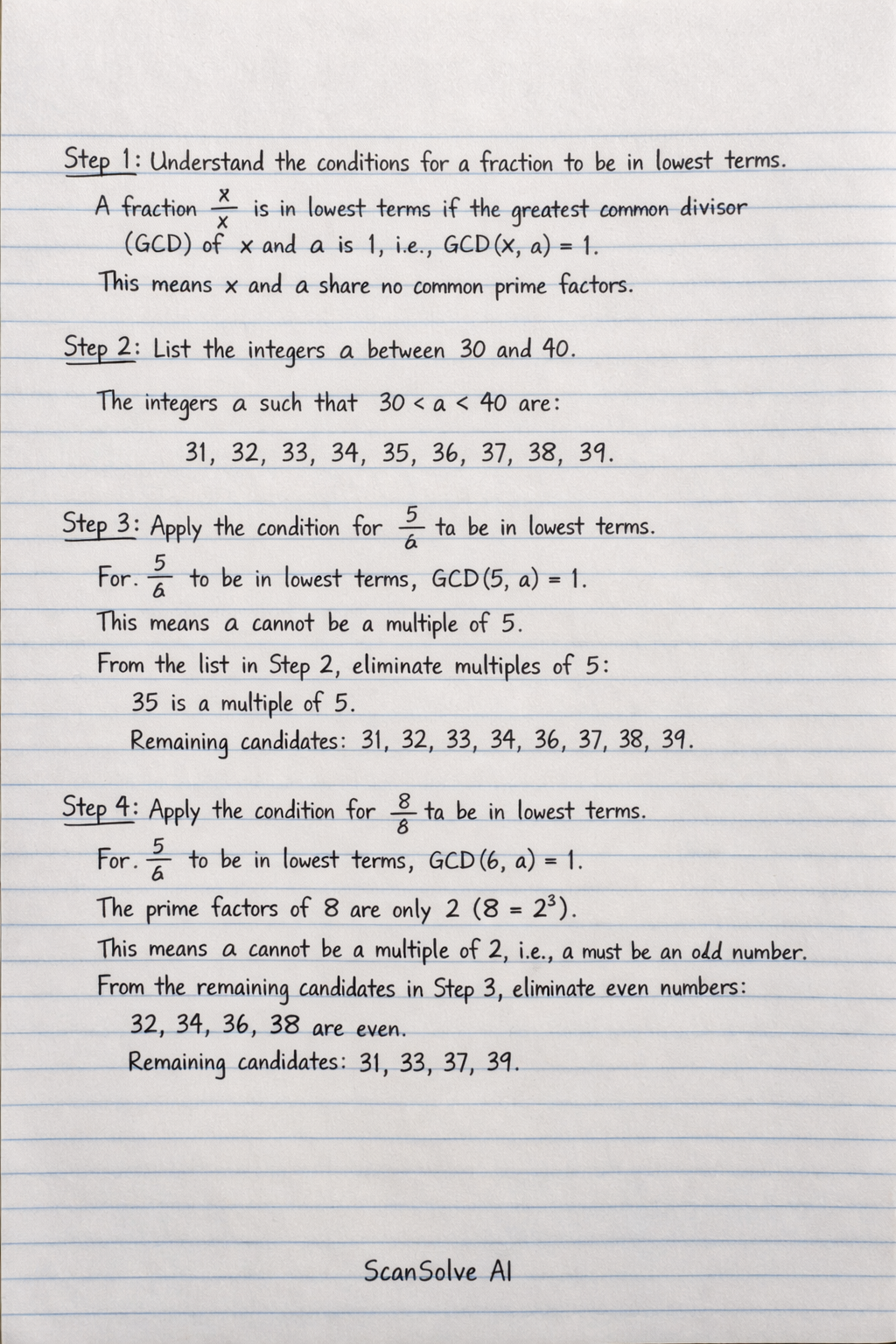
Step 1: Understand the conditions for a fraction to be in lowest terms. A fraction (x)/(a) is in lowest terms if the greatest common divisor (GCD) of x and a is 1, i.e., GCD(x, a) = 1. This means x and a share no common prime factors. Step 2: List the integers a between 30 and 40. The integers a such that 30 < a < 40 are: 31, 32, 33, 34, 35, 36, 37, 38, 39 Step 3: Apply the condition for (5)/(a) to be in lowest terms. For (5)/(a) to be in lowest terms, GCD(5, a) = 1. This means a cannot be a multiple of 5. From the list in Step 2, eliminate multiples of 5: 35 is a multiple of 5. Remaining candidates: 31, 32, 33, 34, 36, 37, 38, 39. Step 4: Apply the condition for (8)/(a) to be in lowest terms. For (8)/(a) to be in lowest terms, GCD(8, a) = 1. The prime factors of 8 are only 2 (8 = 2^3). This means a cannot be a multiple of 2, i.e., a must be an odd number. From the remaining candidates in Step 3, eliminate even numbers: 32, 34, 36, 38 are even. Remaining candidates: 31, 33, 37, 39. Step 5: Apply the condition for (13)/(a) to be in lowest terms. For (13)/(a) to be in lowest terms, GCD(13, a) = 1. This means a cannot be a multiple of 13. From the remaining candidates in Step 4, eliminate multiples of 13: 39 = 3 × 13, so 39 is a multiple of 13. Remaining candidates: 31, 33, 37. Step 6: Count the number of integers that satisfy all conditions. The integers that satisfy all conditions are 31, 33, and 37. There are 3 such integers. The correct option is (C) 3. The number of integers is 3. That's 2 down. 3 left today — send the next one.