We read your photo as:

Solve for the unknown: 4.1.1 2x2 − 14x + 12 = 0 4.1.2 y2(y−3) + 81(3−y) = 0 4.1.3 x/5 - 3x-2/3 = -1 4.1.4 A mother is currently nine times as old as her son. In four years' time, she will be five times as old as her son. What are their present ages? 4.1.5 32x = 243 4.1.6 5^x+2 = 1/625

Mathematics

ScanSolve AI Answer

Step-by-step solution

26 steps

Here are the solutions to the problems.

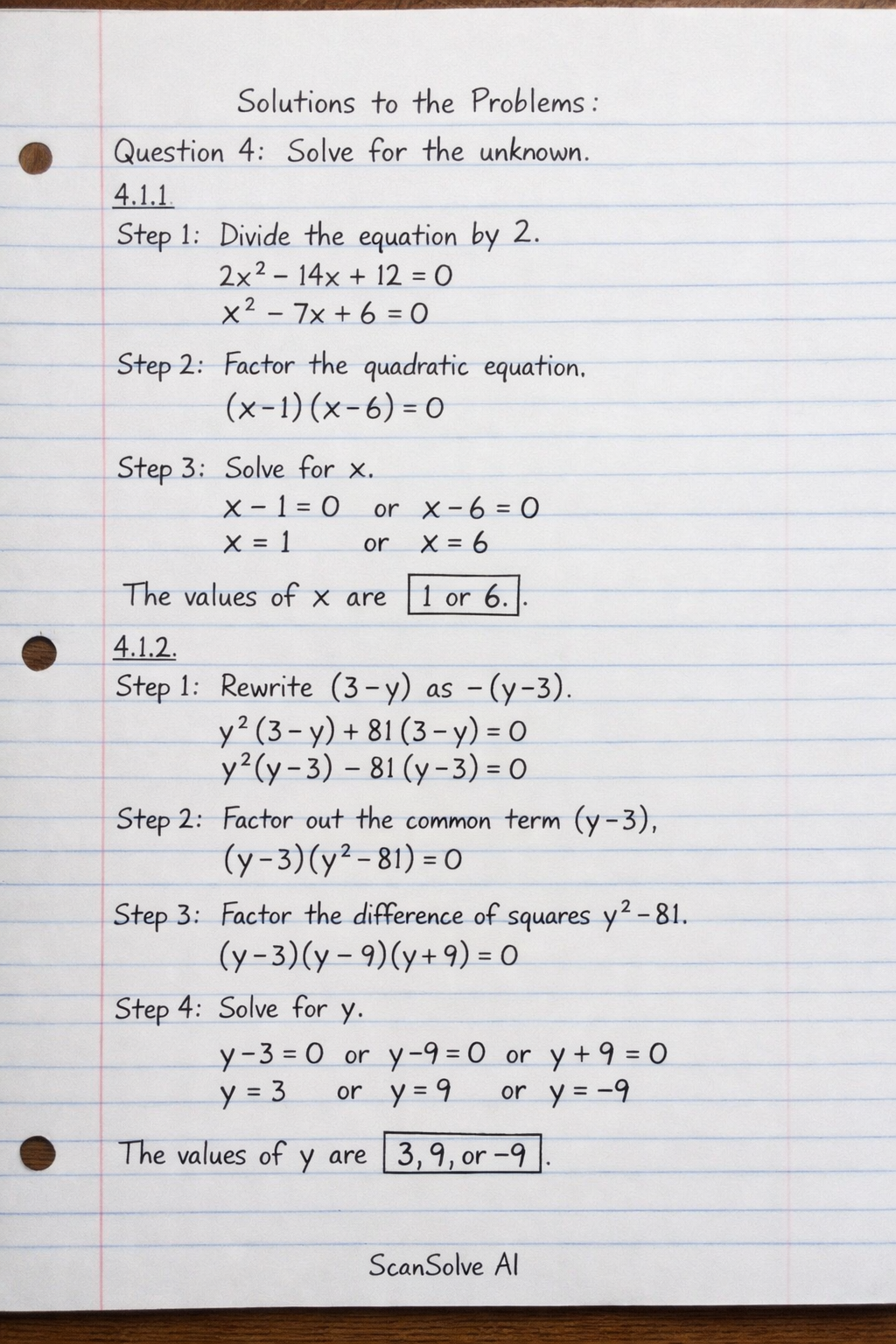
Question 4: Solve for the unknown.

4.1.1

  1. Divide the equation by 2.

    2x2−14x+12=02x^2 - 14x + 12 = 0 x2−7x+6=0x^2 - 7x + 6 = 0
  2. Factor the quadratic equation.

    (x−1)(x−6)=0(x-1)(x-6) = 0
  3. Solve for xx.

    x−1=0orx−6=0x-1 = 0 \quad \text{or} \quad x-6 = 0 x=1orx=6x = 1 \quad \text{or} \quad x = 6

    The values of xx are 1 or 6\boxed{1 \text{ or } 6}.

    4.1.2

  4. Rewrite (3−y)(3-y) as −(y−3)-(y-3).

    y2(y−3)+81(3−y)=0y^2(y-3) + 81(3-y) = 0 y2(y−3)−81(y−3)=0y^2(y-3) - 81(y-3) = 0
  5. Factor out the common term (y−3)(y-3).

    (y−3)(y2−81)=0(y-3)(y^2 - 81) = 0
  6. Factor the difference of squares y2−81y^2 - 81.

    (y−3)(y−9)(y+9)=0(y-3)(y-9)(y+9) = 0
  7. Solve for yy.

    y−3=0ory−9=0ory+9=0y-3 = 0 \quad \text{or} \quad y-9 = 0 \quad \text{or} \quad y+9 = 0 y=3ory=9ory=−9y = 3 \quad \text{or} \quad y = 9 \quad \text{or} \quad y = -9

    The values of yy are 3,9, or −9\boxed{3, 9, \text{ or } -9}.

    4.1.3

  8. Find a common denominator and multiply the entire equation by it.

    The common denominator for 5 and 3 is 15.

    15(x5)−15(3x−23)=15(−1)15 \left(\frac{x}{5}\right) - 15 \left(\frac{3x-2}{3}\right) = 15(-1) 3x−5(3x−2)=−153x - 5(3x-2) = -15
  9. Distribute and simplify.

    3x−15x+10=−153x - 15x + 10 = -15 −12x+10=−15-12x + 10 = -15
  10. Isolate xx.

    −12x=−15−10-12x = -15 - 10 −12x=−25-12x = -25 x=−25−12x = \frac{-25}{-12} x=2512x = \frac{25}{12}

    The value of xx is 2512\boxed{\frac{25}{12}}.

    4.1.4

  11. Define variables and set up equations based on the given information.

    Let MM be the mother's current age and SS be the son's current age.
    "A mother is currently nine times as old as her son":

    M=9S(1)M = 9S \quad (1)

    "In four years' time, she will be five times as old as her son":

    M+4=5(S+4)(2)M+4 = 5(S+4) \quad (2)
  12. Substitute equation (1) into equation (2).

    9S+4=5(S+4)9S + 4 = 5(S+4) 9S+4=5S+209S + 4 = 5S + 20
  13. Solve for SS.

    9S−5S=20−49S - 5S = 20 - 4 4S=164S = 16 S=164S = \frac{16}{4} S=4S = 4
  14. Substitute the value of SS back into equation (1) to find MM.

    M=9(4)M = 9(4) M=36M = 36

    The mother's current age is 36 years\boxed{36 \text{ years}} and the son's current age is 4 years\boxed{4 \text{ years}}.

    4.1.5

  15. Express 243 as a power of 3.

    32x=2433^{2x} = 243 32x=353^{2x} = 3^5
  16. Equate the exponents.

    2x=52x = 5
  17. Solve for xx.

    x=52x = \frac{5}{2}

    The value of xx is 52\boxed{\frac{5}{2}}.

    4.1.6

  18. Express 1625\frac{1}{625} as a power of 5.

    5x+2=16255^{x+2} = \frac{1}{625}

    Since 625=54625 = 5^4, we have:

    5x+2=1545^{x+2} = \frac{1}{5^4} 5x+2=5−45^{x+2} = 5^{-4}
  19. Equate the exponents.

    x+2=−4x+2 = -4
  20. Solve for xx.

    x=−4−2x = -4 - 2 x=−6x = -6

    The value of xx is −6\boxed{-6}.

    Question 5

    5.1.1

  21. Identify the pattern's common difference.

    The given pattern is 9;15;21;27;...9; 15; 21; 27; ...
    The difference between consecutive terms is 15−9=615-9=6, 21−15=621-15=6, 27−21=627-21=6.
    The common difference is 6.

  22. Calculate the next three terms.

    27+6=3327 + 6 = 33 33+6=3933 + 6 = 39 39+6=4539 + 6 = 45

    The next three terms are 33,39,45\boxed{33, 39, 45}.

    5.1.2
    The pattern is an arithmetic sequence where each term is obtained by adding 6 to the previous term. The first term is 9.

    5.1.3

  23. Use the formula for the nthn^{th} term of an arithmetic sequence, Tn=a+(n−1)dT_n = a + (n-1)d.

    Here, the first term a=9a=9, the common difference d=6d=6, and we want the 20th20^{th} term, so n=20n=20.

  24. Substitute the values into the formula.

    T20=9+(20−1)6T_{20} = 9 + (20-1)6 T20=9+(19)6T_{20} = 9 + (19)6 T20=9+114T_{20} = 9 + 114 T20=123T_{20} = 123

    The 20th20^{th} term of the pattern is 123\boxed{123}.

    5.2

  25. Identify the first term and the common difference.

    The given pattern is x+2;x+3;x+4;...x+2; x+3; x+4; ...
    The first term a=x+2a = x+2.
    The common difference d=(x+3)−(x+2)=1d = (x+3) - (x+2) = 1.

  26. Use the formula for the general rule (the nthn^{th} term) of an arithmetic sequence, Tn=a+(n−1)dT_n = a + (n-1)d.

    Tn=(x+2)+(n−1)(1)T_n = (x+2) + (n-1)(1) Tn=x+2+n−1T_n = x+2+n-1 Tn=x+n+1T_n = x+n+1

    The general rule for the pattern is Tn=x+n+1\boxed{T_n = x+n+1}.

Was this helpful?

Still stuck on this one?

Ask a follow-up, and the answer starts from this question.

Got a different question?Ask your own question
Handwritten step-by-step solution preview

Handwritten Step-by-Step Solution

Get this as a handwritten image on WhatsApp — like a tutor wrote it for you.

Try on WhatsApp