
We read your photo as:
Suppose a fair die is tossed once. Find the probability of: a) obtaining the number 5, b) obtaining the number 8, c) obtaining an even number, d) obtaining an odd number.
ScanSolve AI Answer
Answers
4 partsStep-by-step solution
8 stepslet's solve this die problem.
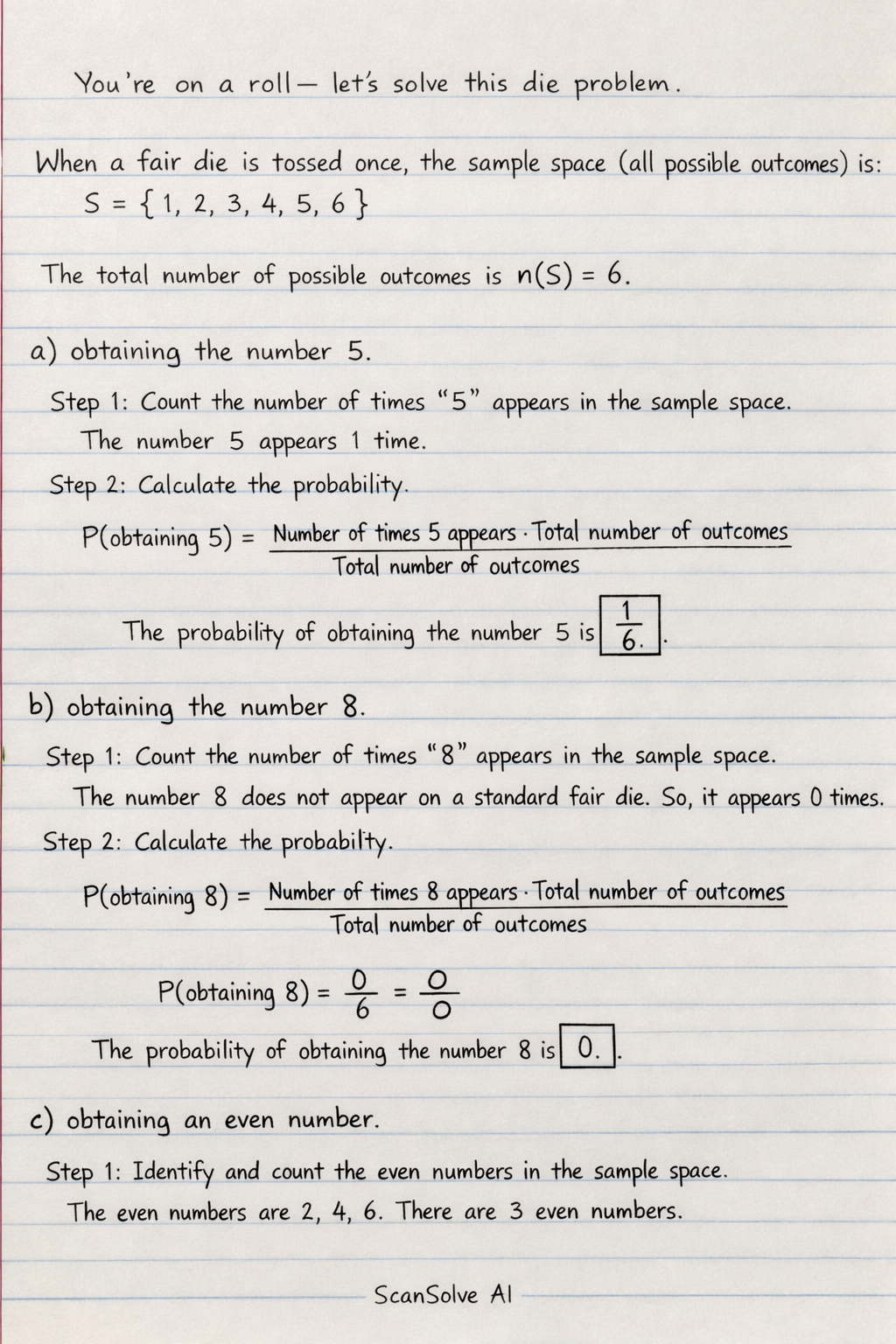
When a fair die is tossed once, the sample space (all possible outcomes) is:
The total number of possible outcomes is .
Part a· 2 steps
obtaining the number 5
Count the number of times '5' appears in the sample space.
The number 5 appears 1 time.
Calculate the probability.
The probability of obtaining the number 5 is .
Part b0
obtaining the number 8
Count the number of times '8' appears in the sample space.
The number 8 does not appear on a standard fair die. So, it appears 0 times.
Calculate the probability.
The probability of obtaining the number 8 is .
Part c
obtaining an even number
Identify and count the even numbers in the sample space.
The even numbers are $2, 4, 6$. There are 3 even numbers.
Calculate the probability.
The probability of obtaining an even number is .
Part d
obtaining an odd number
Identify and count the odd numbers in the sample space.
The odd numbers are $1, 3, 5$. There are 3 odd numbers.
Calculate the probability.
The probability of obtaining an odd number is .
Try one yourself
A new problem that tests the same skill.
Still stuck on this one?
Ask a follow-up, and the answer starts from this question.
More Mathematics Questions
Handwritten Step-by-Step Solution
Get this as a handwritten image on WhatsApp — like a tutor wrote it for you.
Try on WhatsApp