How to calculate for vector a minus b and also a dot b and also a minus b

Mathematics

ScanSolve AI Answer

Answer

The result is a scalar0
The result is a new vector

14i⃗−14j⃗−14k⃗14\vec{i} - 14\vec{j} - 14\vec{k}

Step-by-step solution

9 steps

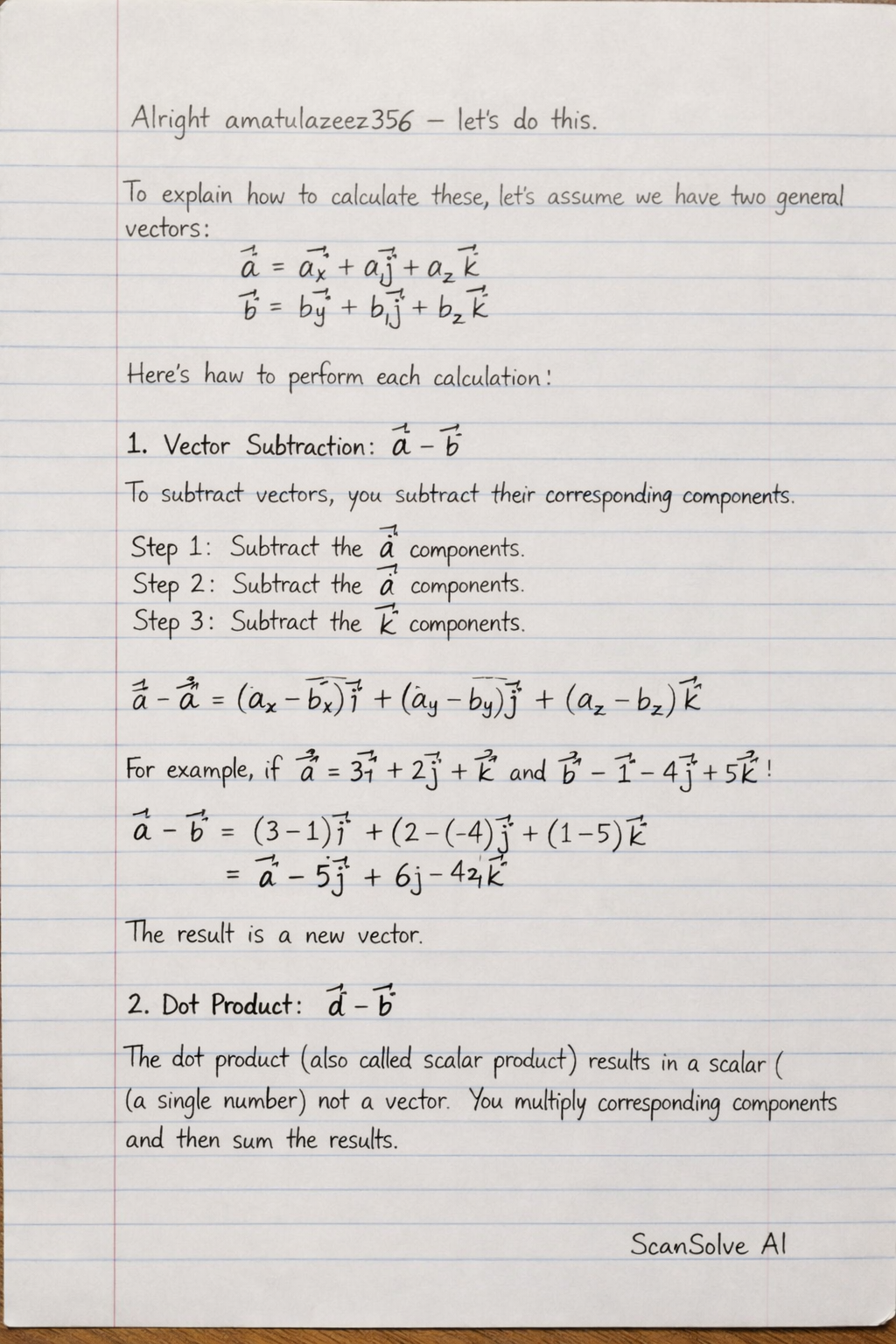
To explain how to calculate these, let's assume we have two general vectors:
a⃗=axi⃗+ayj⃗+azk⃗\vec{a} = a_x\vec{i} + a_y\vec{j} + a_z\vec{k}
b⃗=bxi⃗+byj⃗+bzk⃗\vec{b} = b_x\vec{i} + b_y\vec{j} + b_z\vec{k}

Here's how to perform each calculation:

1. Vector Subtraction: a⃗−b⃗\vec{a} - \vec{b}

To subtract vectors, you subtract their corresponding components.

  1. Subtract the i⃗\vec{i} components.

  2. Subtract the j⃗\vec{j} components.

  3. Subtract the k⃗\vec{k} components.

    a⃗−b⃗=(ax−bx)i⃗+(ay−by)j⃗+(az−bz)k⃗\vec{a} - \vec{b} = (a_x - b_x)\vec{i} + (a_y - b_y)\vec{j} + (a_z - b_z)\vec{k}

    For example, if a⃗=3i⃗+2j⃗+k⃗\vec{a} = 3\vec{i} + 2\vec{j} + \vec{k} and b⃗=i⃗−4j⃗+5k⃗\vec{b} = \vec{i} - 4\vec{j} + 5\vec{k}:

    a⃗−b⃗=(3−1)i⃗+(2−(−4))j⃗+(1−5)k⃗\vec{a} - \vec{b} = (3 - 1)\vec{i} + (2 - (-4))\vec{j} + (1 - 5)\vec{k} a⃗−b⃗=2i⃗+6j⃗−4k⃗\vec{a} - \vec{b} = 2\vec{i} + 6\vec{j} - 4\vec{k}

    The result is a new vector.

    2. Dot Product: a⃗⋅b⃗\vec{a} \cdot \vec{b}

    The dot product (also called scalar product) results in a scalar (a single number), not a vector. You multiply corresponding components and then sum the results.

  4. Multiply the i⃗\vec{i} components.

  5. Multiply the j⃗\vec{j} components.

  6. Multiply the k⃗\vec{k} components.

  7. Sum these products.

    a⃗⋅b⃗=(ax)(bx)+(ay)(by)+(az)(bz)\vec{a} \cdot \vec{b} = (a_x)(b_x) + (a_y)(b_y) + (a_z)(b_z)

    For example, if a⃗=3i⃗+2j⃗+k⃗\vec{a} = 3\vec{i} + 2\vec{j} + \vec{k} and b⃗=i⃗−4j⃗+5k⃗\vec{b} = \vec{i} - 4\vec{j} + 5\vec{k}:

    a⃗⋅b⃗=(3)(1)+(2)(−4)+(1)(5)\vec{a} \cdot \vec{b} = (3)(1) + (2)(-4) + (1)(5) =3−8+5= 3 - 8 + 5 =0= 0

    The result is a scalar: 0\boxed{0}.

    3. Cross Product: a⃗×b⃗\vec{a} \times \vec{b}

    The cross product (also called vector product) results in a new vector that is perpendicular to both a⃗\vec{a} and b⃗\vec{b}. It is calculated using a determinant.

  8. Set up the determinant matrix.

    a⃗×b⃗=∣i⃗j⃗k⃗axayazbxbybz∣\vec{a} \times \vec{b} = \begin{vmatrix} \vec{i} & \vec{j} & \vec{k} \\ a_x & a_y & a_z \\ b_x & b_y & b_z \end{vmatrix}
  9. Expand the determinant.

    a⃗×b⃗=i⃗(aybz−azby)−j⃗(axbz−azbx)+k⃗(axby−aybx)\vec{a} \times \vec{b} = \vec{i}(a_y b_z - a_z b_y) - \vec{j}(a_x b_z - a_z b_x) + \vec{k}(a_x b_y - a_y b_x)

    For example, if a⃗=3i⃗+2j⃗+k⃗\vec{a} = 3\vec{i} + 2\vec{j} + \vec{k} and b⃗=i⃗−4j⃗+5k⃗\vec{b} = \vec{i} - 4\vec{j} + 5\vec{k}:

    a⃗×b⃗=∣i⃗j⃗k⃗3211−45∣\vec{a} \times \vec{b} = \begin{vmatrix} \vec{i} & \vec{j} & \vec{k} \\ 3 & 2 & 1 \\ 1 & -4 & 5 \end{vmatrix} =i⃗((2)(5)−(1)(−4))−j⃗((3)(5)−(1)(1))+k⃗((3)(−4)−(2)(1))= \vec{i}((2)(5) - (1)(-4)) - \vec{j}((3)(5) - (1)(1)) + \vec{k}((3)(-4) - (2)(1)) =i⃗(10−(−4))−j⃗(15−1)+k⃗(−12−2)= \vec{i}(10 - (-4)) - \vec{j}(15 - 1) + \vec{k}(-12 - 2) =i⃗(14)−j⃗(14)+k⃗(−14)= \vec{i}(14) - \vec{j}(14) + \vec{k}(-14) =14i⃗−14j⃗−14k⃗= 14\vec{i} - 14\vec{j} - 14\vec{k}

    The result is a new vector: 14i⃗−14j⃗−14k⃗\boxed{14\vec{i} - 14\vec{j} - 14\vec{k}}.

Was this helpful?

Try one yourself

A new problem that tests the same skill.

Still stuck on this one?

Ask a follow-up, and the answer starts from this question.

Got a different question?Ask your own question
Handwritten step-by-step solution preview

Handwritten Step-by-Step Solution

Get this as a handwritten image on WhatsApp — like a tutor wrote it for you.

Try on WhatsApp