
We read your photo as:
Solve for x: log6 (2x - 4) + log6 (4) = log6 40
ScanSolve AI Answer
Step-by-step solution
6 stepsyes, the method shown in the image is correct, and the steps lead to the right answer. There's just a minor notation point in the third line.
Let's go through the steps clearly:
Given the equation:
Apply the product rule of logarithms, , to the left side of the equation.
Distribute the 4 into the term .
(Note: The image showed , which could be misinterpreted as minus 16. The correct interpretation, as used in the subsequent steps, is that is the argument of the logarithm, so it should be enclosed in parentheses.)
Since the logarithms on both sides have the same base and are equal, their arguments must be equal.
Add 16 to both sides of the equation.
Divide both sides by 8 to solve for .
Check the validity of the solution.
The argument of a logarithm must be positive.
For :
. Since , the logarithm is defined.
The other arguments (4 and 40) are already positive.
Thus, is a valid solution.The final answer is .
Still stuck on this one?
Ask a follow-up, and the answer starts from this question.
More Mathematics Questions
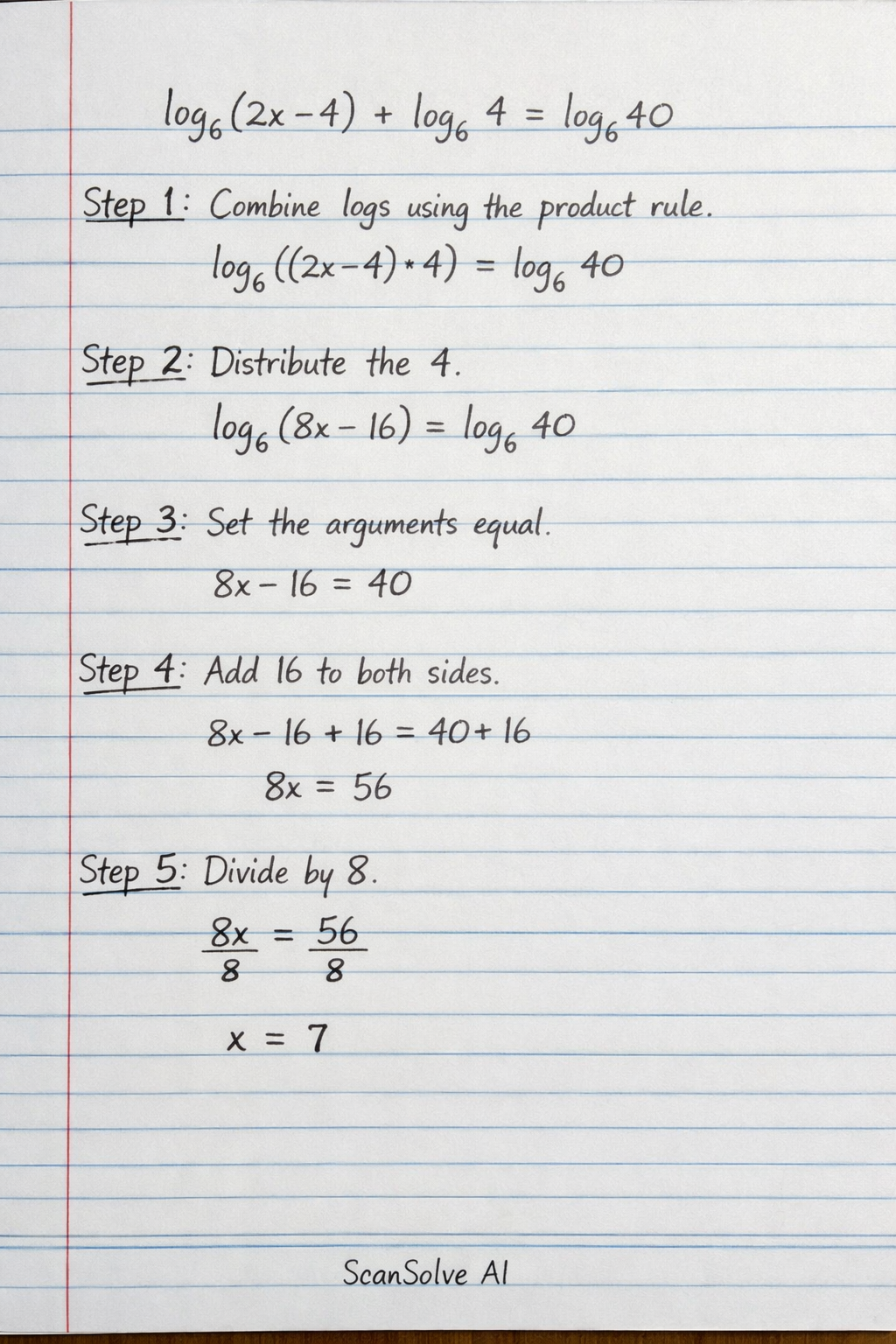
Handwritten Step-by-Step Solution
Get this as a handwritten image on WhatsApp — like a tutor wrote it for you.
Try on WhatsApp