If the sum of the first three terms of a GP is given by 189 and the sum of the first six terms is given by 182, show that the common ratio is given as r = -1/3.

Mathematics
If the sum of the first three terms of a GP is given by 189 and the sum of the first six terms is given by 182, show that the common ratio is given as r = -1/3.

ScanSolve AI Answer

Answer

r=13r = -\frac{1}{3}

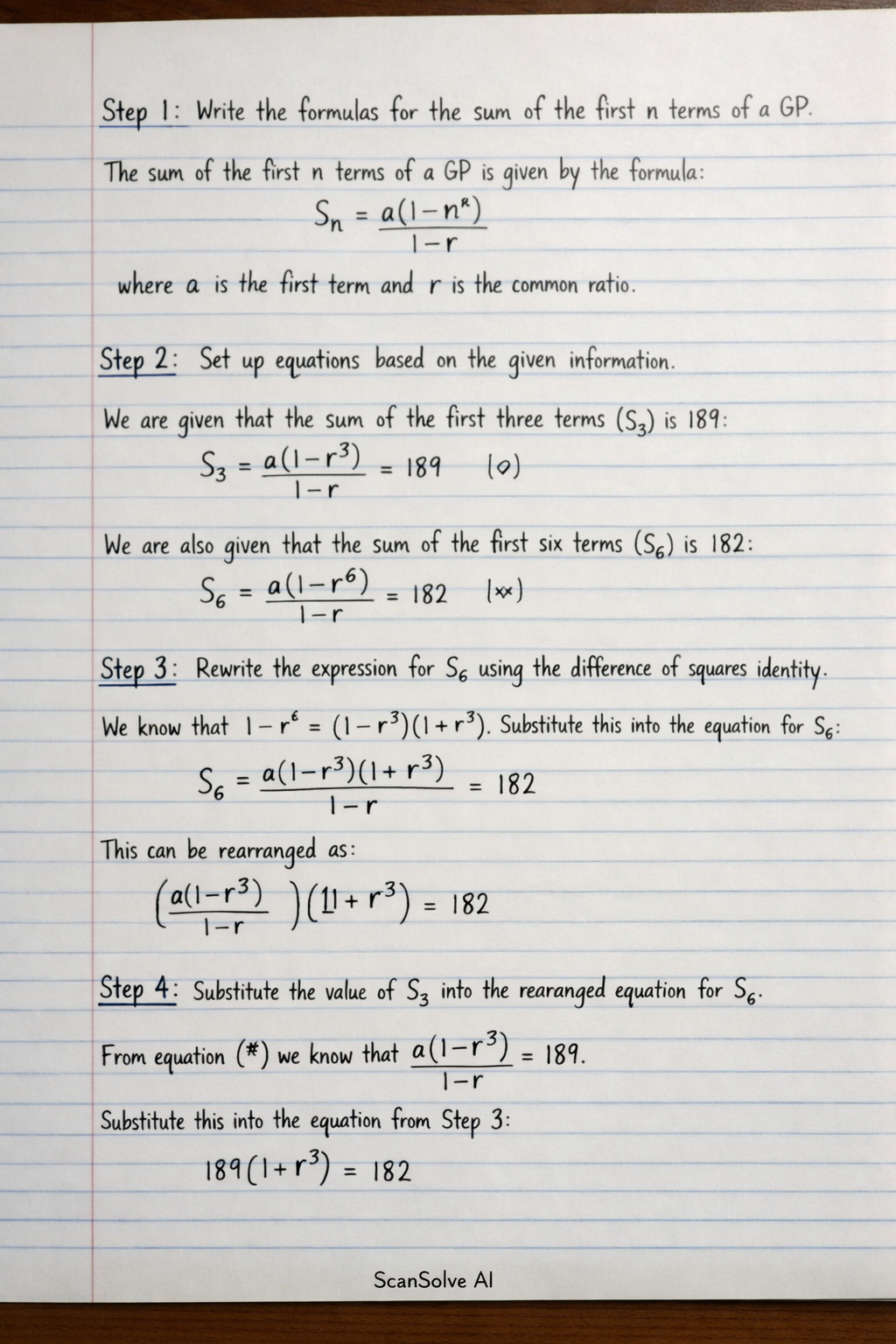
Step 1: Write the formulas for the sum of the first nn terms of a geometric progression (GP). The sum of the first nn terms of a GP is given by the formula: Sn=a(1rn)1rS_n = \frac{a(1-r^n)}{1-r} where aa is the first term and rr is the common ratio.

Step 2: Set up equations based on the given information. We are given that the sum of the first three terms (S3S_3) is 189: S3=a(1r3)1r=189()S_3 = \frac{a(1-r^3)}{1-r} = 189 \quad (*) We are also given that the sum of the first six terms (S6S_6) is 182: S6=a(1r6)1r=182()S_6 = \frac{a(1-r^6)}{1-r} = 182 \quad (**)

Step 3: Rewrite the expression for S6S_6 using the difference of squares identity. We know that 1r6=(1r3)(1+r3)1-r^6 = (1-r^3)(1+r^3). Substitute this into the equation for S6S_6: S6=a(1r3)(1+r3)1r=182S_6 = \frac{a(1-r^3)(1+r^3)}{1-r} = 182 This can be rearranged as: (a(1r3)1r)(1+r3)=182\left(\frac{a(1-r^3)}{1-r}\right)(1+r^3) = 182

Step 4: Substitute the value of S3S_3 into the rearranged equation for S6S_6. From equation ()(*), we know that a(1r3)1r=189\frac{a(1-r^3)}{1-r} = 189. Substitute this into the equation from Step 3: 189(1+r3)=182189(1+r^3) = 182

Step 5: Solve for r3r^3. Divide both sides by 189: 1+r3=1821891+r^3 = \frac{182}{189} Subtract 1 from both sides: r3=1821891r^3 = \frac{182}{189} - 1 r3=182189189r^3 = \frac{182 - 189}{189} r3=7189r^3 = \frac{-7}{189}

Step 6: Simplify the fraction and solve for rr. Both the numerator and the denominator are divisible by 7: r3=7÷7189÷7r^3 = -\frac{7 \div 7}{189 \div 7} r3=127r^3 = -\frac{1}{27} Take the cube root of both sides to find rr: r=1273r = \sqrt[3]{-\frac{1}{27}} r=13r = -\frac{1}{3}

The common ratio is indeed r=13r = -\frac{1}{3}.

The final answer is r=13\boxed{r = -\frac{1}{3}}.

Was this helpful?

Need help with your own homework?

Get instant step-by-step solutions to any question. Free to start.

Ask Your Question
Handwritten step-by-step solution preview

Handwritten Step-by-Step Solution

Get this as a handwritten image on WhatsApp — like a tutor wrote it for you.

Try on WhatsApp

Still have questions?

Quick Answer

Write the formulas for the sum of the first n terms of a geometric progression (GP).

If the sum of the first three terms of a GP is given by 189 and the sum of the first six terms is given by 182, show that the common ratio is given as r = -1/3.
Mathematics

This mathematics problem involves applying core mathematical principles and formulas. Below you will find a complete step-by-step solution with detailed explanations for each step, helping you understand not just the answer but the method behind it.

ScanSolve AI Answer
Step 1: Write the formulas for the sum of the first n terms of a geometric progression (GP). The sum of the first n terms of a GP is given by the formula: S_n = (a(1-r^n))/(1-r) where a is the first term and r is the common ratio. Step 2: Set up equations based on the given information. We are given that the sum of the first three terms (S_3) is 189: S_3 = (a(1-r^3))/(1-r) = 189 (*) We are also given that the sum of the first six terms (S_6) is 182: S_6 = (a(1-r^6))/(1-r) = 182 (**) Step 3: Rewrite the expression for S_6 using the difference of squares identity. We know that 1-r^6 = (1-r^3)(1+r^3). Substitute this into the equation for S_6: S_6 = (a(1-r^3)(1+r^3))/(1-r) = 182 This can be rearranged as: ((a(1-r^3))/(1-r))(1+r^3) = 182 Step 4: Substitute the value of S_3 into the rearranged equation for S_6. From equation (*), we know that (a(1-r^3))/(1-r) = 189. Substitute this into the equation from Step 3: 189(1+r^3) = 182 Step 5: Solve for r^3. Divide both sides by 189: 1+r^3 = (182)/(189) Subtract 1 from both sides: r^3 = (182)/(189) - 1 r^3 = (182 - 189)/(189) r^3 = (-7)/(189) Step 6: Simplify the fraction and solve for r. Both the numerator and the denominator are divisible by 7: r^3 = -(7 ÷ 7)/(189 ÷ 7) r^3 = -(1)/(27) Take the cube root of both sides to find r: r = [3]-(1)/(27) r = -(1)/(3) The common ratio is indeed r = -(1)/(3). The final answer is r = -(1)/(3).