
We read your photo as:
From the information provided, find the value of m and the number of people who speak only one language.
ScanSolve AI Answer
Step-by-step solution
2 stepsQuestion 11:
b) Find the:
(i) value of ;
(ii) number of people who speak one language only.
To solve this, we will use the information provided in the problem statement for Question 11, which was:
Total people = 50
Speak Yoruba (Y):
Speak Hausa (H):
Speak Igbo (I):
Speak all three languages (Y H I): 4
Speak exactly two languages: 14
Those who speak Igbo and Yoruba only (Y I only) are half of those who speak Yoruba and Hausa only (Y H only).
Those who speak Hausa and Igbo only (H I only) are 1 less than those who speak Yoruba and Hausa only (Y H only).
6 of them could not speak any of the languages.
b) (i) Find the value of .
Define variables for the 'exactly two languages' regions.
Let be the number of people who speak Yoruba and Hausa only ().
From the problem statement:- Those who speak Igbo and Yoruba only () are half of those who speak Yoruba and Hausa only: .
- Those who speak Hausa and Igbo only () are 1 less than those who speak Yoruba and Hausa only: .
Use the total number of people speaking exactly two languages to find .
The problem states that 14 people speak exactly two languages.
Combine like terms:
Add 1 to both sides:
Divide by 2.5:
So, the number of people speaking exactly two languages are:
$Y \cap H
Still stuck on this one?
Ask a follow-up, and the answer starts from this question.
More Mathematics Questions
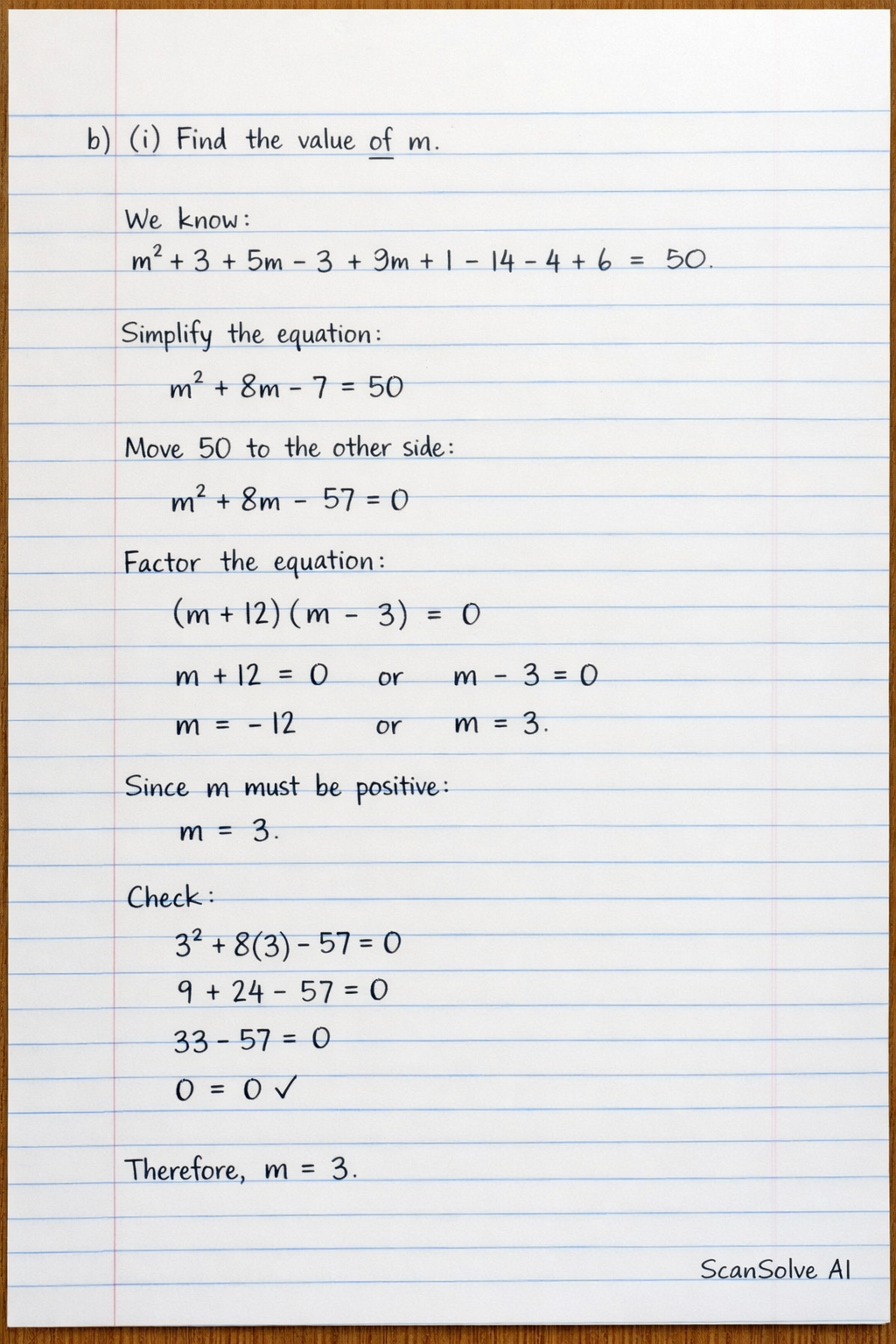
Handwritten Step-by-Step Solution
Get this as a handwritten image on WhatsApp — like a tutor wrote it for you.
Try on WhatsApp