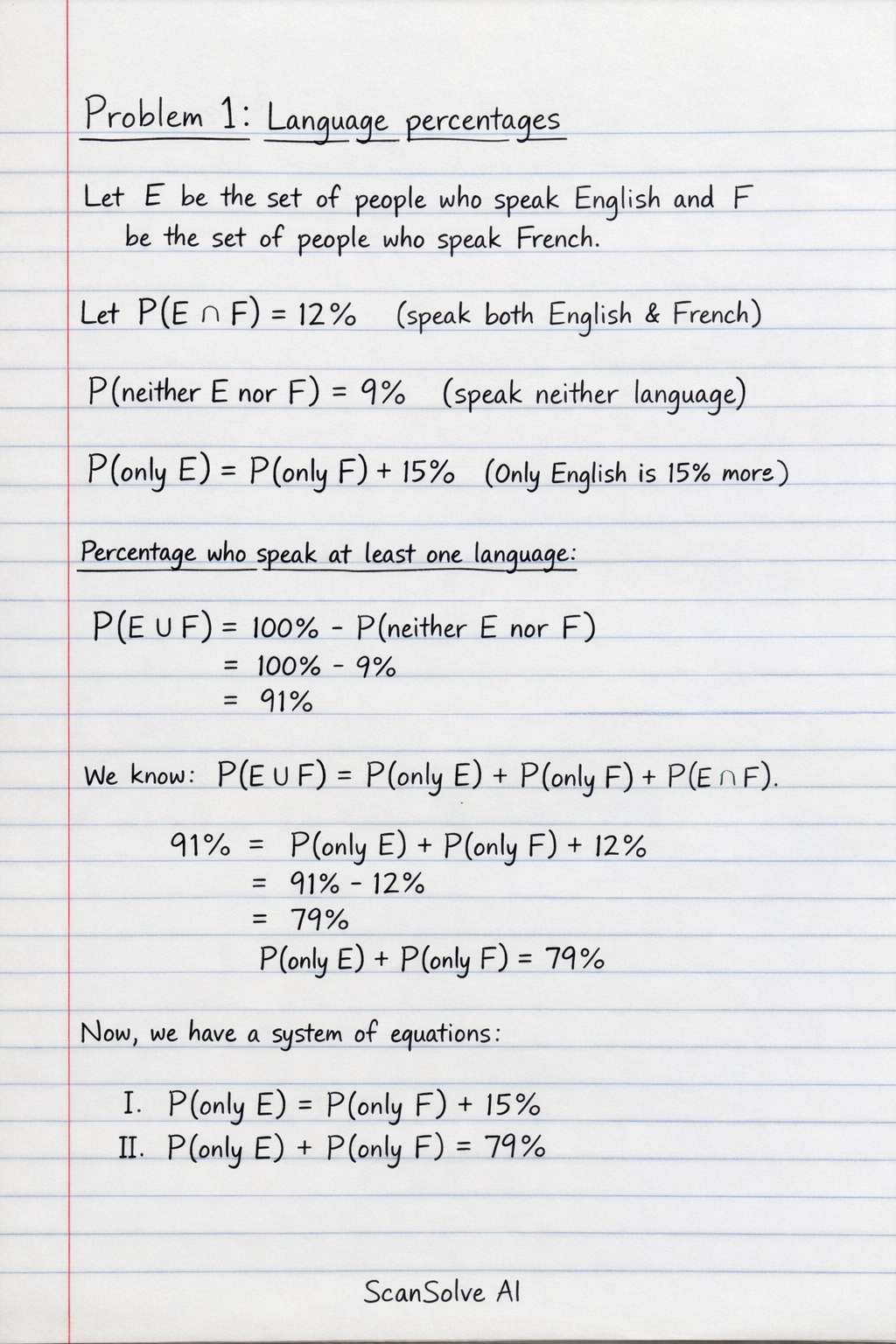
We read your photo as:

In a group of people, 12% speak both English and French, and 9% speak neither. If 15% more people speak only English than only French, find the percentage of people who speak only English and only Fre

Mathematics

ScanSolve AI Answer

Answers

4 parts
b(i)

59%59\%

b(ii)

44%44\%

b(iii)

32%32\%

c

1280 people1280 \text{ people}

: Language percentages

Let EE be the set of people who speak English and FF be the set of people who speak French.
Let P(X)P(X) denote the percentage of people in set XX.

Given information:

  1. P(E∩F)=12%P(E \cap F) = 12\% (speak both English and French)
  2. P(neither E nor F)=9%P(\text{neither E nor F}) = 9\% (cannot speak any of the two)
  3. P(only E)=P(only F)+15%P(\text{only E}) = P(\text{only F}) + 15\% (percentage speaking only English is 15% more than those speaking only French)

From (2), the percentage of people who speak at least one language is:

P(E∪F)=100%−P(neither E nor F)=100%−9%=91%P(E \cup F) = 100\% - P(\text{neither E nor F}) = 100\% - 9\% = 91\%

We know that P(E∪F)=P(only E)+P(only F)+P(E∩F)P(E \cup F) = P(\text{only E}) + P(\text{only F}) + P(E \cap F).
Substituting the known values:

91%=P(only E)+P(only F)+12%91\% = P(\text{only E}) + P(\text{only F}) + 12\% P(only E)+P(only F)=91%−12%=79%P(\text{only E}) + P(\text{only F}) = 91\% - 12\% = 79\%

Now we have a system of two equations:
I. P(only E)=P(only F)+15%P(\text{only E}) = P(\text{only F}) + 15\%
II. P(only E)+P(only F)=79%P(\text{only E}) + P(\text{only F}) = 79\%

Substitute equation I into equation II:

(P(only F)+15%)+P(only F)=79%(P(\text{only F}) + 15\%) + P(\text{only F}) = 79\% 2⋅P(only F)+15%=79%2 \cdot P(\text{only F}) + 15\% = 79\% 2⋅P(only F)=79%−15%2 \cdot P(\text{only F}) = 79\% - 15\% 2⋅P(only F)=64%2 \cdot P(\text{only F}) = 64\% P(only F)=64%2=32%P(\text{only F}) = \frac{64\%}{2} = 32\%

Now find P(only E)P(\text{only E}) using equation I:

P(only E)=32%+15%=47%P(\text{only E}) = 32\% + 15\% = 47\%

a) Represent the information on a Venn diagram.
A Venn diagram would show two overlapping circles, one for English (E) and one for French (F), within a rectangle representing the total population (100%).

  • The intersection of E and F would contain 12%12\%.
  • The part of circle E outside the intersection (only E) would contain 47%47\%.
  • The part of circle F outside the intersection (only F) would contain 32%32\%.
  • The area outside both circles (neither E nor F) would contain 9%9\%.

b) Find the percentage of people who can speak:
i. English

P(E)=P(only E)+P(E∩F)=47%+12%=59%P(E) = P(\text{only E}) + P(E \cap F) = 47\% + 12\% = \boxed{59\%}

ii. French

P(F)=P(only F)+P(E∩F)=32%+12%=44%P(F) = P(\text{only F}) + P(E \cap F) = 32\% + 12\% = \boxed{44\%}

iii. Only French

P(only F)=32%P(\text{only F}) = \boxed{32\%}

c) Find the number of people who can speak only French if the population of the village is 4000.
Number of people who speak only French = P(only F)×Total PopulationP(\text{only F}) \times \text{Total Population}

=32%×4000= 32\% \times 4000 =32100×4000= \frac{32}{100} \times 4000 =32×40= 32 \times 40 =1280 people= \boxed{1280 \text{ people}}
Was this helpful?

Still stuck on this one?

Ask a follow-up, and the answer starts from this question.

Got a different question?Ask your own question
Handwritten step-by-step solution preview

Handwritten Step-by-Step Solution

Get this as a handwritten image on WhatsApp — like a tutor wrote it for you.

Try on WhatsApp