
Full notes on probability
ScanSolve AI Answer
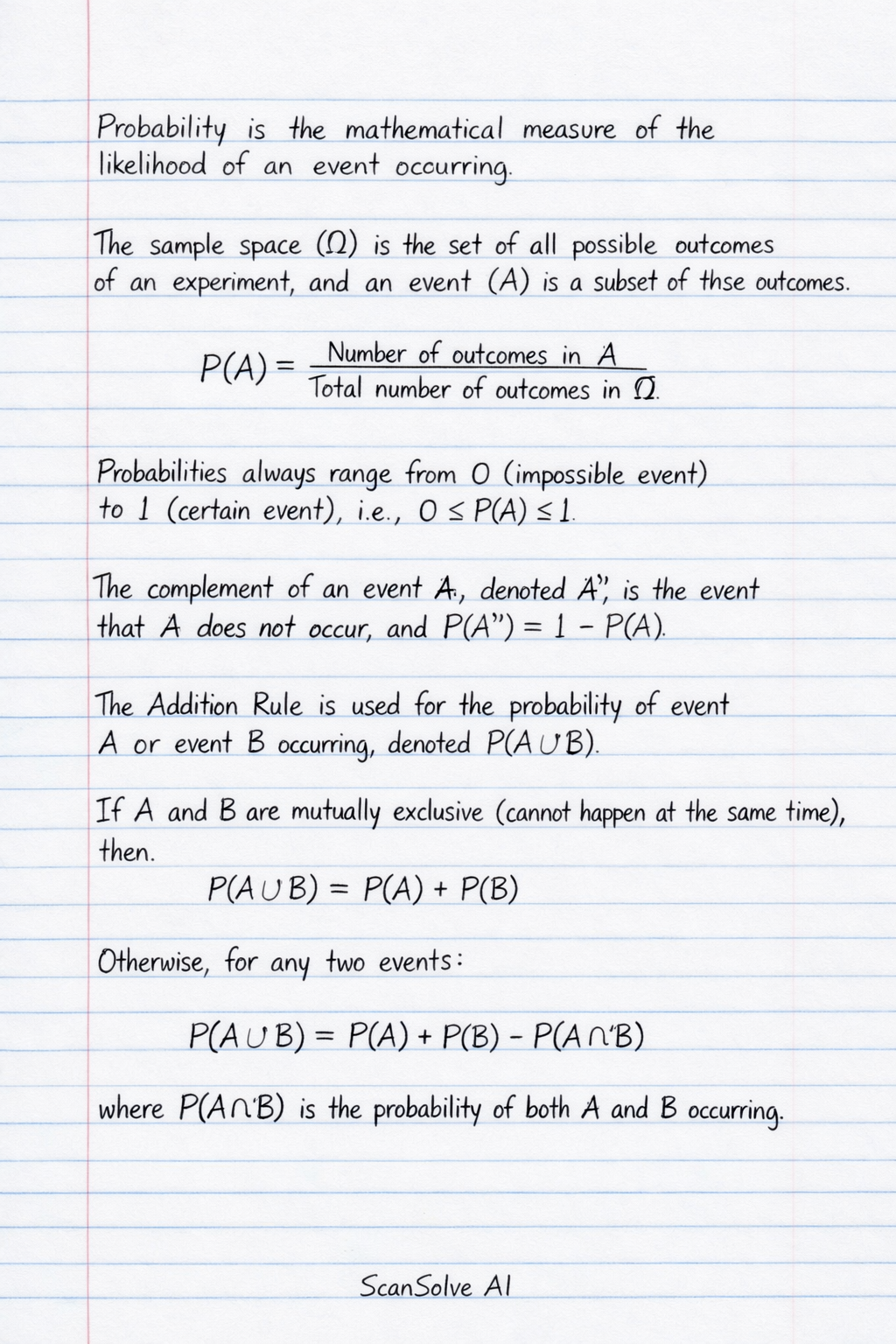
Probability is the mathematical measure of the likelihood of an event occurring. The sample space () is the set of all possible outcomes of an experiment, and an event () is a subset of these outcomes. The probability of an event is given by:
Probabilities always range from 0 (impossible event) to 1 (certain event), i.e., . The complement of an event , denoted , is the event that does not occur, and .
The Addition Rule is used for the probability of event or event occurring, denoted . If and are mutually exclusive (cannot happen at the same time), then . Otherwise, for any two events:
where is the probability of both and occurring.
The Multiplication Rule is for the probability of event and event occurring. For independent events (where the occurrence of one does not affect the other), . For dependent events, we use conditional probability, , which is the probability of occurring given that has already occurred:
From this, the general multiplication rule is .
Still stuck on this one?
Ask a follow-up, and the answer starts from this question.
More Mathematics Questions
Handwritten Step-by-Step Solution
Get this as a handwritten image on WhatsApp — like a tutor wrote it for you.
Try on WhatsApp