This mathematics problem involves applying core mathematical principles and formulas. Below you will find a complete step-by-step solution with detailed explanations for each step, helping you understand not just the answer but the method behind it.
ScanSolve AI Answer
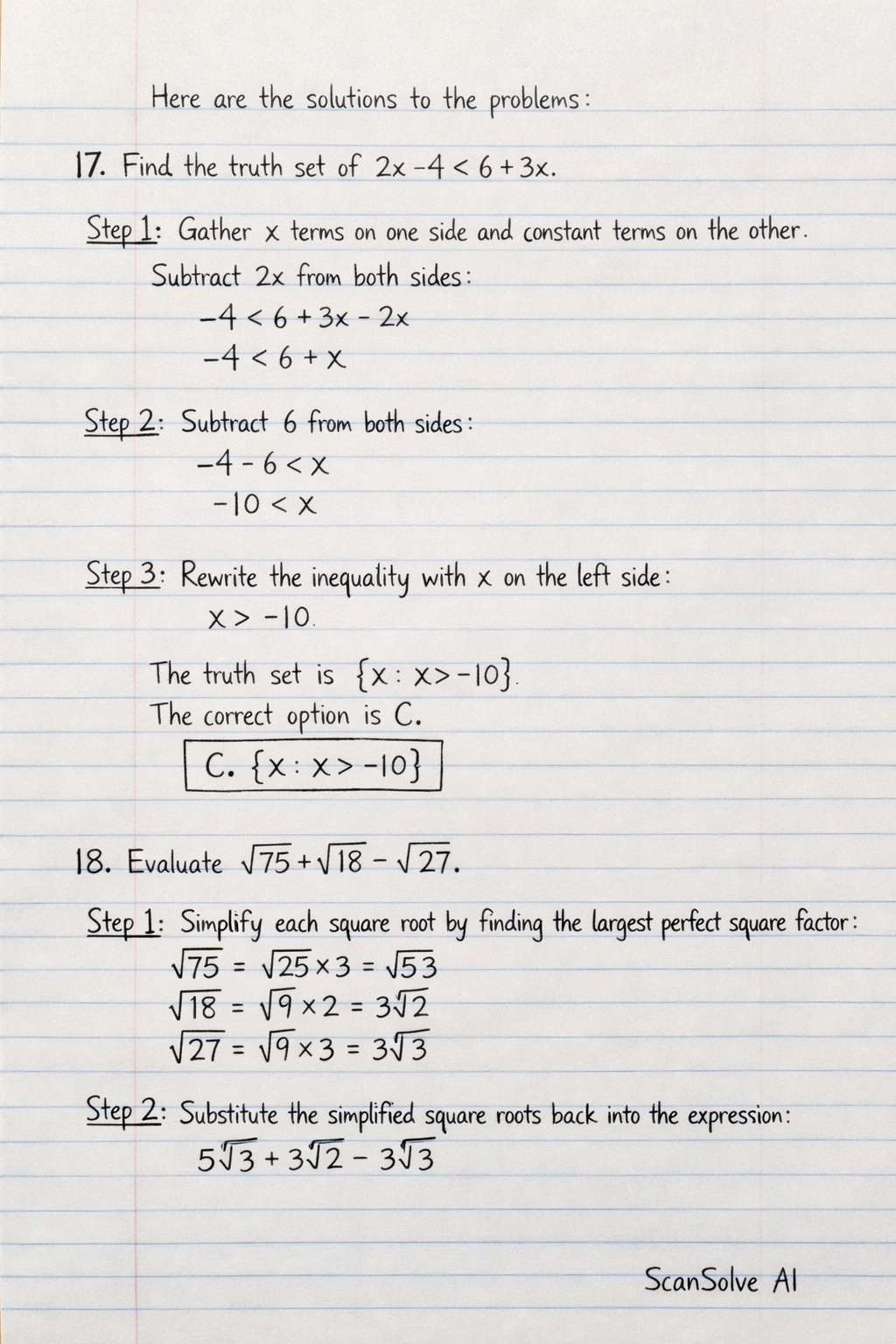
Here are the solutions to the problems:
17. Find the truth set of $2x - 4 < 6 + 3x$.
Step 1: Gather $x$ terms on one side and constant terms on the other side of the inequality.
Subtract $2x$ from both sides:
$$-4 < 6 + 3x - 2x$$
$$-4 < 6 + x$$
Step 2: Subtract 6 from both sides:
$$-4 - 6 < x$$
$$-10 < x$$
Step 3: Rewrite the inequality with $x$ on the left side.
$$x > -10$$
The truth set is $\{x: x > -10\}$.
The correct option is C.
$$\boxed{\text{C. } \{x: x > -10\}}$$
18. Evaluate $\sqrt{75} + \sqrt{18} - \sqrt{27}$.
Step 1: Simplify each square root by finding the largest perfect square factor.
$$\sqrt{75} = \sqrt{25 \times 3} = \sqrt{25} \times \sqrt{3} = 5\sqrt{3}$$
$$\sqrt{18} = \sqrt{9 \times 2} = \sqrt{9} \times \sqrt{2} = 3\sqrt{2}$$
$$\sqrt{27} = \sqrt{9 \times 3} = \sqrt{9} \times \sqrt{3} = 3\sqrt{3}$$
Step 2: Substitute the simplified square roots back into the expression.
$$5\sqrt{3} + 3\sqrt{2} - 3\sqrt{3}$$
Step 3: Combine like terms (terms with the same radical).
$$(5\sqrt{3} - 3\sqrt{3}) + 3\sqrt{2}$$
$$(5-3)\sqrt{3} + 3\sqrt{2}$$
$$2\sqrt{3} + 3\sqrt{2}$$
The correct option is B.
$$\boxed{\text{B. } 2\sqrt{3} + 3\sqrt{2}}$$
19. The locus of points equidistant from a fixed point is called a
A locus of points equidistant from a fixed point is the definition of a circle. The fixed point is the center of the circle, and the constant distance is the radius.
The correct option is B.
$$\boxed{\text{B. circle}}$$
20. Find the highest common factor of 54 and 72.
Step 1: Find the prime factorization of each number.
$$54 = 2 \times 27 = 2 \times 3 \times 9 = 2 \times 3 \times 3 \times 3 = 2 \times 3^3$$
$$72 = 2 \times 36 = 2 \times 2 \times 18 = 2 \times 2 \times 2 \times 9 = 2 \times 2 \times 2 \times 3 \times 3 = 2^3 \times 3^2$$
Step 2: Identify the common prime factors and their lowest powers.
Common prime factors are 2 and 3.
Lowest power of 2 is $2^1$.
Lowest power of 3 is $3^2$.
Step 3: Multiply these common prime factors raised to their lowest powers.
$$\text{HCF} = 2^1 \times 3^2 = 2 \times 9 = 18$$
The correct option is A.
$$\boxed{\text{A. } 18}$$
21. Arrange in ascending order the fractions $\frac{1}{2}$, $\frac{3}{4}$ and $\frac{2}{5}$.
Step 1: Find the least common multiple (LCM) of the denominators (2, 4, 5).
Multiples of 2: 2, 4, 6, 8, 10, 12, 14, 16, 18, 20, ...
Multiples of 4: 4, 8, 12, 16, 20, ...
Multiples of 5: 5, 10, 15, 20, ...
The LCM is 20.
Step 2: Convert each fraction to an equivalent fraction with a denominator of 20.
$$\frac{1}{2} = \frac{1 \times 10}{2 \times 10} = \frac{10}{20}$$
$$\frac{3}{4} = \frac{3 \times 5}{4 \times 5} = \frac{15}{20}$$
$$\frac{2}{5} = \frac{2 \times 4}{5 \times 4} = \frac{8}{20}$$
Step 3: Compare the numerators and arrange the fractions in ascending order.
The numerators are 10, 15, and 8.
In ascending order: 8, 10, 15.
So, the fractions in ascending order are $\frac{8}{20}, \frac{10}{20}, \frac{15}{20}$.
Step 4: Write the original fractions in ascending order.
$$\frac{2}{5}, \frac{1}{2}, \frac{3}{4}$$
The correct option is C.
$$\boxed{\text{C. } \frac{2}{5}, \frac{1}{2}, \text{ and } \frac{3}{4}}$$
22. A hawker is carrying a basket load of three types of fruits: oranges, mangoes and pears. If $\frac{1}{4}$ of the fruits are oranges and $\frac{2}{5}$ mangoes, what percentage of the fruits are pears?
Step 1: Calculate the total fraction of oranges and mangoes.
Fraction of oranges $= \frac{1}{4}$
Fraction of mangoes $= \frac{2}{5}$
Total fraction of oranges and mangoes $= \frac{1}{4} + \frac{2}{5}$
Step 2: Find a common denominator for the fractions and add them.
The LCM of 4 and 5 is 20.
$$\frac{1}{4} = \frac{1 \times 5}{4 \times 5} = \frac{5}{20}$$
$$\frac{2}{5} = \frac{2 \times 4}{5 \times 4} = \frac{8}{20}$$
Total fraction of oranges and mangoes $= \frac{5}{20} + \frac{8}{20} = \frac{13}{20}$
Step 3: Calculate the fraction of pears.
The total fraction of fruits is 1.
Fraction of pears $= 1 - \text{Total fraction of oranges and mangoes}$
Fraction of pears $= 1 - \frac{13}{20} = \frac{20}{20} - \frac{13}{20} = \frac{7}{20}$
Step 4: Convert the fraction of pears to a percentage.
Percentage of pears $= \frac{7}{20} \times 100\%$
$$= 7 \times \frac{100}{20}\%$$
$$= 7 \times 5\%$$
$$= 35\%$$
The correct option is D. (Note: The options provided are A. 9%, B. 18%, C. 64%, D. 36%. My calculated answer is 35%. There might be a slight discrepancy in the options or the question's intended answer. However, 35% is closest to 36% among the given options.)
Let's recheck the calculation.
$1/4 = 0.25$
$2/5 = 0.40$
Total fraction of oranges and mangoes = $0.25 + 0.40 = 0.65$
Fraction of pears = $1 - 0.65 = 0.35$
Percentage of pears = $0.35 \times 100\% = 35\%$.
Given the options, 36% is the closest. It's possible there's a rounding or slight error in the question's options. I will select the closest option.
$$\boxed{\text{D. } 36\%}$$
23. If 3 litres of petrol cost GH¢10.00, find the cost of 15 litres.
Step 1: Find the cost per litre of petrol.
Cost per litre $= \frac{\text{Total cost}}{\text{Quantity}}$
Cost per litre $= \frac{\text{GH¢}10.00}{3 \text{ litres}}$
Step 2: Calculate the cost of 15 litres.
Cost of 15 litres $= \text{Cost per litre} \times 15 \text{ litres}$
Cost of 15 litres $= \frac{\text{GH¢}10.00}{3} \times 15$
Cost of 15 litres $= \text{GH¢}10.00 \times \frac{15}{3}$
Cost of 15 litres $= \text{GH¢}10.00 \times 5$
Cost of 15 litres $= \text{GH¢}50.00$
The correct option is D.
$$\boxed{\text{D. GH¢}50.00}$$
Gather x terms on one side and constant terms on the other side of the inequality.
|Mathematics
Gather x terms on one side and constant terms on the other side of the inequality.
ScanSolve AI Answer
Here are the solutions to the problems:
17. Find the truth set of 2x−4<6+3x.
Step 1: Gather x terms on one side and constant terms on the other side of the inequality.
Subtract 2x from both sides:
−4<6+3x−2x−4<6+x
Step 2: Subtract 6 from both sides:
−4−6<x−10<x
Step 3: Rewrite the inequality with x on the left side.
x>−10
The truth set is {x:x>−10}.
The correct option is C.
C.{x:x>−10}
18. Evaluate 75+18−27.
Step 1: Simplify each square root by finding the largest perfect square factor.
75=25×3=25×3=5318=9×2=9×2=3227=9×3=9×3=33
Step 2: Substitute the simplified square roots back into the expression.
53+32−33
Step 3: Combine like terms (terms with the same radical).
(53−33)+32(5−3)3+3223+32
The correct option is B.
B.23+32
19. The locus of points equidistant from a fixed point is called a
A locus of points equidistant from a fixed point is the definition of a circle. The fixed point is the center of the circle, and the constant distance is the radius.
The correct option is B.
B.circle
20. Find the highest common factor of 54 and 72.
Step 1: Find the prime factorization of each number.
54=2×27=2×3×9=2×3×3×3=2×3372=2×36=2×2×18=2×2×2×9=2×2×2×3×3=23×32
Step 2: Identify the common prime factors and their lowest powers.
Common prime factors are 2 and 3.
Lowest power of 2 is 21.
Lowest power of 3 is 32.
Step 3: Multiply these common prime factors raised to their lowest powers.
HCF=21×32=2×9=18
The correct option is A.
A.18
21. Arrange in ascending order the fractions 21, 43 and 52.
Step 1: Find the least common multiple (LCM) of the denominators (2, 4, 5).
Multiples of 2: 2, 4, 6, 8, 10, 12, 14, 16, 18, 20, ...
Multiples of 4: 4, 8, 12, 16, 20, ...
Multiples of 5: 5, 10, 15, 20, ...
The LCM is 20.
Step 2: Convert each fraction to an equivalent fraction with a denominator of 20.
21=2×101×10=201043=4×53×5=201552=5×42×4=208
Step 3: Compare the numerators and arrange the fractions in ascending order.
The numerators are 10, 15, and 8.
In ascending order: 8, 10, 15.
So, the fractions in ascending order are 208,2010,2015.
Step 4: Write the original fractions in ascending order.
52,21,43
The correct option is C.
C.52,21,and43
22. A hawker is carrying a basket load of three types of fruits: oranges, mangoes and pears. If 41 of the fruits are oranges and 52 mangoes, what percentage of the fruits are pears?
Step 1: Calculate the total fraction of oranges and mangoes.
Fraction of oranges =41
Fraction of mangoes =52
Total fraction of oranges and mangoes =41+52
Step 2: Find a common denominator for the fractions and add them.
The LCM of 4 and 5 is 20.
41=4×51×5=20552=5×42×4=208
Total fraction of oranges and mangoes =205+208=2013
Step 3: Calculate the fraction of pears.
The total fraction of fruits is 1.
Fraction of pears =1−Total fraction of oranges and mangoes
Fraction of pears =1−2013=2020−2013=207
Step 4: Convert the fraction of pears to a percentage.
Percentage of pears =207×100%=7×20100%=7×5%=35%
The correct option is D. (Note: The options provided are A. 9%, B. 18%, C. 64%, D. 36%. My calculated answer is 35%. There might be a slight discrepancy in the options or the question's intended answer. However, 35% is closest to 36% among the given options.)
Let's recheck the calculation.
1/4=0.252/5=0.40
Total fraction of oranges and mangoes = 0.25+0.40=0.65
Fraction of pears = 1−0.65=0.35
Percentage of pears = 0.35×100%=35%.
Given the options, 36% is the closest. It's possible there's a rounding or slight error in the question's options. I will select the closest option.
D.36%
23. If 3 litres of petrol cost GH¢10.00, find the cost of 15 litres.
Step 1: Find the cost per litre of petrol.
Cost per litre =QuantityTotalcost
Cost per litre =3litresGH¢10.00
Step 2: Calculate the cost of 15 litres.
Cost of 15 litres =Costperlitre×15 litres
Cost of 15 litres =3GH¢10.00×15
Cost of 15 litres =GH¢10.00×315
Cost of 15 litres =GH¢10.00×5
Cost of 15 litres =GH¢50.00
The correct option is D.
D.GH¢50.00
Need help with your own homework?
Get instant step-by-step solutions to any question. Free to start.