

This mathematics problem involves applying core mathematical principles and formulas. Below you will find a complete step-by-step solution with detailed explanations for each step, helping you understand not just the answer but the method behind it.
ScanSolve AI Answer
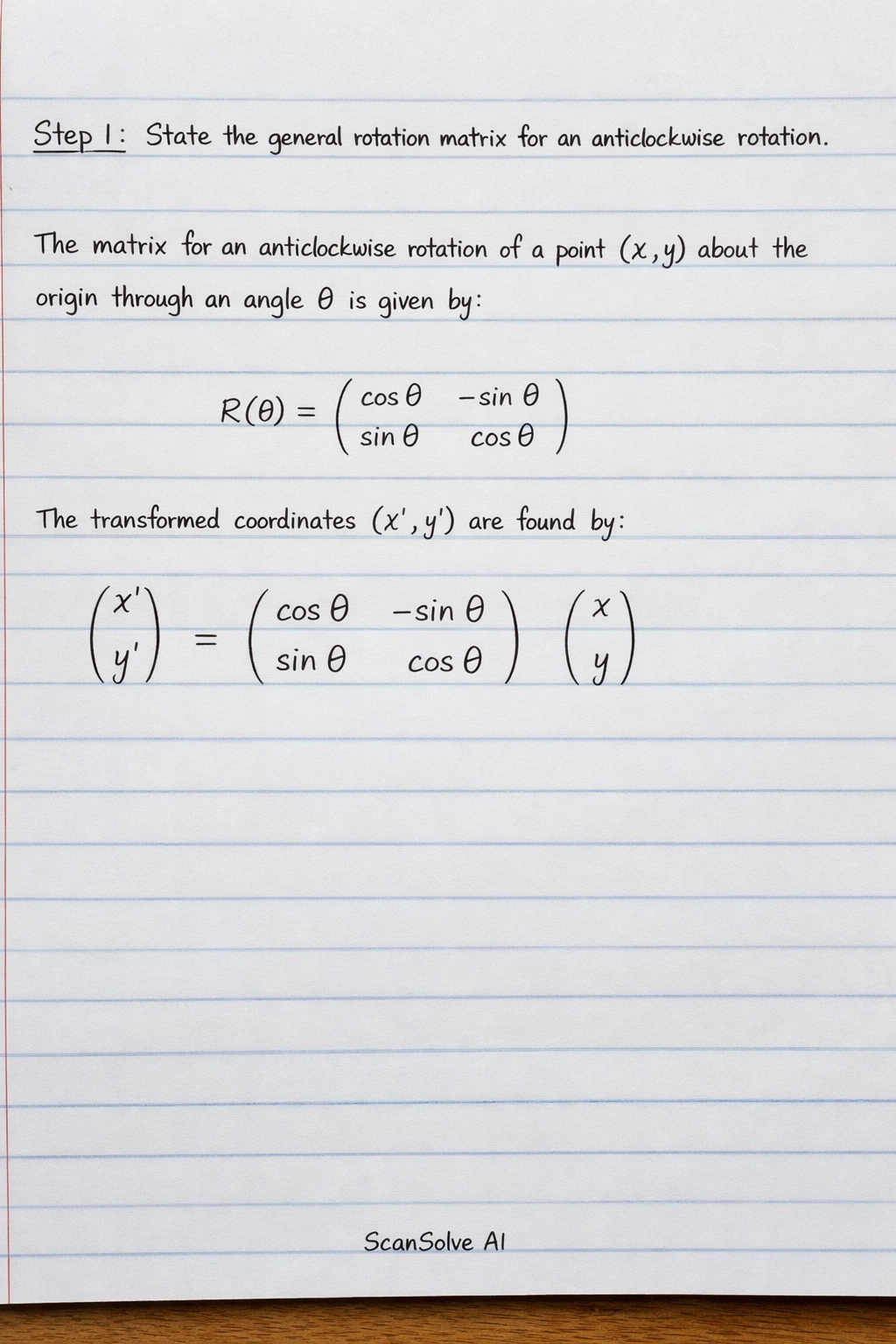
Step 1: State the general rotation matrix for an anticlockwise rotation. The matrix for an anticlockwise rotation of a point (x, y) about the origin through an angle is given by: R() = & - \\ & The transformed coordinates (x', y') are found by: x' \\ y' = & - \\ & x \\ y This matrix is shown at the bottom of the provided image. Step 2: Verify the rotation for 270^ anticlockwise. To verify the specific case of a 270^ anticlockwise rotation shown in the image, we substitute = 270^ into the general rotation matrix: R(270^) = (270^) & -(270^) \\ (270^) & (270^) We know that (270^) = 0 and (270^) = -1. Substitute these values: R(270^) = 0 & -(-1) \\ -1 & 0 = 0 & 1 \\ -1 & 0 This matches the rotation matrix shown in the image for the 270^ rotation. Now, apply this matrix to a point x \\ y : x' \\ y' = 0 & 1 \\ -1 & 0 x \\ y = (0)(x) + (1)(y) \\ (-1)(x) + (0)(y) = y \\ -x This result y \\ -x also matches the transformed coordinates shown in the image for a 270^ anticlockwise rotation of x \\ y . The general rotation matrix for an anticlockwise rotation through an angle is & - \\ & . The specific rotation matrix for an anticlockwise rotation through 270^ is 0 & 1 \\ -1 & 0 .