We read your photo as:

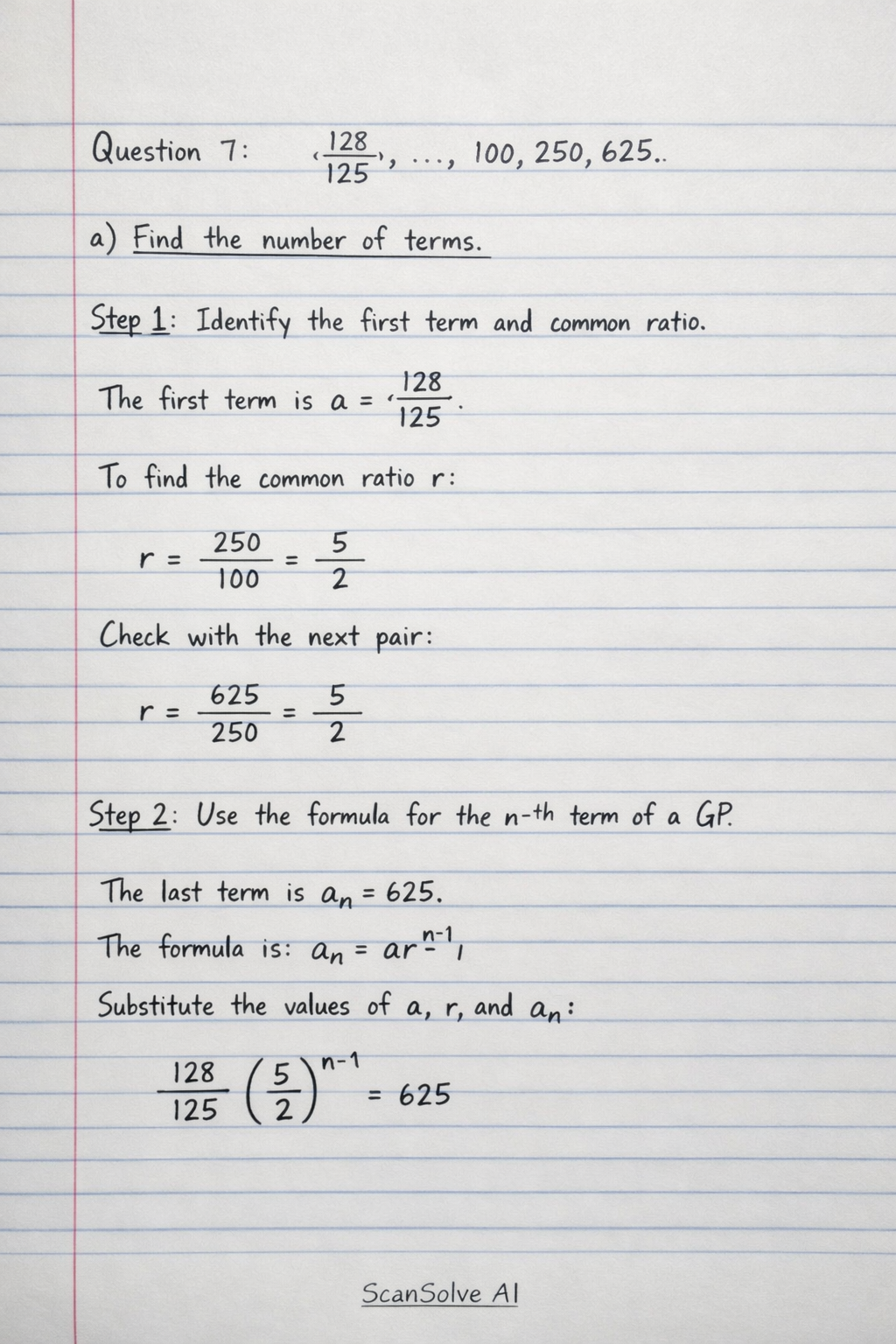
Given a Geometric Progression (GP): (128)/(125), ..., 100, 250, 625. Find the number of terms and the first three terms.

Mathematics

ScanSolve AI Answer

Answers

3 parts
a

8\text{8}

b

128125,6425,325\frac{128}{125}, \frac{64}{25}, \frac{32}{5}

8

12th term\text{12th term}

Step-by-step solution

10 steps

Part 7

Given a Geometric Progression (GP): 128125,...,100,250,625\frac{128}{125}, ..., 100, 250, 625.

Part a

8\text{8}

Find the number of terms.

  1. Identify the first term and common ratio.

    The first term is a=128125a = \frac{128}{125}.
    From the given terms 100,250,625100, 250, 625, we can find the common ratio rr.

    r=250100=52r = \frac{250}{100} = \frac{5}{2}

    We can verify this with the next pair:

    r=625250=52r = \frac{625}{250} = \frac{5}{2}
  2. Use the formula for the nn-th term of a GP.

    The last term is an=625a_n = 625. The formula for the nn-th term is an=arn−1a_n = ar^{n-1}.
    Substitute the values of aa, rr, and ana_n:

    128125(52)n−1=625\frac{128}{125} \left(\frac{5}{2}\right)^{n-1} = 625
  3. Solve for nn.

    Express the numbers as powers of their prime factors: 128=27128 = 2^7, 125=53125 = 5^3, 625=54625 = 5^4.

    2753(52)n−1=54\frac{2^7}{5^3} \left(\frac{5}{2}\right)^{n-1} = 5^4 27535n−12n−1=54\frac{2^7}{5^3} \frac{5^{n-1}}{2^{n-1}} = 5^4 27−(n−1)⋅5(n−1)−3=542^{7-(n-1)} \cdot 5^{(n-1)-3} = 5^4 28−n⋅5n−4=542^{8-n} \cdot 5^{n-4} = 5^4

    For this equality to hold, the powers of the bases must match.
    Equating the powers of 2:

    8−n=0  ⟹  n=88-n = 0 \implies n = 8

    Equating the powers of 5:

    n−4=4  ⟹  n=8n-4 = 4 \implies n = 8

    Both equations yield n=8n=8.

    The number of terms is 8\boxed{\text{8}}.

Part b

128125,6425,325\frac{128}{125}, \frac{64}{25}, \frac{32}{5}

Write down the first three terms.

  1. Identify the first term.

    The first term is a1=a=128125a_1 = a = \frac{128}{125}.

  2. Calculate the second term.

    The second term is a2=ara_2 = ar.

    a2=128125×52=64×225×5×52=6425a_2 = \frac{128}{125} \times \frac{5}{2} = \frac{64 \times 2}{25 \times 5} \times \frac{5}{2} = \frac{64}{25}
  3. Calculate the third term.

    The third term is a3=ar2a_3 = ar^2.

    a3=128125×(52)2=128125×254=32×45×25×254=325a_3 = \frac{128}{125} \times \left(\frac{5}{2}\right)^2 = \frac{128}{125} \times \frac{25}{4} = \frac{32 \times 4}{5 \times 25} \times \frac{25}{4} = \frac{32}{5}

    The first three terms are 128125,6425,325\boxed{\frac{128}{125}, \frac{64}{25}, \frac{32}{5}}.

Part 8

12th term\text{12th term}

Which term of the sequence: 1018,634,412,...10\frac{1}{8}, 6\frac{3}{4}, 4\frac{1}{2}, ... is 2562187\frac{256}{2187}?

  1. Convert mixed numbers to improper fractions and identify the first term.

    1018=8×10+18=81810\frac{1}{8} = \frac{8 \times 10 + 1}{8} = \frac{81}{8} 634=4×6+34=2746\frac{3}{4} = \frac{4 \times 6 + 3}{4} = \frac{27}{4} 412=2×4+12=924\frac{1}{2} = \frac{2 \times 4 + 1}{2} = \frac{9}{2}

    The sequence is 818,274,92,...\frac{81}{8}, \frac{27}{4}, \frac{9}{2}, ...
    The first term is a=818a = \frac{81}{8}.

  2. Find the common ratio rr.

    r=second termfirst term=27/481/8=274×881=2781×84=13×2=23r = \frac{\text{second term}}{\text{first term}} = \frac{27/4}{81/8} = \frac{27}{4} \times \frac{8}{81} = \frac{27}{81} \times \frac{8}{4} = \frac{1}{3} \times 2 = \frac{2}{3}

    Verify with the next pair:

    r=third termsecond term=9/227/4=92×427=927×42=13×2=23r = \frac{\text{third term}}{\text{second term}} = \frac{9/2}{27/4} = \frac{9}{2} \times \frac{4}{27} = \frac{9}{27} \times \frac{4}{2} = \frac{1}{3} \times 2 = \frac{2}{3}

    The common ratio is r=23r = \frac{2}{3}.

  3. Use the formula for the nn-th term of a GP and solve for nn.

    We want to find nn such that an=2562187a_n = \frac{256}{2187}.
    The formula is an=arn−1a_n = ar^{n-1}.

    818(23)n−1=2562187\frac{81}{8} \left(\frac{2}{3}\right)^{n-1} = \frac{256}{2187}
  4. Express numbers as powers of their prime factors and solve for nn.

    81=3481 = 3^4
    8=238 = 2^3
    256=28256 = 2^8
    2187=372187 = 3^7
    Substitute these into the equation:

    3423(23)n−1=2837\frac{3^4}{2^3} \left(\frac{2}{3}\right)^{n-1} = \frac{2^8}{3^7} 34232n−13n−1=2837\frac{3^4}{2^3} \frac{2^{n-1}}{3^{n-1}} = \frac{2^8}{3^7} 2(n−1)−3⋅34−(n−1)=28⋅3−72^{(n-1)-3} \cdot 3^{4-(n-1)} = 2^8 \cdot 3^{-7} 2n−4⋅35−n=28⋅3−72^{n-4} \cdot 3^{5-n} = 2^8 \cdot 3^{-7}

    Equating the powers of 2:

    n−4=8  ⟹  n=12n-4 = 8 \implies n = 12

    Equating the powers of 3:

    5−n=−7  ⟹  n=5+7  ⟹  n=125-n = -7 \implies n = 5+7 \implies n = 12

    Both equations give n=12n=12.

    The term is the 12th term\boxed{\text{12th term}}.

Was this helpful?

Try one yourself

A new problem that tests the same skill.

Still stuck on this one?

Ask a follow-up, and the answer starts from this question.

Got a different question?Ask your own question
Handwritten step-by-step solution preview

Handwritten Step-by-Step Solution

Get this as a handwritten image on WhatsApp — like a tutor wrote it for you.

Try on WhatsApp