
We read your photo as:
Given a rectangle ABCD, where point A is (-3, 1) and line AB is parallel to 3y − x = 4. a) Find the equation of line AB. b) Find the equation of line AD.
ScanSolve AI Answer
Answers
4 partsStep-by-step solution
13 stepsPart a· 3 steps
Find the equation of line AB.
Find the gradient of the given line.
The given line is .
Rearrange it into the slope-intercept form :The gradient of this line is .
Determine the gradient of line AB.
Since line AB is parallel to the given line, their gradients are equal.
So, the gradient of line AB is .Find the equation of line AB.
Line AB passes through point A and has a gradient of .
Using the point-slope form :Multiply by 3 to clear the fraction:
Rearrange into the general form :
The equation of line AB is .
Part b
Find the equation of line AD.
Determine the gradient of line AD.
In a rectangle, adjacent sides are perpendicular. Therefore, line AD is perpendicular to line AB.
The gradient of line AB is .
The gradient of a line perpendicular to AB is the negative reciprocal of :Find the equation of line AD.
Line AD passes through point A and has a gradient of .
Using the point-slope form :Rearrange into the general form :
The equation of line AD is .
Part c
If C has coordinates , find the equations of the line BC and CD in the double intercept form, .
Equation of line BC:
Determine the gradient of line BC.
In a rectangle, opposite sides are parallel. Therefore, line BC is parallel to line AD.
The gradient of line AD is .
So, the gradient of line BC is .Find the equation of line BC.
Line BC passes through point C and has a gradient of .
Using the point-slope form :Rearrange into the form :
Convert the equation to double intercept form.
To get , divide the entire equation by 12:
The equation of line BC is .
Equation of line CD:
Determine the gradient of line CD.
In a rectangle, opposite sides are parallel. Therefore, line CD is parallel to line AB.
The gradient of line AB is .
So, the gradient of line CD is .Find the equation of line CD.
Line CD passes through point C and has a gradient of .
Using the point-slope form :Multiply by 3 to clear the fraction:
Rearrange into the form :
Convert the equation to double intercept form.
To get , divide the entire equation by :
This can also be written as:
The equation of line CD is .
Part d(3, 3)
Find the coordinates of B.
Identify the lines that intersect at B.
Point B is the intersection of line AB and line BC.
From part (a), the equation of line AB is .
From part (c), the equation of line BC is .Solve the system of equations.
From equation (2), express in terms of :
Substitute this expression for into equation (1):
Now substitute back into the expression for :
The coordinates of B are .
Try one yourself
A new problem that tests the same skill.
Still stuck on this one?
Ask a follow-up, and the answer starts from this question.
More Mathematics Questions
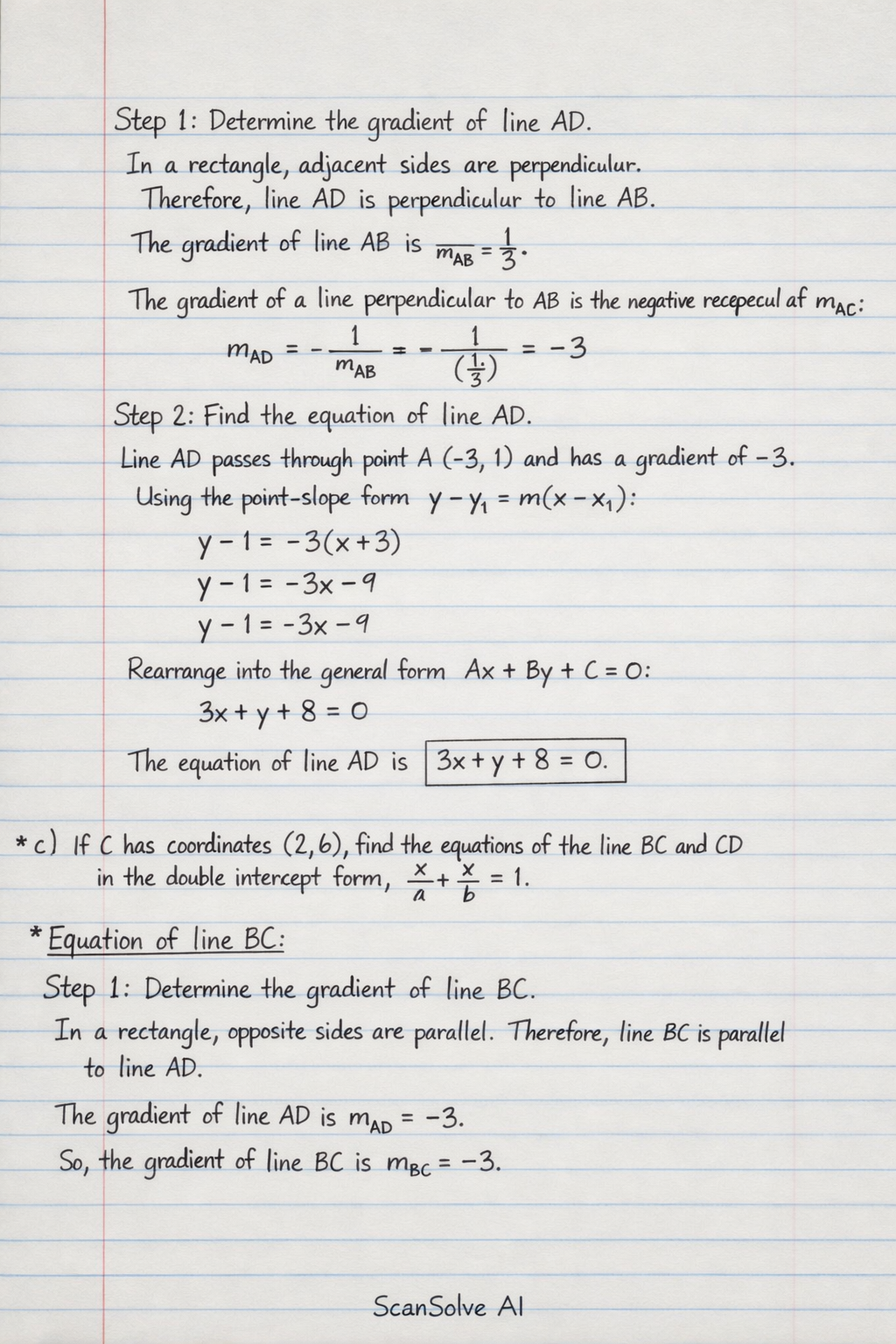
Handwritten Step-by-Step Solution
Get this as a handwritten image on WhatsApp — like a tutor wrote it for you.
Try on WhatsApp