
We read your photo as:
Given a triangle with vertices at A(1,3), B(4,7) and C(6,2) it undergoes two successive translation first by vector V1 = (2/3) and second by vector V2 = (-4/-1). Find the final coordinate of the triangle and explain how the composition of these translation affect the overall position movement.
ScanSolve AI Answer
Answer
A'(-1, 12), B'(2, 16), C'(4, 11)
Step-by-step solution
3 stepsFind the resultant translation vector.
To find the overall translation, we add the two translation vectors and .
Apply the resultant translation vector to each vertex of the triangle.
For a point and a translation vector , the new point is .
For vertex A(1, 3):
For vertex B(4, 7):
For vertex C(6, 2):
The final coordinates of the triangle are .
Explain how the composition of these translations affects the overall movement.
The composition of two successive translations is equivalent to a single translation by the sum of the individual translation vectors. In this case, the triangle undergoes an overall translation by the vector . This means the entire triangle moves 2 units to the left and 9 units upwards from its original position.
Try one yourself
A new problem that tests the same skill.
Still stuck on this one?
Ask a follow-up, and the answer starts from this question.
More Mathematics Questions
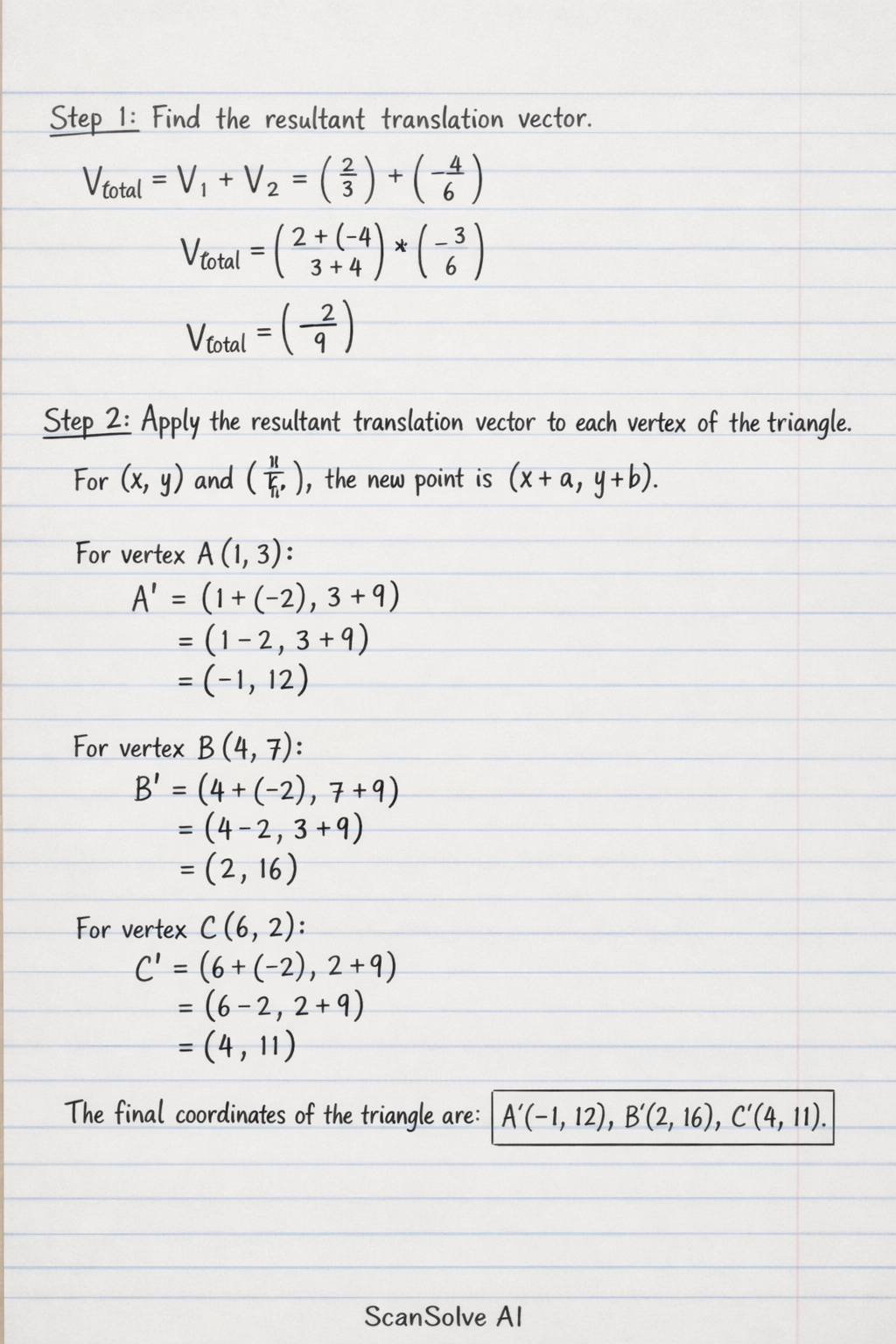
Handwritten Step-by-Step Solution
Get this as a handwritten image on WhatsApp — like a tutor wrote it for you.
Try on WhatsApp