This mathematics problem involves applying core mathematical principles and formulas. Below you will find a complete step-by-step solution with detailed explanations for each step, helping you understand not just the answer but the method behind it.
ScanSolve AI Answer
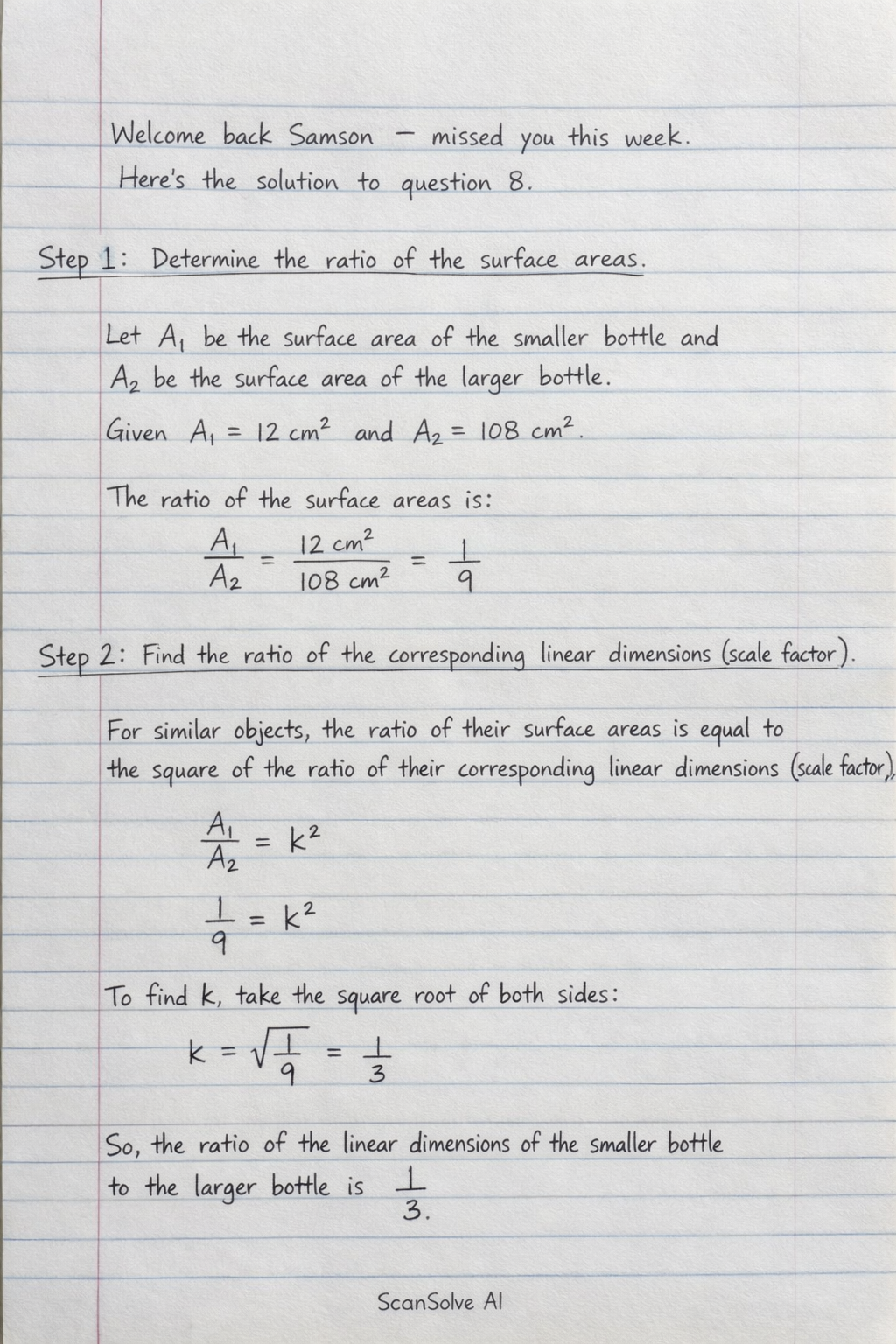
Welcome back Samson — missed you this week.
Here's the solution to question 8.
Step 1: Determine the ratio of the surface areas.
Let $A_1$ be the surface area of the smaller bottle and $A_2$ be the surface area of the larger bottle.
Given $A_1 = 12 \text{ cm}^2$ and $A_2 = 108 \text{ cm}^2$.
The ratio of the surface areas is:
$$ \frac{A_1}{A_2} = \frac{12 \text{ cm}^2}{108 \text{ cm}^2} = \frac{1}{9} $$
Step 2: Find the ratio of the corresponding linear dimensions (scale factor).
For similar objects, the ratio of their surface areas is equal to the square of the ratio of their corresponding linear dimensions (scale factor, $k$).
$$ \frac{A_1}{A_2} = k^2 $$
$$ \frac{1}{9} = k^2 $$
To find $k$, take the square root of both sides:
$$ k = \sqrt{\frac{1}{9}} = \frac{1}{3} $$
So, the ratio of the linear dimensions of the smaller bottle to the larger bottle is $\frac{1}{3}$.
Step 3: Calculate the volume of the smaller bottle.
For similar objects, the ratio of their volumes is equal to the cube of the ratio of their corresponding linear dimensions.
Let $V_1$ be the volume of the smaller bottle and $V_2$ be the volume of the larger bottle.
Given $V_2 = 810 \text{ cm}^3$.
$$ \frac{V_1}{V_2} = k^3 $$
$$ \frac{V_1}{810 \text{ cm}^3} = \left(\frac{1}{3}\right)^3 $$
$$ \frac{V_1}{810 \text{ cm}^3} = \frac{1}{27} $$
Now, solve for $V_1$:
$$ V_1 = \frac{1}{27} \times 810 \text{ cm}^3 $$
$$ V_1 = \frac{810}{27} \text{ cm}^3 $$
$$ V_1 = 30 \text{ cm}^3 $$
The volume of the smaller bottle is $\boxed{\text{30 cm}^3}$.
Send me the next one 📸
Given A1 = 12 cm^2 and A2 = 108 cm^2.
|Mathematics
Given A1 = 12 cm^2 and A2 = 108 cm^2.
ScanSolve AI Answer
Verified
Welcome back Samson — missed you this week.
Here's the solution to question 8.
Step 1: Determine the ratio of the surface areas.
Let A1 be the surface area of the smaller bottle and A2 be the surface area of the larger bottle.
Given A1=12cm2 and A2=108cm2.
The ratio of the surface areas is:
A2A1=108cm212cm2=91
Step 2: Find the ratio of the corresponding linear dimensions (scale factor).
For similar objects, the ratio of their surface areas is equal to the square of the ratio of their corresponding linear dimensions (scale factor, k).
A2A1=k291=k2
To find k, take the square root of both sides:
k=91=31
So, the ratio of the linear dimensions of the smaller bottle to the larger bottle is 31.
Step 3: Calculate the volume of the smaller bottle.
For similar objects, the ratio of their volumes is equal to the cube of the ratio of their corresponding linear dimensions.
Let V1 be the volume of the smaller bottle and V2 be the volume of the larger bottle.
Given V2=810cm3.
V2V1=k3810cm3V1=(31)3810cm3V1=271
Now, solve for V1:
V1=271×810cm3V1=27810cm3V1=30cm3
The volume of the smaller bottle is 30cm3.
Send me the next one 📸
Need help with your own homework?
Get instant step-by-step solutions to any question. Free to start.