

This mathematics problem involves applying core mathematical principles and formulas. Below you will find a complete step-by-step solution with detailed explanations for each step, helping you understand not just the answer but the method behind it.
ScanSolve AI Answer
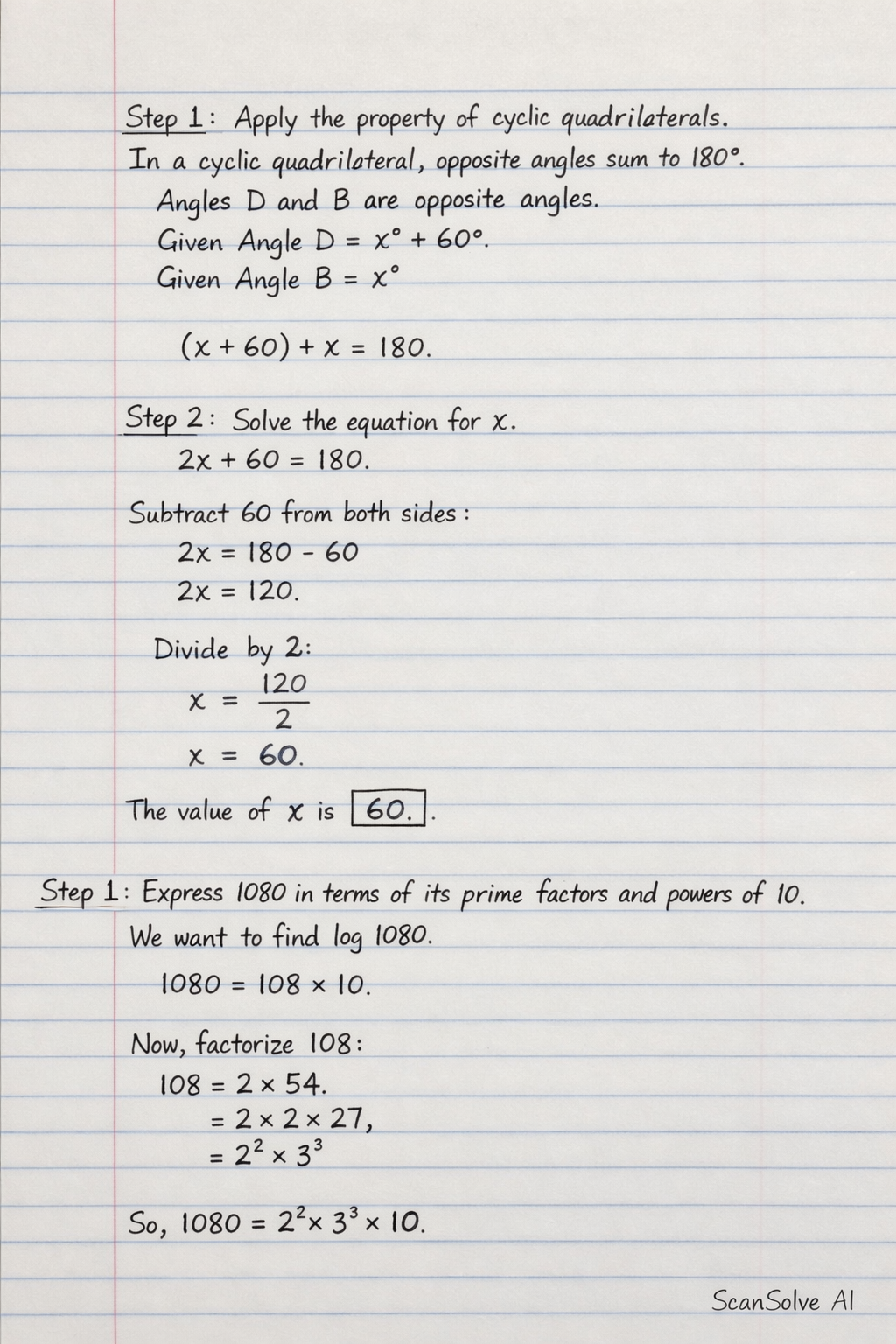
Step 1: Apply the property of cyclic quadrilaterals. In a cyclic quadrilateral, opposite angles sum to 180^. Angles D and B are opposite angles. Given Angle D = x^ + 60^. Given Angle B = x^. (x + 60) + x = 180 Step 2: Solve the equation for x. 2x + 60 = 180 Subtract 60 from both sides: 2x = 180 - 60 2x = 120 Divide by 2: x = (120)/(2) x = 60 The value of x is 60. Step 1: Express 1080 in terms of its prime factors and powers of 10. We want to find log 1080. 1080 = 108 × 10 Now, factorize 108: 108 = 2 × 54 = 2 × 2 × 27 = 2^2 × 3^3 So, 1080 = 2^2 × 3^3 × 10. Step 2: Apply logarithm properties. Using the property log (ab) = log a + log b: log 1080 = log (2^2 × 3^3 × 10) log 1080 = log (2^2) + log (3^3) + log 10 Using the property log (a^n) = n log a: log 1080 = 2 log 2 + 3 log 3 + log 10 We know that log 10 = 1 (assuming base 10 logarithm). Step 3: Substitute the given values and calculate. Given log 2 = 0.30103 and log 3 = 0.47712. log 1080 = 2(0.30103) + 3(0.47712) + 1 log 1080 = 0.60206 + 1.43136 + 1 log 1080 = 3.03342 The value of log 1080 is 3.03342. Step 1: Determine the absolute error for each measurement. The measurements are given to one decimal place