

This mathematics problem involves applying core mathematical principles and formulas. Below you will find a complete step-by-step solution with detailed explanations for each step, helping you understand not just the answer but the method behind it.
ScanSolve AI Answer
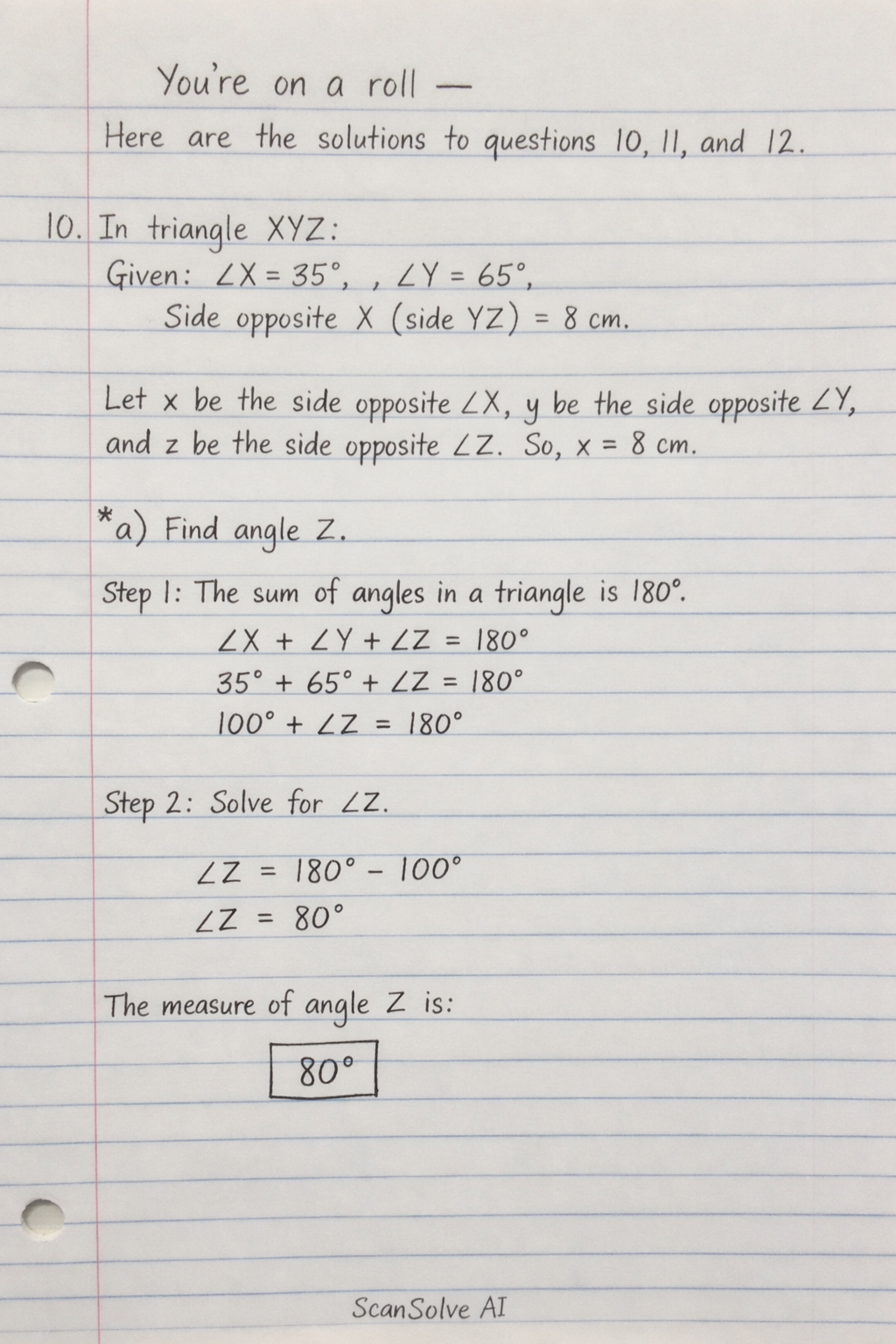
You're on a roll — Here are the solutions to questions 10, 11, and 12. 10. In triangle XYZ: Given: Angle X = 35^, Angle Y = 65^, Side opposite X (side YZ) = 8 cm. Let x be the side opposite angle X, y be the side opposite angle Y, and z be the side opposite angle Z. So, x = 8 cm. a) Find angle Z. Step 1: The sum of angles in a triangle is 180^. X + Y + Z = 180^ 35^ + 65^ + Z = 180^ 100^ + Z = 180^ Step 2: Solve for Z. Z = 180^ - 100^ Z = 80^ The measure of angle Z is: 80^ b) Find side YZ using the sine rule. The sine rule states: (a)/( A) = (b)/( B) = (c)/( C). We are given side x = 8 cm and X = 35^. We need to find side YZ, which is side x. The question asks to find side YZ using the sine rule, but YZ is already given as 8 cm. It is likely that the question meant to ask for side XZ (side y) or side XY (side z). Assuming it meant to find side XZ (side y): Step 1: Apply the sine rule to find side y (side XZ). (x)/( X) = (y)/( Y) 8 cm 35^ = (y)/( 65^) Step 2: Solve for y. y = 8 cm × 65^ 35^ y = (8 × 0.9063)/(0.5736) y = (7.2504)/(0.5736) y ≈ 12.64 cm Assuming the question meant to find side XZ: XZ ≈ 12.64 cm If the question literally meant to find side YZ, then YZ = 8 cm, as given. c) Find the area of the triangle. Step 1: Use the formula for the area of a triangle: Area = (1)/(2)ab C. We can use any two sides and the included angle. Let's use sides x and y and the included angle Z. We have x = 8 cm, y ≈ 12.64 cm, and Z = 80^. Area = (1)/(2)xy Z Area = (1)/(2) × 8 cm × 12.64 cm × 80^ Step 2: Calculate the value. Area = 4 × 12.64 × 0.9848 Area = 4 × 12.451 Area ≈ 49.80 cm^2 The area of the triangle is: 49.80 cm^2 11. A ship sails 120 km on a bearing of 030^. It then sails 80 km on a bearing of 120^. a) Represent the journey on a scale diagram (1 cm = 20 km). Step 1: Determine the lengths on the diagram. First leg: 120 km ÷ 20 km/cm = 6 cm. Second leg: 80 km ÷ 20 km/cm = 4 cm. Step 2: Draw the diagram. • Start at a point (A). Draw a North line. • Draw a line segment 6 cm long from A at an angle of 30^ clockwise from North. Label the end point B. • From point B, draw another North line. • Draw a line segment 4 cm long from B at an angle of 120^ clockwise from the North line at B. Label the end point C. • Draw a line segment from A to C to represent the final displacement. (Diagram cannot be drawn here, but the steps describe how to construct it.) b) Find the final displacement from the starting point. Step 1: Identify the angles in the triangle formed by the journey. Let the starting point be A, the intermediate point B, and the final point C. The bearing from A to B is 030^. The bearing from B to C is 120^. The interior angle at B, ABC, can be found. The angle from the North line at B to BA (back bearing) is 30^ + 180^ = 210^. The angle from the North line at B to BC is 120^. The angle between the North line at B and the line segment BA (pointing back to A) is 30^. The angle between the North line at B and the line segment BC is 120^. The angle ABC is the angle between BA and BC. The angle between the North line at B and the line BA (pointing towards A) is 30^. The angle between the South line at B and the line BA is 30^. The angle between the North line at B and the line BC is 120^. The angle between the South line at B and the line BC is 180^ - 120^ = 60^. The angle ABC = 30^ + 60^ = 90^. Alternatively, the interior angle at B is 180^ - (30^ + (180^ - 120^)) = 180^ - (30^ + 60^) = 180^ - 90^ = 90^. So, ABC is a right-angled triangle. Side AB = 120 km, Side BC = 80 km. Step 2: Use the Pythagorean theorem to find the displacement AC. AC^2 = AB^2 + BC^2 AC^2 = (120 km)^2 + (80 km)^2 AC^2 = 14400 km^2 + 6400 km^2 AC^2 = 20800 km^2 AC = sqrt(20800) km AC ≈ 144.22 km The final displacement from the starting point is: 144.22 km c) Find the bearing of the final position from the starting point. Step 1: Find the angle BAC in the right-angled triangle ABC. ( BAC) = OppositeAdjacent = (BC)/(AB) ( BAC) = 80 km120 km = (2)/(3) BAC = ((2)/(3)) BAC ≈ 33.69^ Step 2: Calculate the bearing. The initial bearing was 030^. The angle BAC is measured from the line AB towards AC. The bearing of C from A is 30^ + BAC. Bearing = 30^ + 33.69^ = 63.69^ Expressed as a three-figure bearing: 063.69^ 12. a) Solve the following graphically: y = x (Equation 1) x + y = 4 (Equation 2) Step 1: Create a table of values for each equation. For y = x: | x | y | |---|---| | 0 | 0 | | 1 | 1 | | 2 | 2 | | 3 | 3 | For x + y = 4 (which can be rewritten as y = 4 - x): | x | y | |---|---| | 0 | 4 | | 1 | 3 | | 2 | 2 | | 3 | 1 | Step 2: Plot the points for each equation on a graph paper and draw the lines. (Graph cannot be drawn here, but the steps describe how to construct it.) • For y=x, plot (0,0), (1,1), (2,2), (3,3) and draw a straight line through them. • For x+y=4, plot (0,4), (1,3), (2,2), (3,1) and draw a straight line through them. Step 3: Identify the point of intersection. The two lines intersect at the point where their x and y values are the same. From the tables, we can see that both lines pass through the point (2,2). Graphically, the intersection point will be (2,2). The solution is: x = 2, y = 2 Got more? Send 'em 📸