

This mathematics problem involves applying core mathematical principles and formulas. Below you will find a complete step-by-step solution with detailed explanations for each step, helping you understand not just the answer but the method behind it.
ScanSolve AI Answer
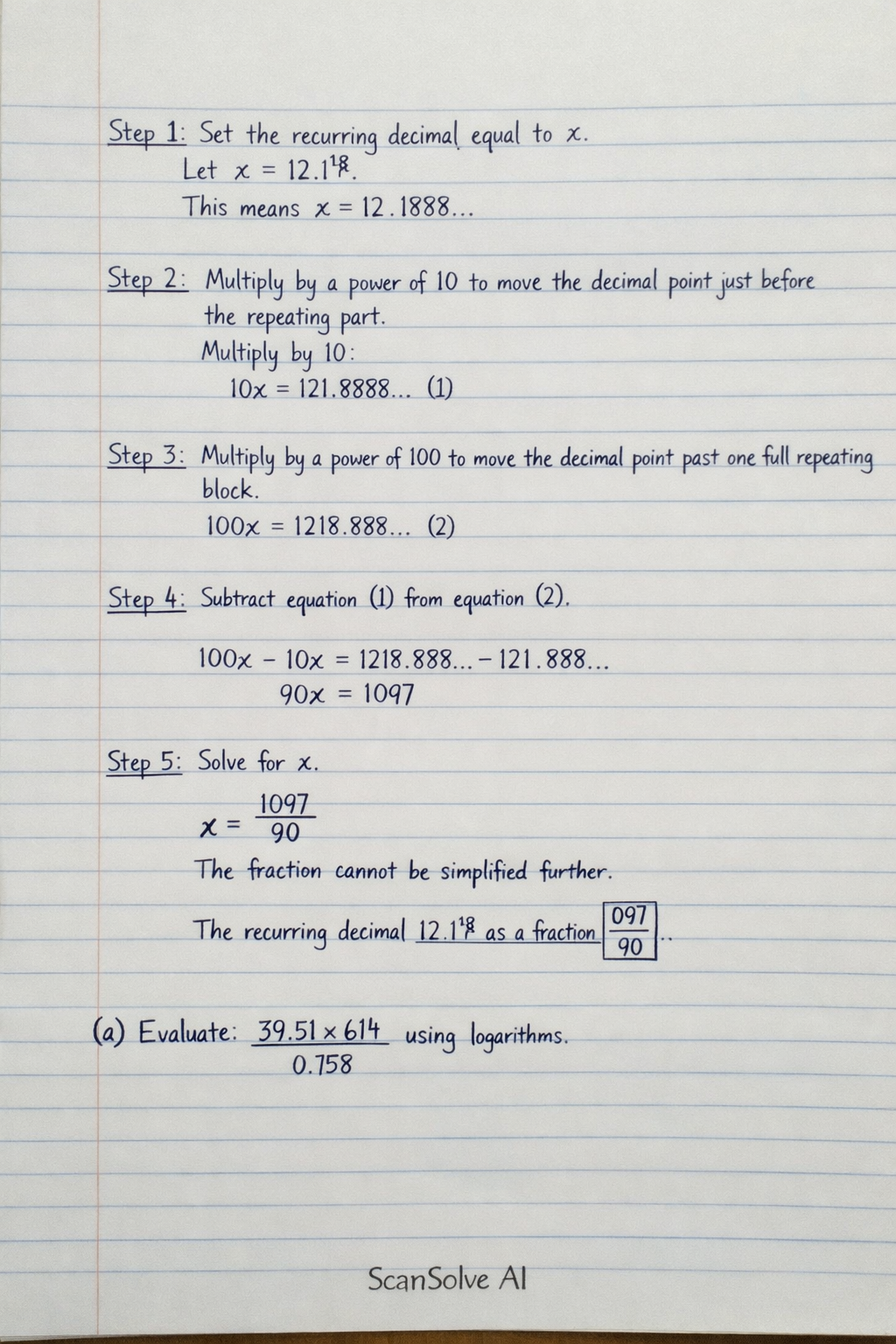
Step 1: Set the recurring decimal equal to x. Let x = 12.18. This means x = 12.1888... Step 2: Multiply by a power of 10 to move the decimal point just before the repeating part. Multiply by 10: 10x = 121.888... (1) Step 3: Multiply by a power of 10 to move the decimal point past one full repeating block. Since one digit repeats, multiply x by 100 (to move the decimal past the non-repeating '1' and the repeating '8'): 100x = 1218.888... (2) Step 4: Subtract equation (1) from equation (2). 100x - 10x = 1218.888... - 121.888... 90x = 1097 Step 5: Solve for x. x = (1097)/(90) The fraction cannot be simplified further. The recurring decimal 12.18 as a fraction is (1097)/(90). a) Evaluate (39.51 × 614)/(0.758) using logarithms. Step 1: Let Y be the expression and take the logarithm base 10 of both sides. Y = (39.51 × 614)/(0.758) _10 Y = _10 ( (39.51 × 614)/(0.758) ) Using logarithm properties (AB) = A + B and ((A)/(B)) = A - B: _10 Y = _10(39.51) + _10(614) - _10(0.758) Step 2: Find the logarithm of each number (using 4 decimal places). _10(39.51) ≈ 1.5967 _10(614) ≈ 2.7882 _10(0.758) ≈ 1.8801 or -0.1199 Step 3: Perform the addition and subtraction. _10 Y = 1.5967 + 2.7882 - (-0.1199) _10 Y = 1.5967 + 2.7882 + 0.1199 _10 Y = 4.5048 Step 4: Find the antilogarithm. Y