
We read your photo as:
Given expressions C = 3(p−2) and D = 3(2−p), evaluate them for p=1 and p=0, multiply them out, and determine if they are the same.
ScanSolve AI Answer
Step-by-step solution
6 stepsHere are the solutions to the questions:
1.2.1 Substitute in C and D respectively.
Substitute into expression C.
Substitute into expression D.
Do you get the same answer?
NoConclusion:
The expressions C and D yield different values when .1.2.2 Choose another value for , except for 2, and substitute in C and D. Do you get the same answer?
Choose .
Substitute into expression C.
Substitute into expression D.
Do you get the same answer?
NoConclusion:
The expressions C and D yield different values when .1.2.3 Multiply out expression C.
Apply the distributive property to expression C.
The multiplied-out expression C is .
1.2.4 Multiply out expression D.
Apply the distributive property to expression D.
The multiplied-out expression D is .
1.2.5 Are the multiplied-out expressions the same? Explain.
Are the multiplied-out expressions the same?
NoExplain:
The multiplied-out expressions and are not the same. While they contain the same terms ( and 6), the signs are opposite. is the negative of , meaning .
Still stuck on this one?
Ask a follow-up, and the answer starts from this question.
More Mathematics Questions
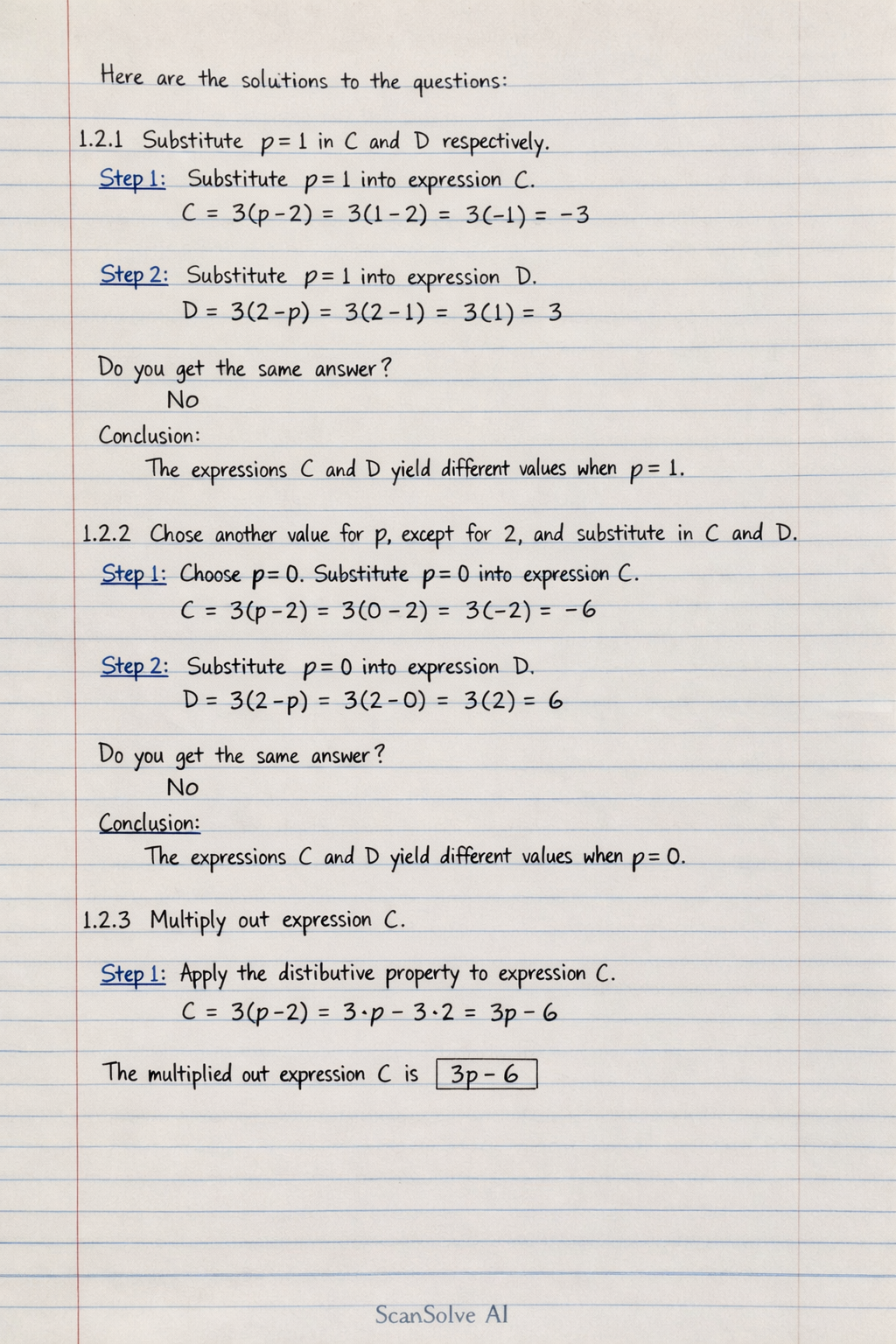
Handwritten Step-by-Step Solution
Get this as a handwritten image on WhatsApp — like a tutor wrote it for you.
Try on WhatsApp