
We read your photo as:
Given f'(c) = 0, f''(c) = 0, and f'''(c) eq 0, what can be concluded about the point x=c?
Mathematics
ScanSolve AI Answer
Answer
D
Step-by-step solution
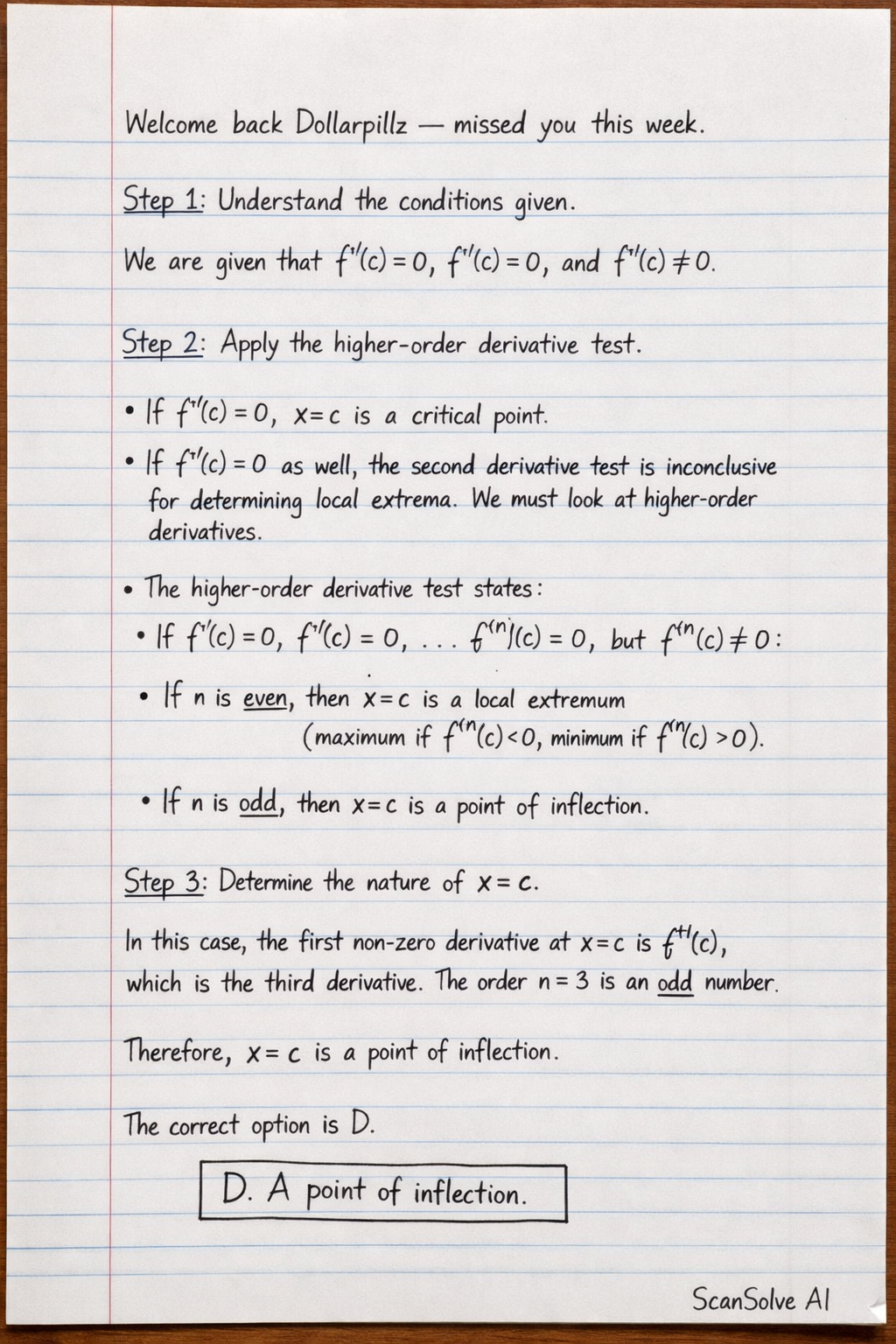
3 stepsUnderstand the conditions given.
We are given that , , and .
Apply the higher-order derivative test.
- If , is a critical point.
- If as well, the second derivative test is inconclusive for determining local extrema. We must look at higher-order derivatives.
- The higher-order derivative test states that if , , ..., , but :
- If is even, then is a local extremum (maximum if , minimum if ).
- If is odd, then is a point of inflection.
Determine the nature of .
In this case, the first non-zero derivative at is , which is the third derivative. The order is an odd number.
Therefore, is a point of inflection.
The correct option is D.
Was this helpful?
Try one yourself
A new problem that tests the same skill.
Still stuck on this one?
Ask a follow-up, and the answer starts from this question.
Got a different question?Ask your own question
More Mathematics Questions
QTo determine if a function F(x) is continuous at a point x=c, three conditions must be met:QGiven f(x) = x3 + ax2 + 5x + c, and that f(2)=0 and f(−1)=0, find the value of a.QAccording to the factor theorem, if (x-c) is a factor of f(x), then f(c)=0. Here, c=4.QUse the intermediate value theorem to show that f(x) = 2x³ − 3 has a zero in the interval [1, 2].QFind the equation of the function f(x) = −x3 + ax2 + bx + c given that it has a point of inflection…
Handwritten Step-by-Step Solution
Get this as a handwritten image on WhatsApp — like a tutor wrote it for you.
Try on WhatsApp