
We read your photo as:
Given f(x) = (2x+1)/(3x+3) and g(x) = 3x+2. Find g(f(x)) and the invariant elements of g(x).
ScanSolve AI Answer
Answers
2 partsStep-by-step solution
6 stepsPart a· 3 steps
To express the function , we substitute into .
Substitute into .
Given and .
Simplify the expression.
To combine the terms, find a common denominator:
Determine the domain.
The domain of requires to be in the domain of , and to be in the domain of .
The domain of is . The domain of is .
Since will always produce a real number (for ), and accepts all real numbers, the only restriction is .
Therefore, the domain of is .The function expressed in a similar manner is:
Part b
An element is invariant under a function if .
Set up the equation for an invariant element.
Given .
We need to solve :Solve for .
Subtract from both sides:
Subtract 2 from both sides:
Divide by 2:
Verify the element is in the domain of .
The domain of is . Since is a real number, it is in the domain of .
The element in the domain of which is invariant under is:
Try one yourself
A new problem that tests the same skill.
Still stuck on this one?
Ask a follow-up, and the answer starts from this question.
More Mathematics Questions
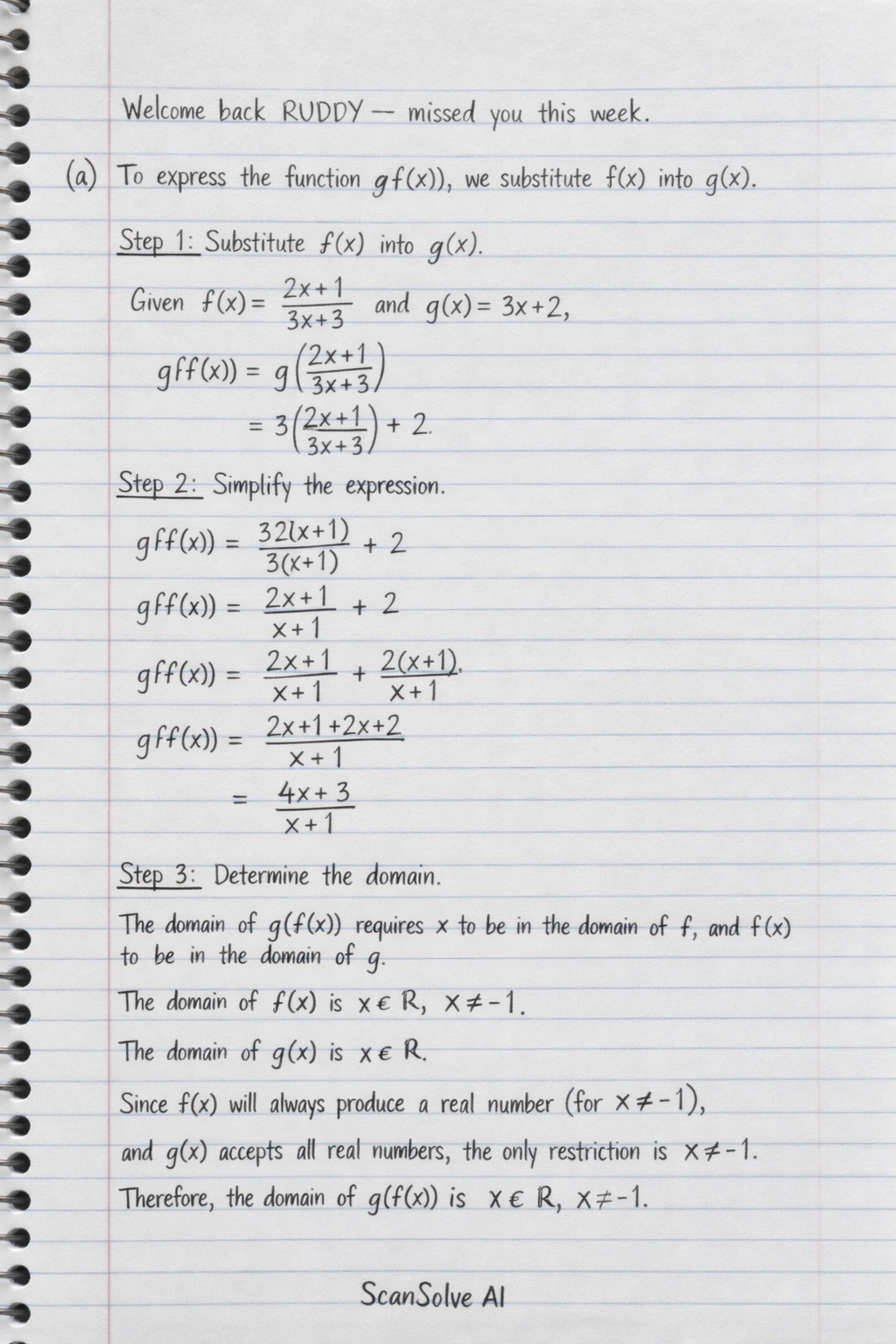
Handwritten Step-by-Step Solution
Get this as a handwritten image on WhatsApp — like a tutor wrote it for you.
Try on WhatsApp