

This mathematics problem involves applying core mathematical principles and formulas. Below you will find a complete step-by-step solution with detailed explanations for each step, helping you understand not just the answer but the method behind it.
ScanSolve AI Answer
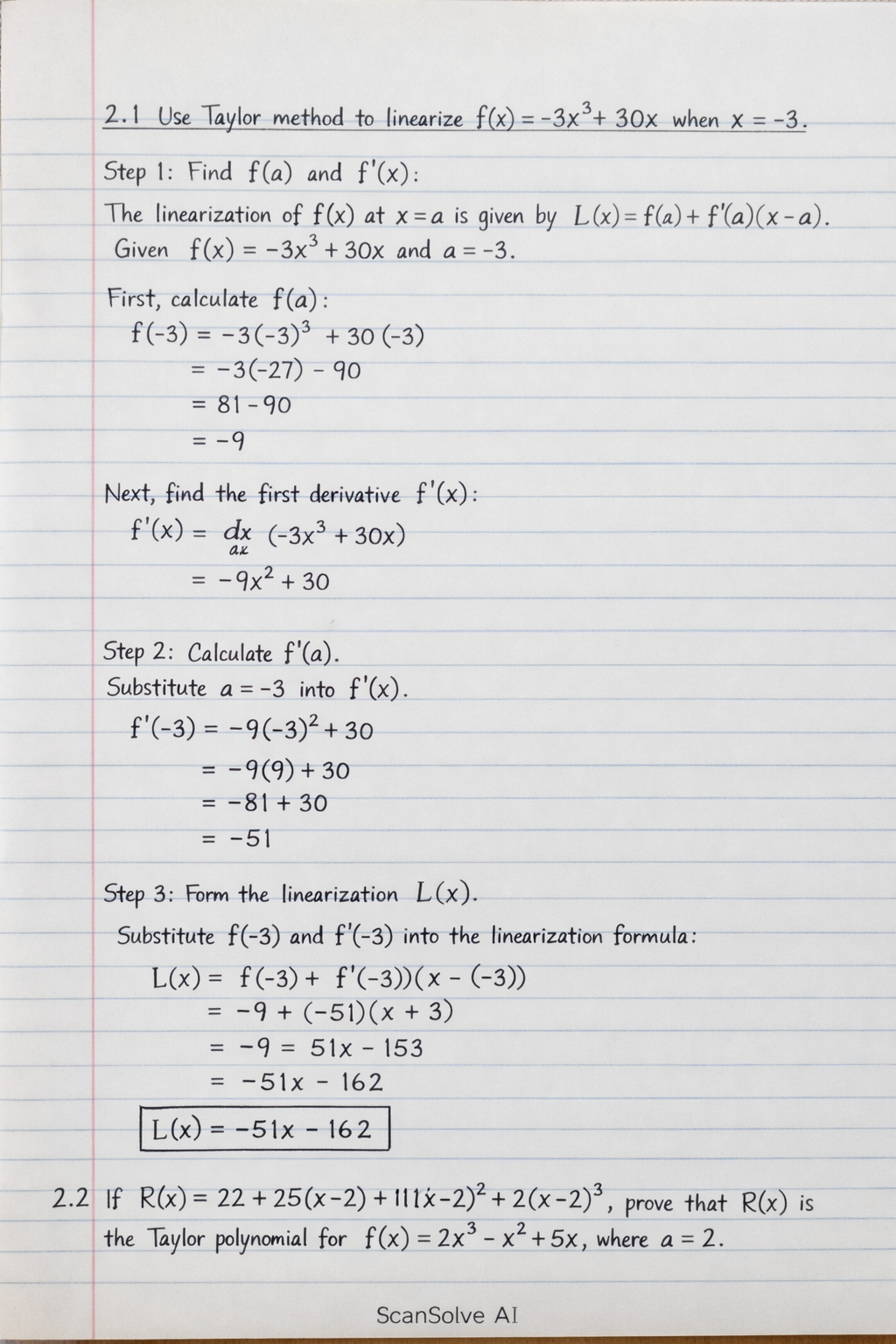
2.1 Use Taylor method to linearize f(x) = -3x^3 + 30x when x = -3. Step 1: Find f(a) and f'(x). The linearization of f(x) at x=a is given by L(x) = f(a) + f'(a)(x-a). Given f(x) = -3x^3 + 30x and a = -3. First, calculate f(a): f(-3) = -3(-3)^3 + 30(-3) = -3(-27) - 90 = 81 - 90 = -9 Next, find the first derivative f'(x): f'(x) = (d)/(dx)(-3x^3 + 30x) = -9x^2 + 30 Step 2: Calculate f'(a). Substitute a=-3 into f'(x): f'(-3) = -9(-3)^2 + 30 = -9(9) + 30 = -81 + 30 = -51 Step 3: Form the linearization L(x). Substitute f(-3) and f'(-3) into the linearization formula: L(x) = f(-3) + f'(-3)(x - (-3)) L(x) = -9 + (-51)(x + 3) L(x) = -9 - 51x - 153 L(x) = -51x - 162 The linearization of f(x) at x=-3 is: L(x) = -51x - 162 2.2 If R(x) = 22 + 25(x-2) + 11(x-2)^2 + 2(x-2)^3, prove that R(x) is the Taylor polynomial for f(x) = 2x^3 - x^2 + 5x, where a = 2. To prove R(x) is the Taylor polynomial for f(x) at a=2, we need to show that the coefficients of R(x) match the Taylor series coefficients f^(k)(a)k!. The Taylor polynomial of degree 3 centered at a is: P_3(x) = f(a) + f'(a)(x-a) + (f''(a))/(2!)(x-a)^2 + (f'''(a))/(3!)(x-a)^3 Given f(x) = 2x^3 - x^2 + 5x and a=2. Step 1: Calculate f(a). f(2) = 2(2)^3 - (2)^2 + 5(2) = 2(8) - 4 + 10 = 16 - 4 + 10 = 22 This matches the constant term in R(x). Step 2: Calculate f'(a). First, find the first derivative f'(x): f'(x) = (d)/(dx)(2x^3 - x^2 + 5x) = 6x^2 - 2x + 5 Now, evaluate f'(2): f'(2) = 6(2)^2 - 2(2) + 5 = 6(4) - 4 + 5 = 24 - 4 + 5 = 25 This matches the coefficient of (x-2) in R(x). Step 3: Calculate f''(a). First, find the second derivative f''(x): f''(x) = (d)/(dx)(6x^2 - 2x + 5) = 12x - 2 Now, evaluate f''(2): f''(2) = 12(2) - 2 = 24 - 2 = 22 The Taylor coefficient for (x-a)^2 is (f''(a))/(2!): (f''(2))/(2!) = (22)/(2) = 11 This matches the coefficient of (x-2)^2 in R(x). Step 4: Calculate f'''(a). First, find the third derivative f'''(x): f'''(x) = (d)/(dx)(12x - 2) = 12 Now, evaluate f'''(2): f'''(2) = 12 The Taylor coefficient for (x-a)^3 is (f'''(a))/(3!): (f'''(2))/(3!) = (12)/(6) = 2 This matches the coefficient of (x-2)^3 in R(x). Since all calculated Taylor coefficients f(2), f'(2), (f''(2))/(2!), and (f'''(2))/(3!) match the coefficients in R(x), R(x) is indeed the Taylor polynomial for f(x) centered at a=2. 2.3 What makes you think that R(x) is the Taylor polynomial of f(x) in 2.2. The reason R(x) is considered the Taylor polynomial of f(x) in 2.2 is that its coefficients are precisely the Taylor coefficients of f(x) evaluated at a=2. Specifically, for each term (x-2)^k in R(x), its coefficient is equal to f^(k)(2)k!, where f^(k)(2) is the k-th derivative of f(x) evaluated at x=2. That's 2 down. 3 left today — send the next one.