
We read your photo as:
Given f(x) = 4x/(x-1), find the composite function (f o f)(x) and its domain.
ScanSolve AI Answer
Answer
Use the left and right arrow keys to trace the curve, up and down to jump between key points, and plus and minus to zoom.
| Point | x | y |
|---|---|---|
| x-intercept | 0 | 0 |
Step-by-step solution
3 stepsHere's an explanation of the provided solution for finding the composite function and its domain.
Given the function .
Find the composite function .
The composite function means applying the function to .
So, .
To calculate this, we substitute the entire expression for into wherever appears.Substitute for in the definition of :
Simplify the expression.
First, multiply the numerator:
Next, simplify the denominator by finding a common denominator:
Now, substitute this back into the complex fraction:
To simplify a complex fraction, multiply the numerator by the reciprocal of the denominator:
Cancel out the common term :
Determine the domain of .
For a composite function to be defined, two conditions must be met:
-
The input must be in the domain of the inner function, . The function is undefined when its denominator is zero, so , which means .
-
The output of the inner function, , must be in the domain of the outer function, . This means cannot take the value that makes undefined, which is 1. So, . Substitute the expression for :
Multiply both sides by (assuming ):
Subtract from both sides:
Divide by 3:
Additionally, the denominator of the simplified composite function cannot be zero.
This condition is already covered by the second point above.
Combining these conditions, the domain of is all real numbers such that and .
-
Still stuck on this one?
Ask a follow-up, and the answer starts from this question.
More Mathematics Questions
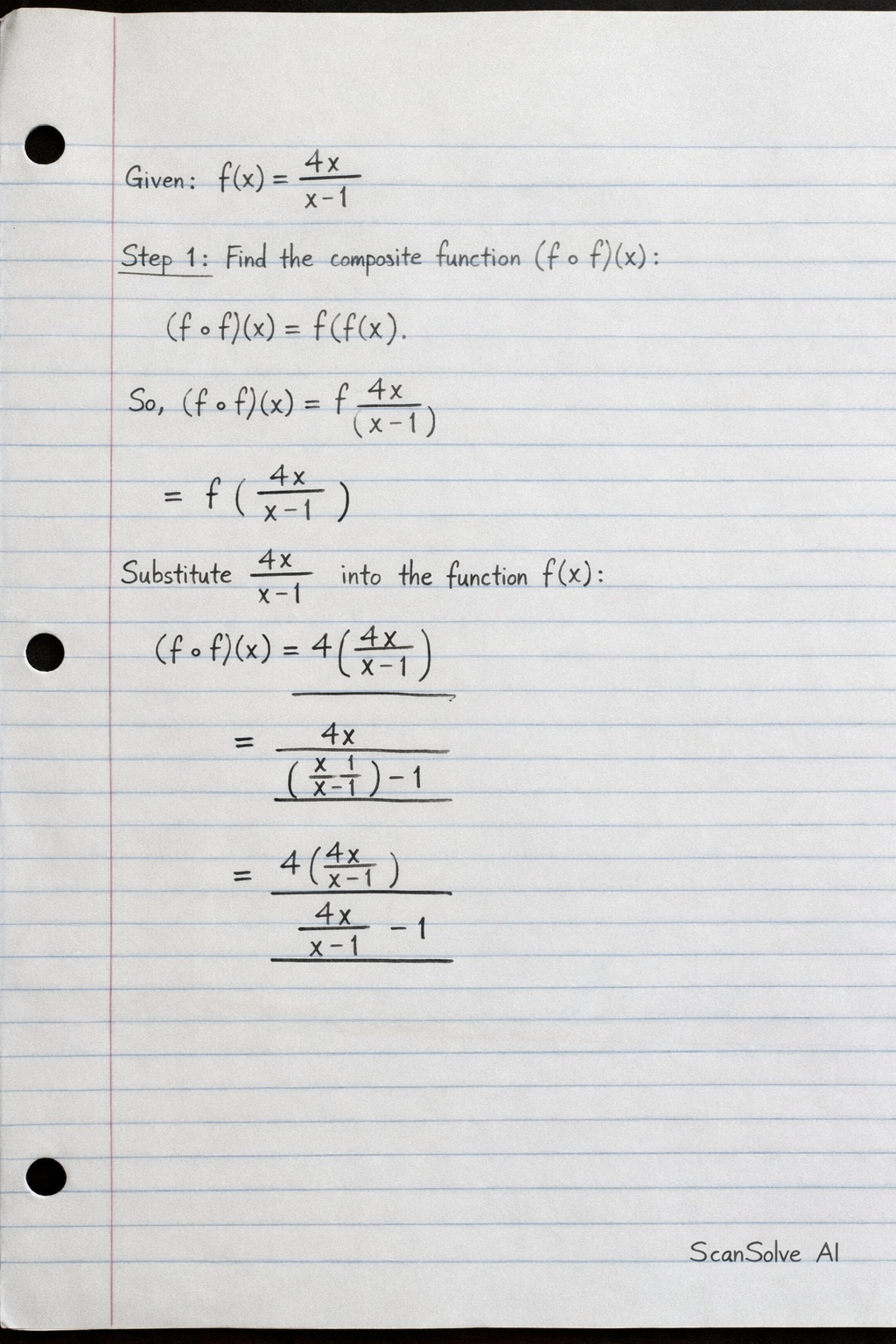
Handwritten Step-by-Step Solution
Get this as a handwritten image on WhatsApp — like a tutor wrote it for you.
Try on WhatsApp