
We read your photo as:
Given f(x) = ax4 + 7x3 + x2 + bx - 3, if (x-1) and (x+1) are factors, find a and b, and then find the set of real values of x for which f(x) > 0.
ScanSolve AI Answer
Answer
Step-by-step solution
4 stepsUse the Factor Theorem to find and .
The polynomial is .
Given that and are factors of , we know that and .For :
For :
Solve the system of linear equations for and .
We have:
Add equation (1) and equation (2):
Substitute into equation (1):
The values of the constants are and .
Find the set of real values of for which .
Substitute and into :
Since and are factors, their product is also a factor.
Perform polynomial long division to find the other factor:So, .
Factor the quadratic term :Thus, the fully factored form of is:
Determine the intervals where .
The roots of are the values of where :
Order the roots on a number line: .
These roots divide the number line into five intervals. We test the sign of in each interval:-
For (e.g., ):
-
For (e.g., ):
-
For (e.g., ):
-
For (e.g., ):
-
For (e.g., ):
We are looking for . This occurs in the intervals , , and .
The set of real values of for which is:-
Try one yourself
A new problem that tests the same skill.
Still stuck on this one?
Ask a follow-up, and the answer starts from this question.
More Mathematics Questions
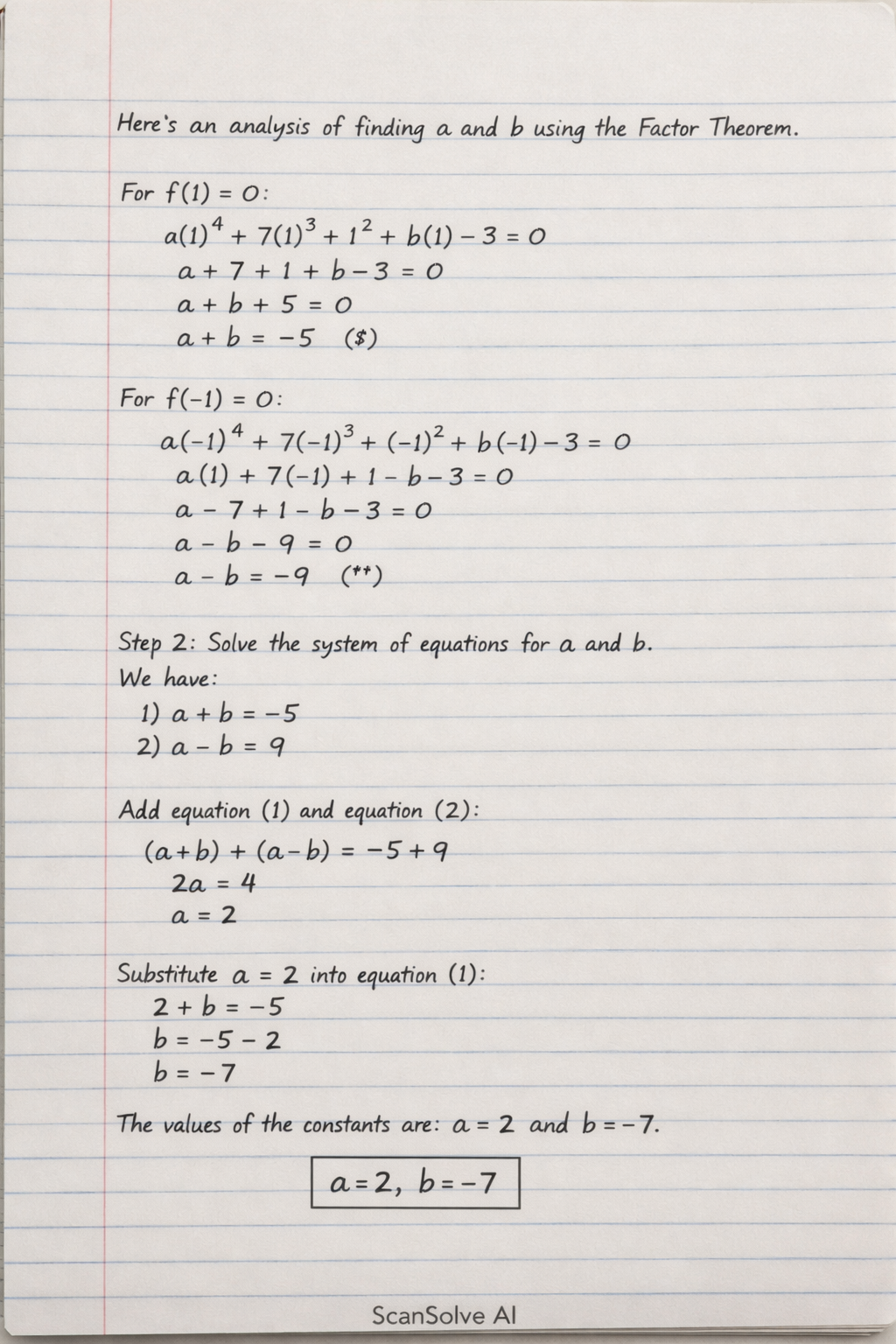
Handwritten Step-by-Step Solution
Get this as a handwritten image on WhatsApp — like a tutor wrote it for you.
Try on WhatsApp