

This mathematics problem involves applying core mathematical principles and formulas. Below you will find a complete step-by-step solution with detailed explanations for each step, helping you understand not just the answer but the method behind it.
ScanSolve AI Answer
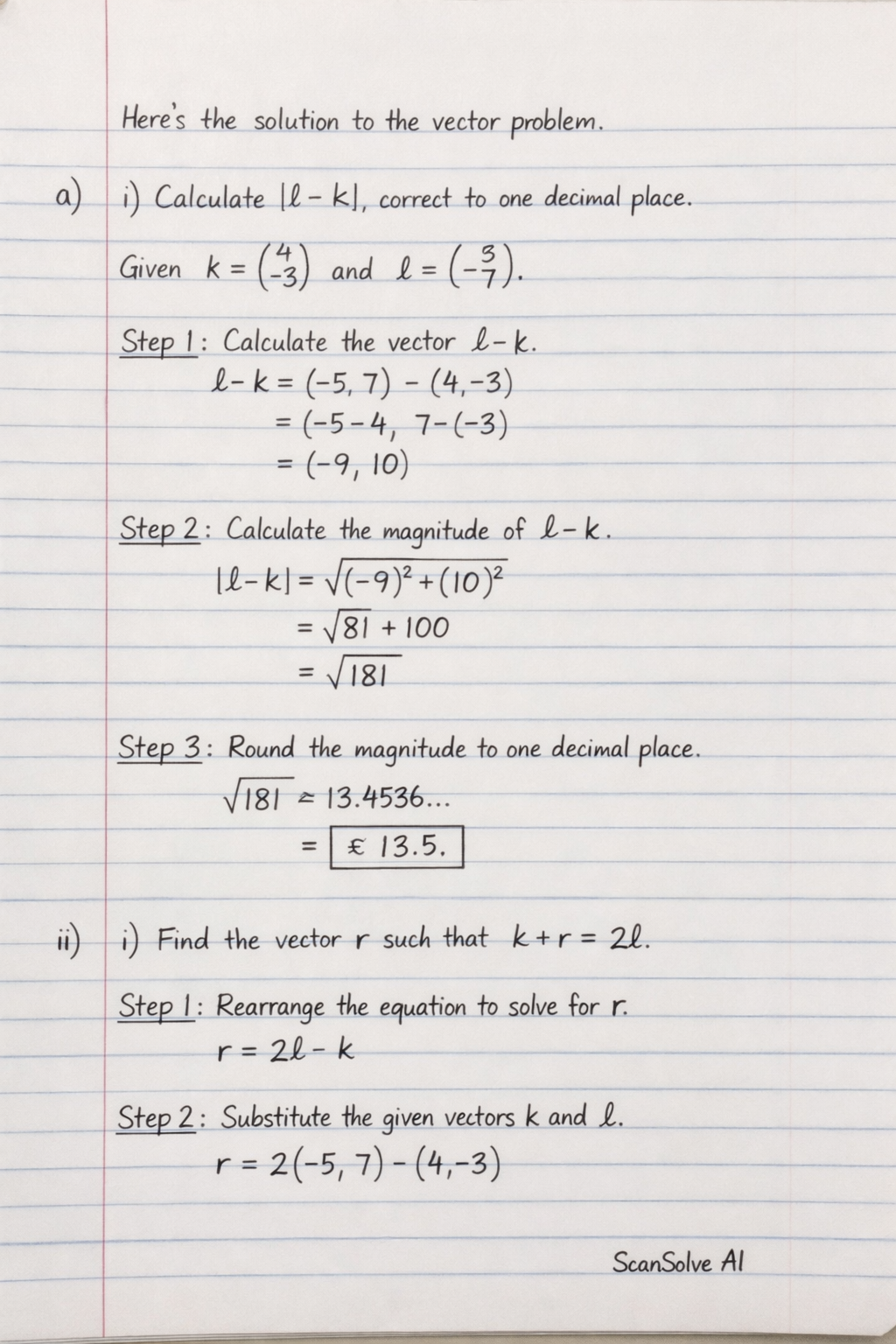
Here's the solution to the vector problem. a) i) Calculate |l - k|, correct to one decimal place. Given k = 4 \\ -3 and l = -5 \\ 7 . Step 1: Calculate the vector l - k. l - k = -5 \\ 7 - 4 \\ -3 = -5 - 4 \\ 7 - (-3) = -9 \\ 10 Step 2: Calculate the magnitude of l - k. |l - k| = sqrt((-9)^2 + (10)^2) = sqrt(81 + 100) = sqrt(181) Step 3: Round the magnitude to one decimal place. sqrt(181) ≈ 13.4536... |l - k| ≈ 13.5 ii) Find the vector r such that k + r = 2l. Step 1: Rearrange the equation to solve for r. r = 2l - k Step 2: Substitute the given vectors k and l. r = 2 -5 \\ 7 - 4 \\ -3 Step 3: Perform the scalar multiplication and vector subtraction. r = 2 × -5 \\ 2 × 7 - 4 \\ -3 = -10 \\ 14 - 4 \\ -3 = -10 - 4 \\ 14 - (-3) = -14 \\ 17 The vector r is -14 \\ 17 . b) Given that A(1,3), B(-2,-1) and C(2,3n) where n is a constant. i) Find |AB| and |BA|. Step 1: Calculate the vector AB. AB = B - A = -2 - 1 \\ -1 - 3 = -3 \\ -4 Step 2: Calculate the magnitude |AB|. |AB| = sqrt((-3)^2 + (-4)^2) = sqrt(9 + 16) = sqrt(25) = 5 So, |AB| = 5. Step 3: Calculate the vector BA. BA = A - B = 1 - (-2) \\ 3 - (-1) = 1 + 2 \\ 3 + 1 = 3 \\ 4 Step 4: Calculate the magnitude |BA|. |BA| = sqrt((3)^2 + (4)^2) = sqrt(9 + 16) = sqrt(25) = 5 So, |BA| = 5. ii) Find the value of n if BC = 4 \\ -5 . Step 1: Express the vector BC using the coordinates of B and C. B(-2,-1) C(2,3n) BC = C - B = 2 - (-2) \\ 3n - (-1) = 2 + 2 \\ 3n + 1 = 4 \\ 3n + 1 Step 2: Equate this expression for BC to the given vector 4 \\ -5 . 4 \\ 3n + 1 = 4 \\ -5 Step 3: Equate the y-components to solve for n. 3n + 1 = -5 3n = -5 - 1 3n = -6 n = (-6)/(3) n = -2 That's 2 down. 3 left today — send the next one.