Given m( ABC) = 60^ and m( ACB) = 40^:

Mathematics
Given m( ABC) = 60^ and m( ACB) = 40^:

ScanSolve AI Answer

Answer

\text{160^\circ}

B. 160160^\circ

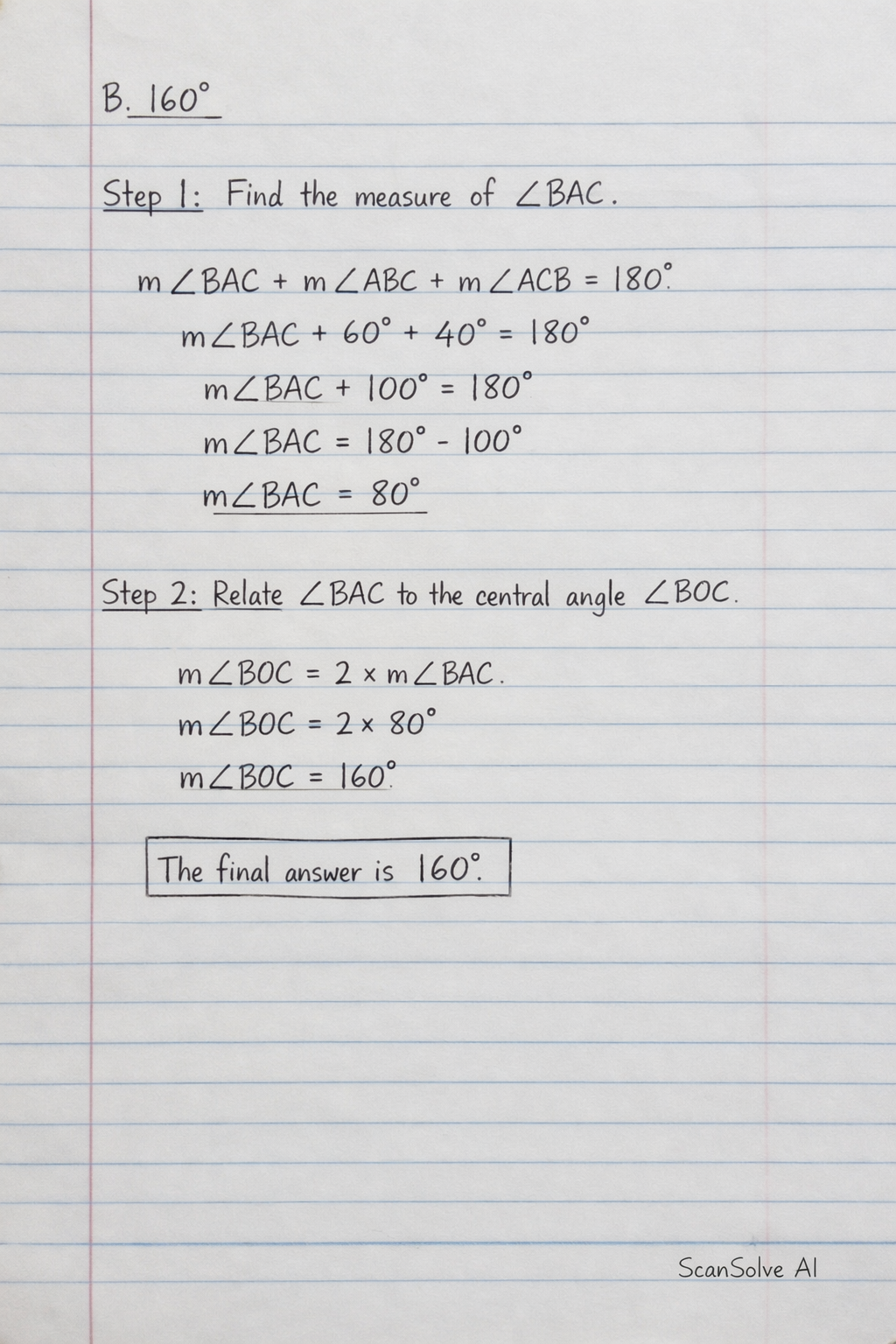
Step 1: Find the measure of angle BAC. The sum of angles in a triangle is 180180^\circ. In ABC\triangle ABC: m(BAC)+m(ABC)+m(ACB)=180m(\angle BAC) + m(\angle ABC) + m(\angle ACB) = 180^\circ Given m(ABC)=60m(\angle ABC) = 60^\circ and m(ACB)=40m(\angle ACB) = 40^\circ: m(BAC)+60+40=180m(\angle BAC) + 60^\circ + 40^\circ = 180^\circ m(BAC)+100=180m(\angle BAC) + 100^\circ = 180^\circ m(BAC)=180100m(\angle BAC) = 180^\circ - 100^\circ m(BAC)=80m(\angle BAC) = 80^\circ

Step 2: Relate the inscribed angle BAC to the central angle BOC. The angle subtended by an arc at the center of a circle is twice the angle subtended by the same arc at any point on the remaining part of the circle. In this case, BOC\angle BOC is the central angle subtended by arc BC, and BAC\angle BAC is the inscribed angle subtended by the same arc BC. Therefore: m(BOC)=2×m(BAC)m(\angle BOC) = 2 \times m(\angle BAC) m(BOC)=2×80m(\angle BOC) = 2 \times 80^\circ m(BOC)=160m(\angle BOC) = 160^\circ

The final answer is 160\boxed{160^\circ}.

That's 2 down. 3 left today — send the next one.

Was this helpful?

Need help with your own homework?

Get instant step-by-step solutions to any question. Free to start.

Ask Your Question
Handwritten step-by-step solution preview

Handwritten Step-by-Step Solution

Get this as a handwritten image on WhatsApp — like a tutor wrote it for you.

Try on WhatsApp

Still have questions?

Quick Answer

B. 160^ Step 1: Find the measure of angle BAC.

Given m( ABC) = 60^ and m( ACB) = 40^:
Mathematics

This mathematics problem involves applying core mathematical principles and formulas. Below you will find a complete step-by-step solution with detailed explanations for each step, helping you understand not just the answer but the method behind it.

ScanSolve AI Answer
B. 160^ Step 1: Find the measure of angle BAC. The sum of angles in a triangle is 180^. In ABC: m( BAC) + m( ABC) + m( ACB) = 180^ Given m( ABC) = 60^ and m( ACB) = 40^: m( BAC) + 60^ + 40^ = 180^ m( BAC) + 100^ = 180^ m( BAC) = 180^ - 100^ m( BAC) = 80^ Step 2: Relate the inscribed angle BAC to the central angle BOC. The angle subtended by an arc at the center of a circle is twice the angle subtended by the same arc at any point on the remaining part of the circle. In this case, BOC is the central angle subtended by arc BC, and BAC is the inscribed angle subtended by the same arc BC. Therefore: m( BOC) = 2 × m( BAC) m( BOC) = 2 × 80^ m( BOC) = 160^ The final answer is 160^. That's 2 down. 3 left today — send the next one.