

This mathematics problem involves applying core mathematical principles and formulas. Below you will find a complete step-by-step solution with detailed explanations for each step, helping you understand not just the answer but the method behind it.
ScanSolve AI Answer
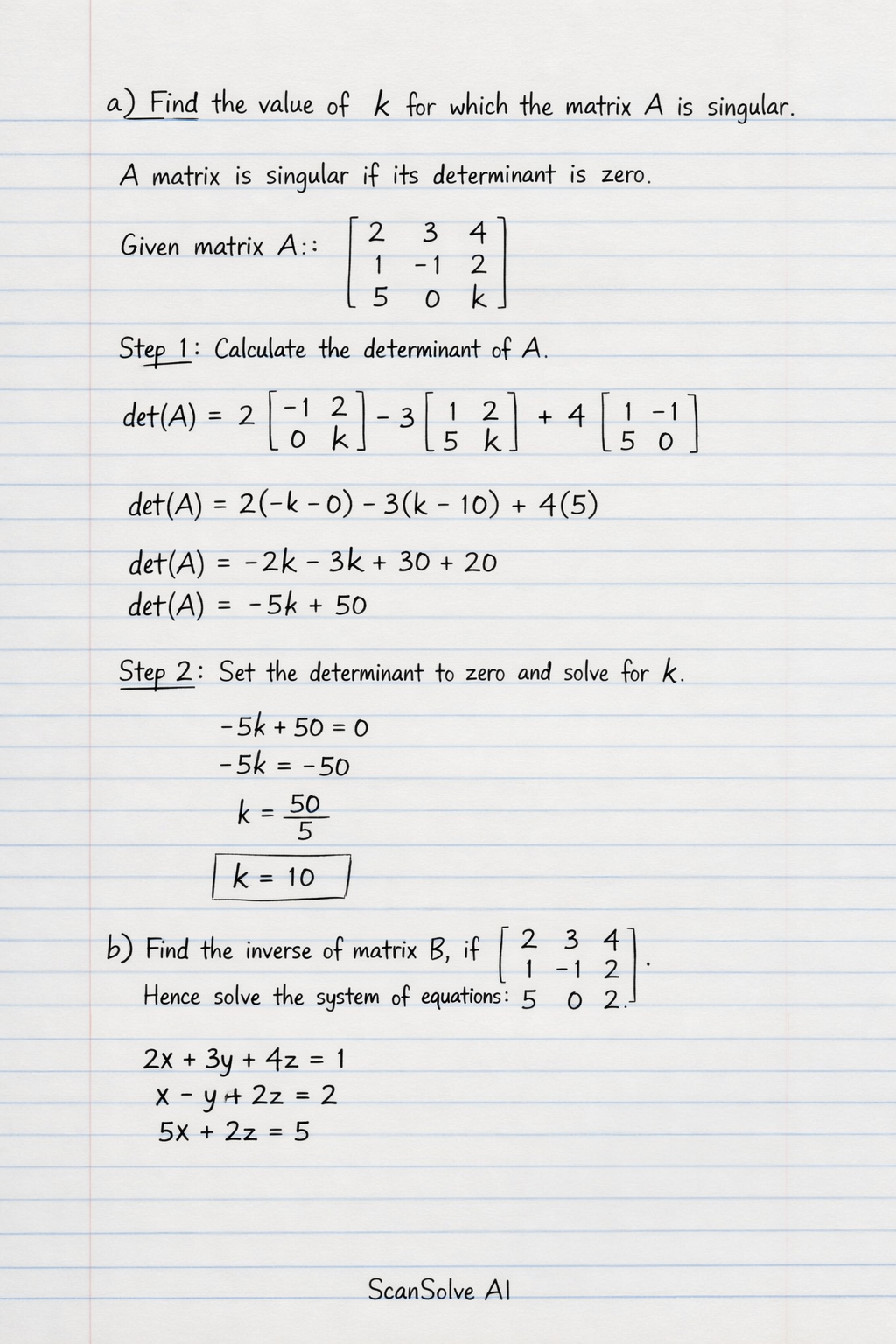
You're on a roll — a) Find the value of the constant k for which the matrix A is singular. A matrix is singular if its determinant is zero. Given matrix A: A = 2 & 3 & 4 \\ 1 & -1 & 2 \\ 5 & 0 & k Step 1: Calculate the determinant of A. (A) = 2 -1 & 2 \\ 0 & k - 3 1 & 2 \\ 5 & k + 4 1 & -1 \\ 5 & 0 (A) = 2((-1)(k) - (2)(0)) - 3((1)(k) - (2)(5)) + 4((1)(0) - (-1)(5)) (A) = 2(-k - 0) - 3(k - 10) + 4(0 - (-5)) (A) = -2k - 3k + 30 + 20 (A) = -5k + 50 Step 2: Set the determinant to zero and solve for k. -5k + 50 = 0 -5k = -50 k = (-50)/(-5) k = 10 k=10 b) Find the inverse of matrix B, if B = 2 & 3 & 4 \\ 1 & -1 & 2 \\ 5 & 0 & 2 . Hence solve the system of equations: 2x + 3y + 4z = 1 x - y + 2z = 2 5x + 2z = 5 Step 1: Calculate the determinant of B. (B) = 2 -1 & 2 \\ 0 & 2 - 3 1 & 2 \\ 5 & 2 + 4 1 & -1 \\ 5 & 0 (B) = 2((-1)(2) - (2)(0)) - 3((1)(2) - (2)(5)) + 4((1)(0) - (-1)(5)) (B) = 2(-2 - 0) - 3(2 - 10) + 4(0 - (-5)) (B) = 2(-2) - 3(-8) + 4(5) (B) = -4 + 24 + 20 (B) = 40 Step 2: Calculate the matrix of cofactors, C. C_11 = -1 & 2 \\ 0 & 2 = -2 C_12 = - 1 & 2 \\ 5 & 2 = -(2 - 10) = 8 C_13 = 1 & -1 \\ 5 & 0 = 0 - (-5) = 5 C_21 = - 3 & 4 \\ 0 & 2 = -(6 - 0) = -6 C_22 = 2 & 4 \\ 5 & 2 = 4 - 20 = -16 C_23 = - 2 & 3 \\ 5 & 0 = -(0 - 15) = 15 C_3