

This mathematics problem involves applying core mathematical principles and formulas. Below you will find a complete step-by-step solution with detailed explanations for each step, helping you understand not just the answer but the method behind it.
ScanSolve AI Answer
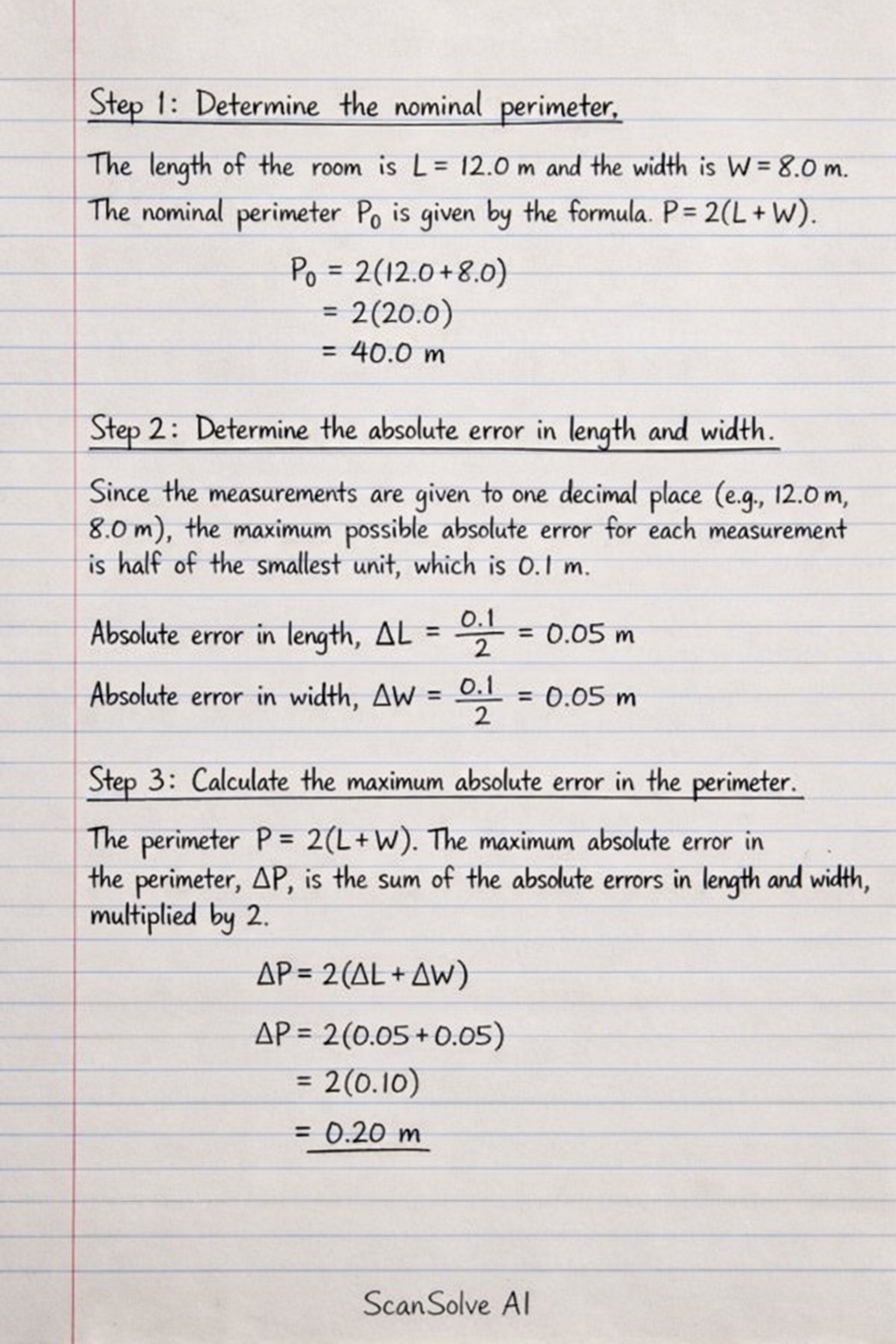
Step 1: Determine the nominal perimeter. The length of the room is L = 12.0 m and the width is W = 8.0 m. The nominal perimeter P_0 is given by the formula P = 2(L + W). P_0 = 2(12.0 + 8.0) = 2(20.0) = 40.0 m Step 2: Determine the absolute error in length and width. Since the measurements are given to one decimal place (e.g., 12.0 m, 8.0 m), the maximum possible absolute error for each measurement is half of the smallest unit, which is 0.1 m. Absolute error in length, L = (0.1)/(2) = 0.05 m. Absolute error in width, W = (0.1)/(2) = 0.05 m. Step 3: Calculate the maximum absolute error in the perimeter. The perimeter P = 2(L + W). The maximum absolute error in the perimeter, P, is the sum of the absolute errors in length and width, multiplied by 2. P = 2( L + W) P = 2(0.05 + 0.05) P = 2(0.10) P = 0.20 m Step 4: Calculate the maximum percentage error. The maximum percentage error is given by the formula: Percentage Error = Maximum Absolute ErrorNominal Value × 100\% Percentage Error = ( P)/(P_0) × 100\% Percentage Error = (0.20)/(40.0) × 100\% Percentage Error = 0.005 × 100\% Percentage Error = 0.5\% The maximum percentage error in estimating the perimeter of the room is 0.5\%. Send me the next one 📸