
We read your photo as:
Identify the given perimeter.
ScanSolve AI Answer
Answers
3 partsStep-by-step solution
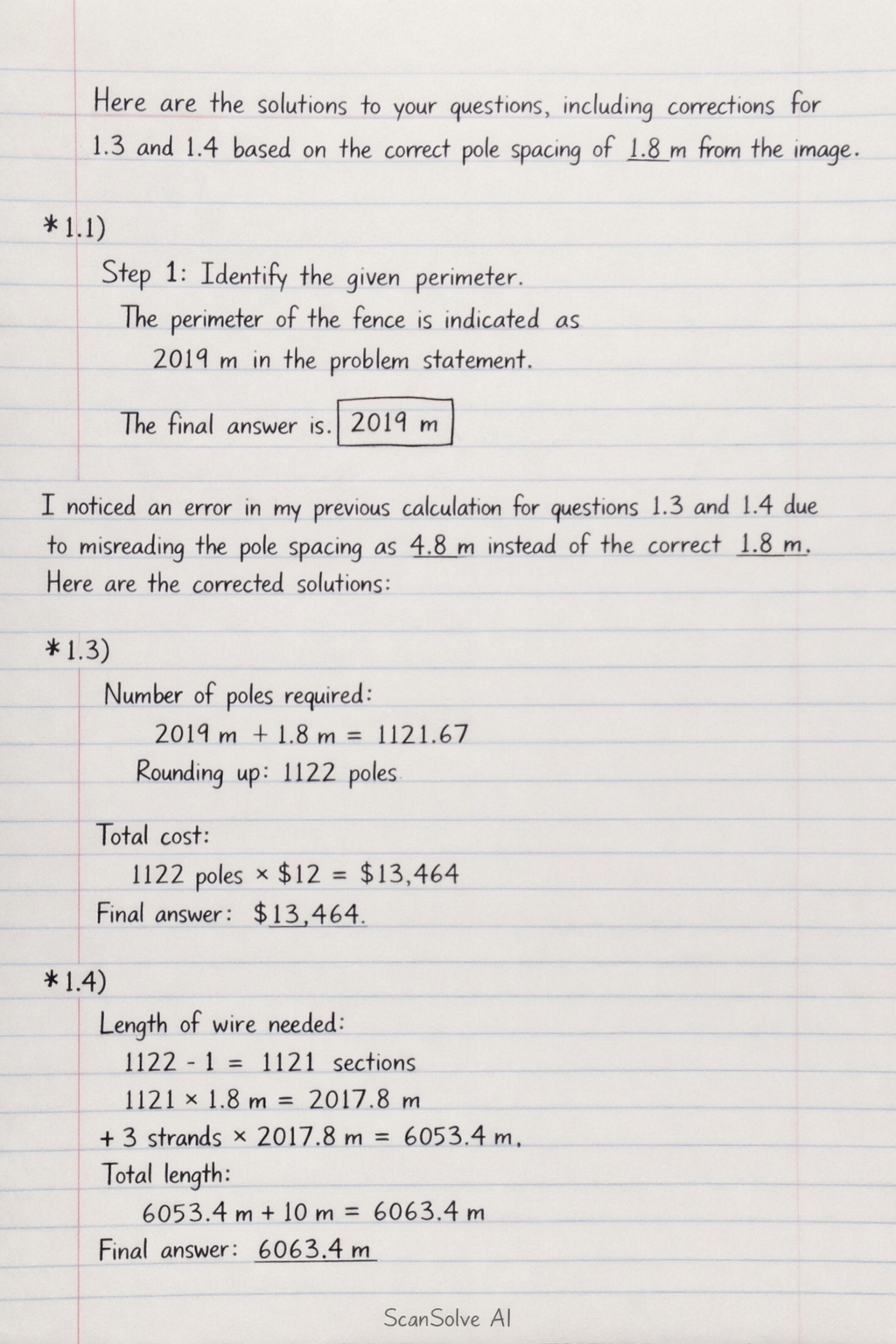
6 stepsHere are the solutions to your questions, including corrections for 1.3 and 1.4 based on the correct pole spacing of from the image.
Part 1.1· 1 step
Identify the given perimeter.
The perimeter of the fence is indicated as in the problem statement.
The final answer is .I noticed an error in my previous calculation for questions 1.3 and 1.4 due to misreading the pole spacing as instead of the correct . Here are the corrected solutions:
Part 1.3
(Corrected)
Calculate the number of intervals for the fence with spacing.
Determine the number of poles.
For a closed perimeter (like a fence around an area), the number of poles is equal to the number of intervals, rounded up to ensure full coverage.
The final answer is .
Part 1.4R93500.00
(Corrected)
Calculate the cost if poles are bought in groups of 6 and individually for the remainder.
Total poles needed: 1122.
Number of groups of 6:Since 1122 is perfectly divisible by 6, 187 groups of 6 poles will be bought, with no individual poles.
Cost for groups: .
Cost for individual poles: .
Total cost (groups + singles): .Calculate the cost if all poles are bought individually.
Compare the costs.
The cost of buying in groups () is less than buying all individually ().
The final answer is .
Try one yourself
A new problem that tests the same skill.
Still stuck on this one?
Ask a follow-up, and the answer starts from this question.
More Mathematics Questions
Handwritten Step-by-Step Solution
Get this as a handwritten image on WhatsApp — like a tutor wrote it for you.
Try on WhatsApp