
We read your photo as:
Show the Development of the truncated cone in the figure (a) below. A Coin of 50mm diameter rolls along a straight path without slippery, trace the path of the coin and assume it to be cycloid.
ScanSolve AI Answer
Step-by-step solution
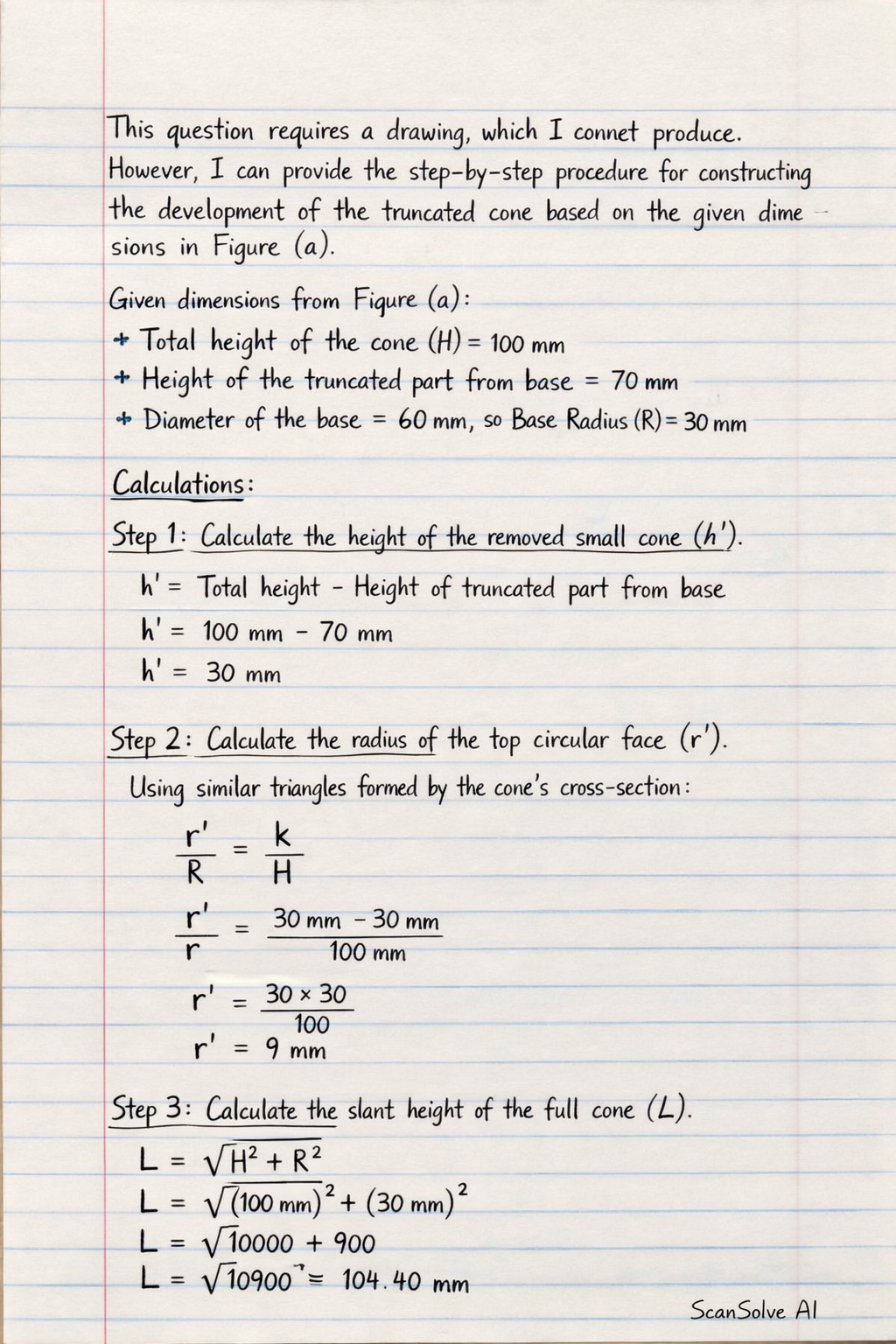
12 stepsThis question requires a drawing, which I cannot produce. However, I can provide the step-by-step procedure for constructing the development of the truncated cone based on the given dimensions in Figure (a).
Given dimensions from Figure (a):
- Total height of the cone (H) =
- Height of the truncated part from the base =
- Diameter of the base = , so Base Radius (R) =
Calculations:
Calculate the height of the removed small cone ().
Calculate the radius of the top circular face ().
Using similar triangles formed by the cone's cross-section:
Calculate the slant height of the full cone (L).
Calculate the slant height of the removed small cone ().
Calculate the slant height of the truncated cone ().
This is the distance from the apex of the full cone to the top edge of the truncated cone.
Calculate the sector angle () for the development of the full cone.
The arc length of the sector is equal to the circumference of the base of the cone (). The radius of the sector is the slant height of the full cone ().
Steps for Construction of the Development:
Draw a point on your drawing sheet, which will represent the apex of the full cone (label it O).
With O as the center, use a compass to draw an arc with a radius equal to the full cone's slant height, .
This arc represents the base circumference of the full cone.
From point O, draw a radial line to any point on the arc.
Using a protractor, measure an angle of from this first radial line and draw a second radial line from O to the arc. The region enclosed by these two radial lines and the arc is the development of the lateral surface of the full cone.
With O as the center, draw another arc with a radius equal to the slant height of the truncated cone, .
This arc will be parallel to the first arc and represents the top edge of the truncated cone.
The area between the arc of radius and the arc of radius , bounded by the two radial lines, is the lateral surface development of the truncated cone.
To complete the development, draw two separate circles
- One circle with radius (representing the base of the truncated cone).
- One circle with radius (representing the top surface of the truncated cone). These circles should be attached to the respective arcs of the developed lateral surface.
Still stuck on this one?
Ask a follow-up, and the answer starts from this question.
More Mathematics Questions
Handwritten Step-by-Step Solution
Get this as a handwritten image on WhatsApp — like a tutor wrote it for you.
Try on WhatsApp