We read your photo as:

OPQR is a rectangle and O is the origin, M is the midpoint of RQ and PT: TQ = 2:1. Find, in terms of p and/or r, in its simplest form (i) MO, (ii) MT, (iii) OT, (iv) MT = (2k/-k) and |MT| = sqrt(180). Find the positive value of k.

Mathematics

ScanSolve AI Answer

Answers

4 parts
a(i)

−r−12p-\mathbf{r} - \frac{1}{2}\mathbf{p}

a(ii)

12p−13r\frac{1}{2}\mathbf{p} - \frac{1}{3}\mathbf{r}

a(iii)

p+23r\mathbf{p} + \frac{2}{3}\mathbf{r}

Step-by-step solution

8 steps

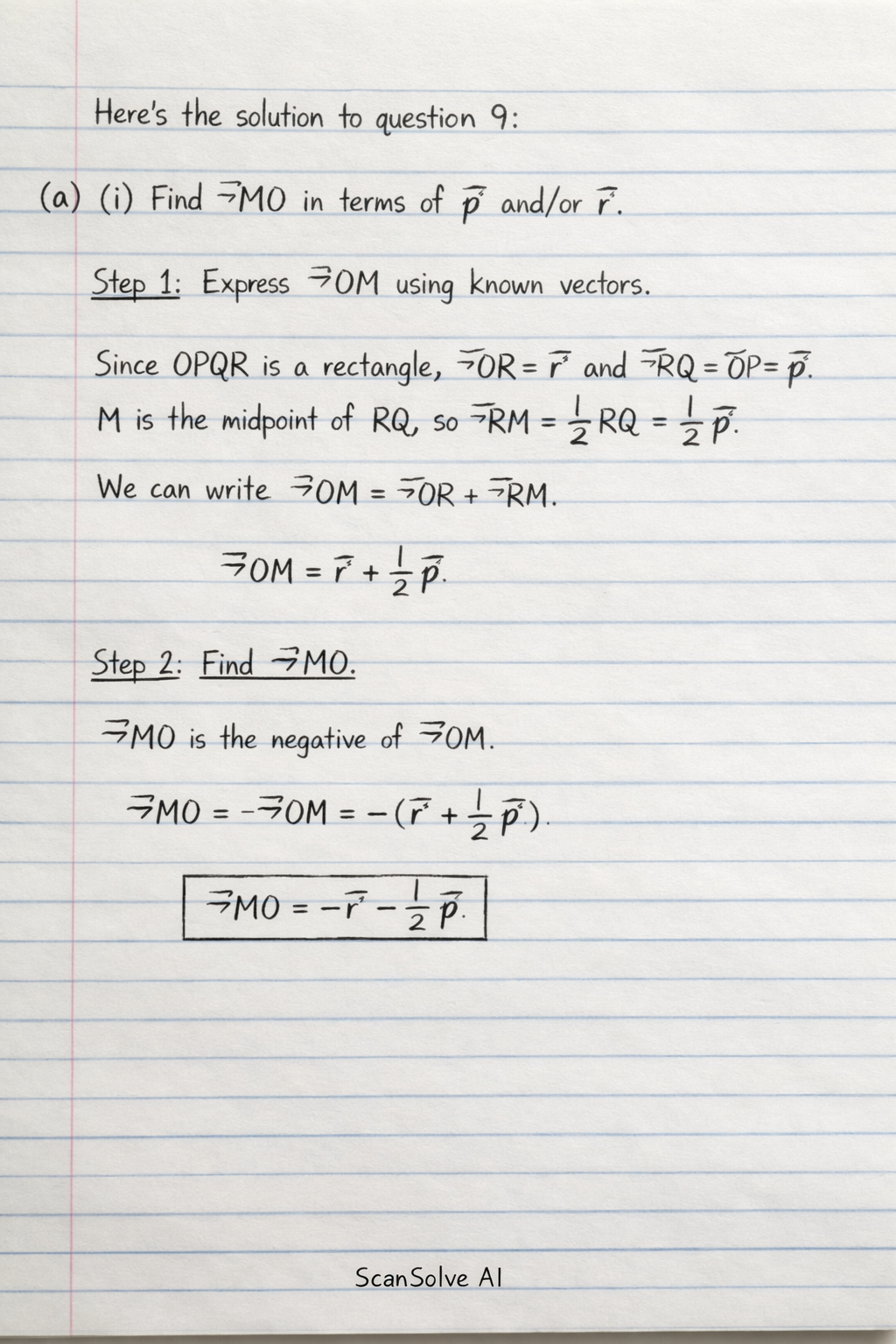
Here's the solution to question 9:

Part a(i)· 2 steps

Find MO⃗\vec{MO} in terms of p\mathbf{p} and/or r\mathbf{r}.

  1. Express OM⃗\vec{OM} using known vectors.

    Since O P Q R is a rectangle, OR⃗=r\vec{OR} = \mathbf{r} and RQ⃗=OP⃗=p\vec{RQ} = \vec{OP} = \mathbf{p}.
    M is the midpoint of RQ, so RM⃗=12RQ⃗=12p\vec{RM} = \frac{1}{2}\vec{RQ} = \frac{1}{2}\mathbf{p}.
    We can write OM⃗=OR⃗+RM⃗\vec{OM} = \vec{OR} + \vec{RM}.

    OM⃗=r+12p\vec{OM} = \mathbf{r} + \frac{1}{2}\mathbf{p}
  2. Find MO⃗\vec{MO}.

    MO⃗\vec{MO} is the negative of OM⃗\vec{OM}.

    MO⃗=−OM⃗=−(r+12p)\vec{MO} = -\vec{OM} = - \left( \mathbf{r} + \frac{1}{2}\mathbf{p} \right) MO⃗=−r−12p\vec{MO} = \boxed{-\mathbf{r} - \frac{1}{2}\mathbf{p}}

Part a(ii)

12p−13r\frac{1}{2}\mathbf{p} - \frac{1}{3}\mathbf{r}

Find MT⃗\vec{MT} in terms of p\mathbf{p} and/or r\mathbf{r}.

  1. Express MT⃗\vec{MT} using known vectors.

    We can write MT⃗=MQ⃗+QT⃗\vec{MT} = \vec{MQ} + \vec{QT}.
    M is the midpoint of RQ, so MQ⃗=12RQ⃗=12p\vec{MQ} = \frac{1}{2}\vec{RQ} = \frac{1}{2}\mathbf{p}.
    Given PT : TQ = 2 : 1, this means QT⃗=13QP⃗\vec{QT} = \frac{1}{3}\vec{QP}.
    Since O P Q R is a rectangle, QP⃗=−PQ⃗=−OR⃗=−r\vec{QP} = -\vec{PQ} = -\vec{OR} = -\mathbf{r}.
    So, QT⃗=13(−r)=−13r\vec{QT} = \frac{1}{3}(-\mathbf{r}) = -\frac{1}{3}\mathbf{r}.

  2. Substitute the expressions for MQ⃗\vec{MQ} and QT⃗\vec{QT}.

    MT⃗=12p+(−13r)\vec{MT} = \frac{1}{2}\mathbf{p} + \left(-\frac{1}{3}\mathbf{r}\right) MT⃗=12p−13r\vec{MT} = \boxed{\frac{1}{2}\mathbf{p} - \frac{1}{3}\mathbf{r}}

Part a(iii)

p+23r\mathbf{p} + \frac{2}{3}\mathbf{r}

Find OT⃗\vec{OT} in terms of p\mathbf{p} and/or r\mathbf{r}.

  1. Express OT⃗\vec{OT} using known vectors.

    We can write OT⃗=OP⃗+PT⃗\vec{OT} = \vec{OP} + \vec{PT}.
    Given OP⃗=p\vec{OP} = \mathbf{p}.
    Given PT : TQ = 2 : 1, this means PT⃗=23PQ⃗\vec{PT} = \frac{2}{3}\vec{PQ}.
    Since O P Q R is a rectangle, PQ⃗=OR⃗=r\vec{PQ} = \vec{OR} = \mathbf{r}.
    So, PT⃗=23r\vec{PT} = \frac{2}{3}\mathbf{r}.

  2. Substitute the expressions for OP⃗\vec{OP} and PT⃗\vec{PT}.

    OT⃗=p+23r\vec{OT} = \mathbf{p} + \frac{2}{3}\mathbf{r} OT⃗=p+23r\vec{OT} = \boxed{\mathbf{p} + \frac{2}{3}\mathbf{r}}

Part a(iv)6

Given MT⃗=(2k−k)\vec{MT} = \begin{pmatrix} 2k \\ -k \end{pmatrix} and ∣MT⃗∣=180|\vec{MT}| = \sqrt{180}. Find the positive value of kk.

  1. Use the formula for the magnitude of a vector.

    The magnitude of a vector (xy)\begin{pmatrix} x \\ y \end{pmatrix} is x2+y2\sqrt{x^2 + y^2}.
    For MT⃗=(2k−k)\vec{MT} = \begin{pmatrix} 2k \\ -k \end{pmatrix}, its magnitude is:

    ∣MT⃗∣=(2k)2+(−k)2|\vec{MT}| = \sqrt{(2k)^2 + (-k)^2} ∣MT⃗∣=4k2+k2|\vec{MT}| = \sqrt{4k^2 + k^2} ∣MT⃗∣=5k2|\vec{MT}| = \sqrt{5k^2}
  2. Set the magnitude equal to the given value and solve for kk.

    We are given ∣MT⃗∣=180|\vec{MT}| = \sqrt{180}.

    5k2=180\sqrt{5k^2} = \sqrt{180}

    Square both sides of the equation:

    5k2=1805k^2 = 180 k2=1805k^2 = \frac{180}{5} k2=36k^2 = 36

    Take the square root of both sides:

    k=±36k = \pm\sqrt{36} k=±6k = \pm 6

    The question asks for the positive value of kk.

    k=6k = \boxed{6}
Was this helpful?

Still stuck on this one?

Ask a follow-up, and the answer starts from this question.

Got a different question?Ask your own question
Handwritten step-by-step solution preview

Handwritten Step-by-Step Solution

Get this as a handwritten image on WhatsApp — like a tutor wrote it for you.

Try on WhatsApp