
We read your photo as:
PQRS is a cyclic quadrilateral. TPX is a tangent. RQX is a straight line. RPQ = 50^ . PRS = 25^ . If PQ = RS, find PRQ.
ScanSolve AI Answer
Answers
5 partsStep-by-step solution
7 stepsHere's the solution for the geometry problem.
Given:
- PQRS is a cyclic quadrilateral.
- TPX is a tangent to the circle at P.
- O is the centre of the circle.
- RQX is a straight line.
- .
- .
Part a· 2 steps
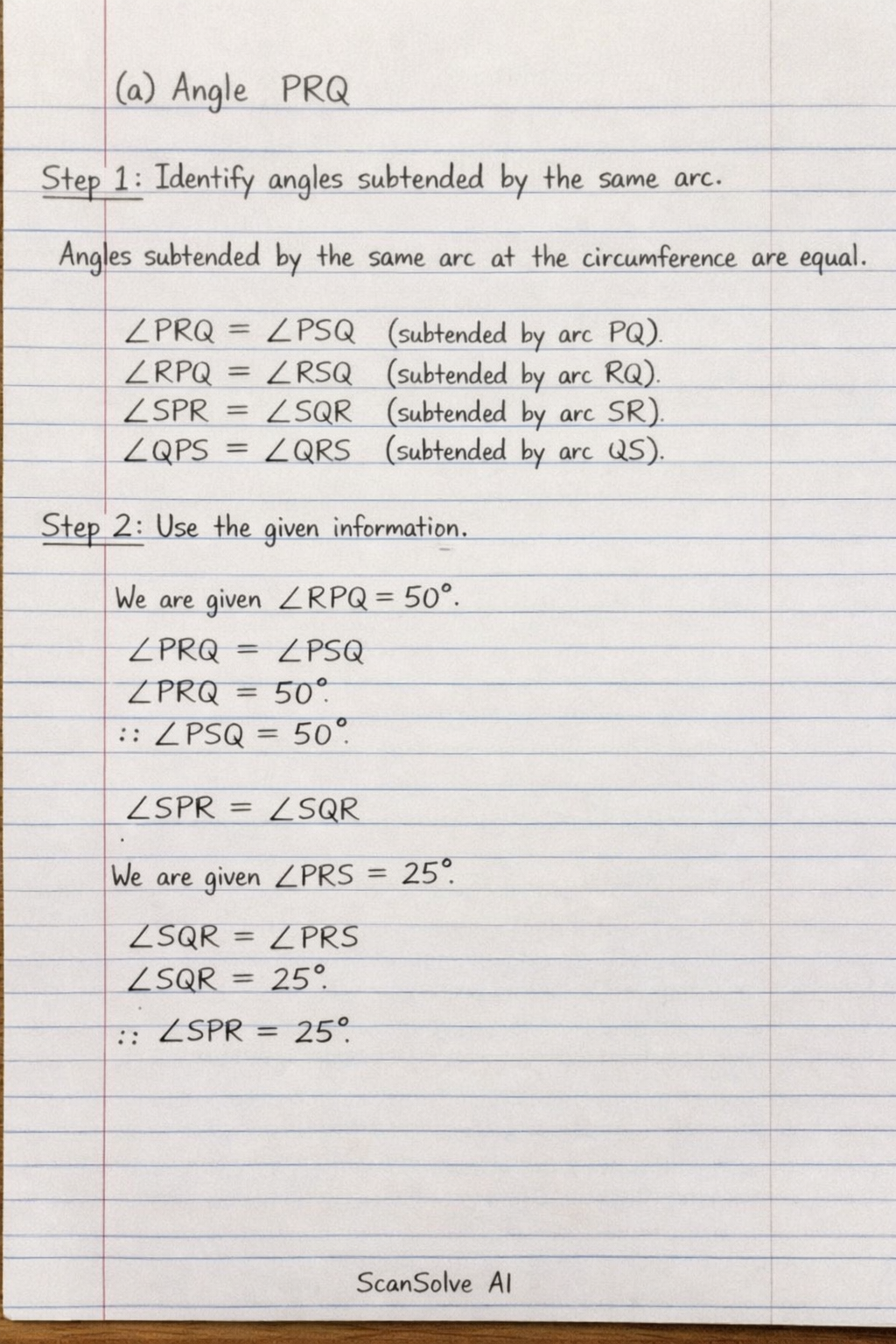
Angle PRQ
Identify angles subtended by the same arc.
Angles subtended by the same arc at the circumference are equal.
and are subtended by arc PQ.
and are subtended by arc RQ.
and are subtended by arc SR.
and are subtended by arc QS.Use the given information.
We are given .
and are subtended by arc PQ.
and are subtended by arc SR.
We are given .Consider . The sum of angles in a triangle is .
We need to find . We know .
We also know that (angles subtended by arc QS).
And (opposite angles of a cyclic quadrilateral).Let's re-examine the diagram and given values.
The diagram shows and .
The markings on the chords PQ and RS indicate that PQ = RS.
If PQ = RS, then the angles subtended by these chords at the circumference are equal.
So, .
Also, (angles subtended by arc PQ).
And (angles subtended by arc RS).Since PQ = RS, the arcs PQ and RS are equal.
Therefore, the angles subtended by these arcs at the circumference are equal.
.
We are given and .
In , we have .
In , we have .Let's use the property that angles subtended by the same arc are equal.
is subtended by arc PQ.
is subtended by arc PQ.
So, .We are given .
We are given .
From the diagram, the chords PQ and RS are marked as equal.
If chords PQ and RS are equal, then the angles they subtend at the circumference are equal.
So, .
Also, .
And .Since PQ = RS, then .
In , we have .
In , we have .Let's use the fact that (angles subtended by the same arc PQ).
Also, (angles subtended by the same arc RS).
Since PQ = RS, then .
So, .We know .
We also know .
Since PQRS is a cyclic quadrilateral, .
So, .
.Since PQ = RS, then .
Let . Then .
In , .
.
.In , .
.
.Since PQRS is a cyclic quadrilateral, .
.
.
.
.
.So, .
Reason: Angles subtended by equal chords (PQ and RS) are equal, and opposite angles of a cyclic quadrilateral sum to .
Part b
Angle PSR
Use the result from part (a).
From part (a), we found .
We also established that .
Substitute :
.
Reason: Opposite angles of a cyclic quadrilateral sum to .
Alternatively, .
We know .
.
Part c
Angle PXQ
Identify the relevant triangle.
Consider . We need to find .
We know .
We know RQX is a straight line.
(from part b calculation).
So, (angles on a straight line).Use the sum of angles in .
In , .
We need .
TPX is a tangent at P.
is the angle between the tangent PX and the chord PQ.
By the Alternate Segment Theorem, .
From part (a), .
So, .Now substitute the known angles into the sum of angles for :
.
.
.
Reason: Alternate Segment Theorem and sum of angles in a triangle.
Part d
Angle TPS
Apply the Alternate Segment Theorem.
is the angle between the tangent TP and the chord PS.
By the Alternate Segment Theorem, .
We are given .
Reason: Alternate Segment Theorem.
Part e
Angle POS
Relate the angle at the centre to the angle at the circumference.
is the angle subtended by arc PS at the centre O.
is the angle subtended by arc PS at the circumference.
The angle at the centre is twice the angle at the circumference subtended by the same arc.
So, .
We are given .
.
Reason: Angle at the centre is twice the angle at the circumference.
Try one yourself
A new problem that tests the same skill.
Still stuck on this one?
Ask a follow-up, and the answer starts from this question.
More Mathematics Questions
Handwritten Step-by-Step Solution
Get this as a handwritten image on WhatsApp — like a tutor wrote it for you.
Try on WhatsApp