
We read your photo as:
If D is any point on the side BC of a triangle ABC, then
ScanSolve AI Answer
Answer
Step-by-step solution
6 stepsUnderstand the Triangle Inequality Theorem.
The Triangle Inequality Theorem states that the sum of the lengths of any two sides of a triangle must be greater than the length of the third side.
Apply the theorem to .
In , the sides are AB, BD, and AD. According to the triangle inequality:
Apply the theorem to .
In , the sides are AC, CD, and AD. According to the triangle inequality:
Combine the inequalities.
Add Equation 1 and Equation 2:
Substitute BC into the inequality.
Since D is a point on the side BC, we know that . Substitute this into the combined inequality:
This can also be written as .
Compare with the given options.
The derived inequality matches the first option.
Try one yourself
A new problem that tests the same skill.
Still stuck on this one?
Ask a follow-up, and the answer starts from this question.
More Mathematics Questions
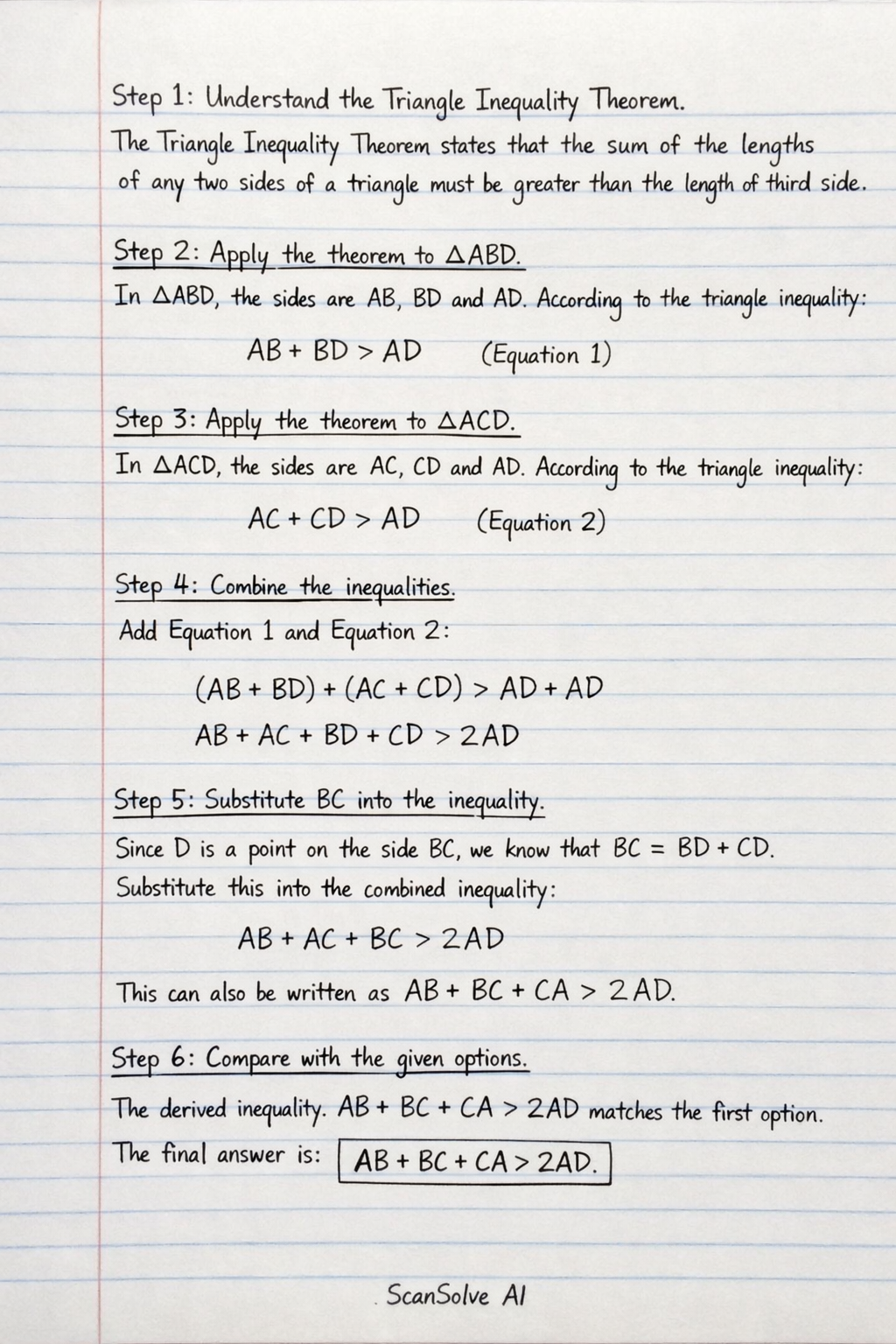
Handwritten Step-by-Step Solution
Get this as a handwritten image on WhatsApp — like a tutor wrote it for you.
Try on WhatsApp