
We read your photo as:
In a circle with center O, angle QOR = 146 degrees and angle QRT = 52 degrees, where RT is a tangent. Find angles QPR, QTR, and OQR.
ScanSolve AI Answer
Answer
Step-by-step solution
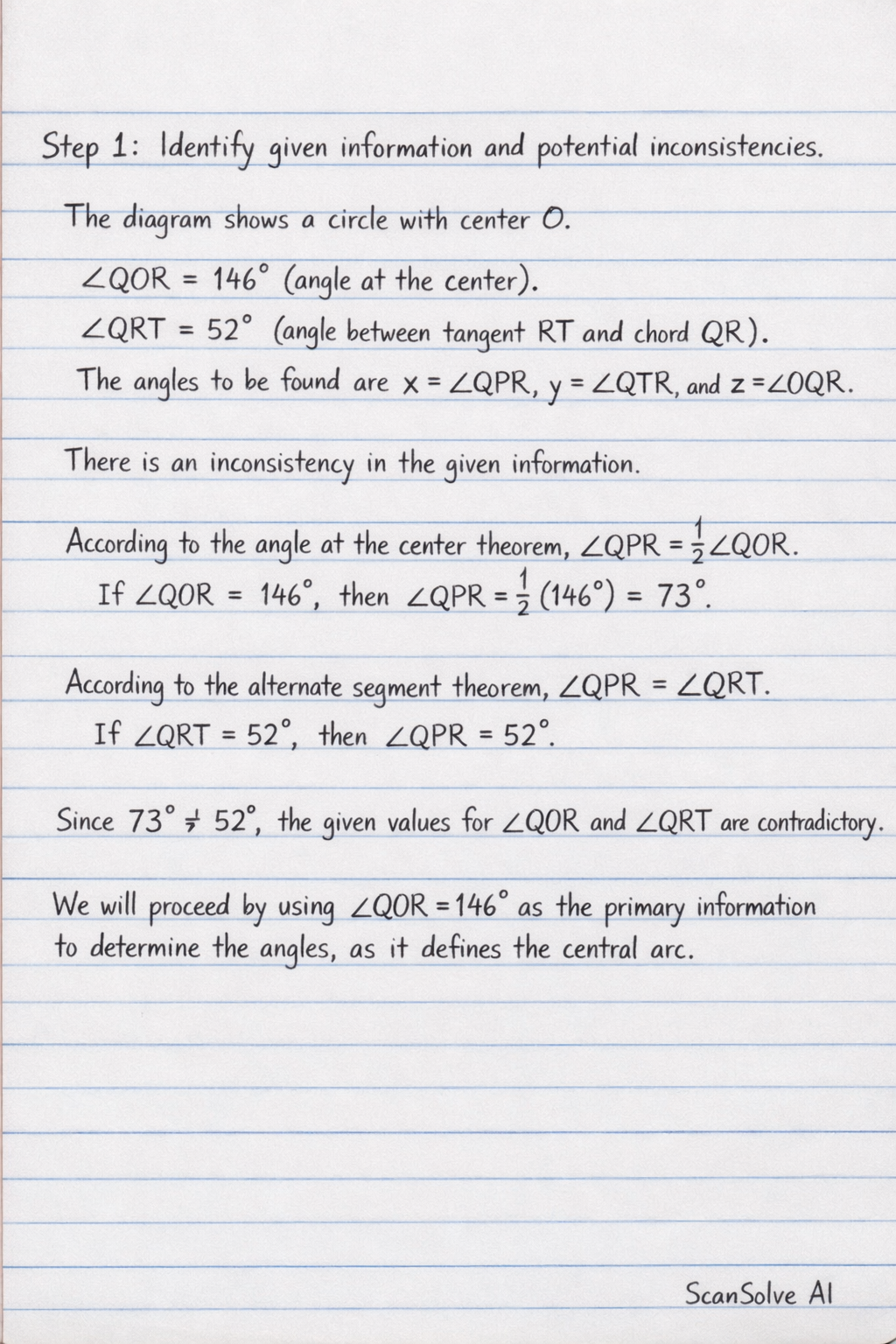
4 stepsIdentify given information and potential inconsistencies.
The diagram shows a circle with center .
(angle at the center).
(angle between tangent and chord ).
The angles to be found are , , and .There is an inconsistency in the given information.
According to the angle at the center theorem, . If , then .
According to the alternate segment theorem, . If , then .
Since , the given values for and are contradictory.
We will proceed by using as the primary information to determine the angles, as it defines the central arc.Calculate ().
The angle at the center is twice the angle at the circumference subtended by the same arc .
Reason: Angle at the center is twice the angle at the circumference.
Calculate ().
and are radii of the circle, so .
Therefore, is an isosceles triangle.
The base angles of an isosceles triangle are equal: .
The sum of angles in a triangle is .Reason: Base angles of an isosceles triangle are equal; sum of angles in a triangle is .
Calculate ().
is a radius and is a tangent at point . A radius is perpendicular to the tangent at the point of tangency.
Similarly, is a radius and is a tangent at point .
Consider the quadrilateral . The sum of interior angles in a quadrilateral is .
Reason: Radius is perpendicular to tangent at the point of contact; sum of angles in a quadrilateral is .
The angles marked with letters are:
Try one yourself
A new problem that tests the same skill.
Still stuck on this one?
Ask a follow-up, and the answer starts from this question.
More Mathematics Questions
Handwritten Step-by-Step Solution
Get this as a handwritten image on WhatsApp — like a tutor wrote it for you.
Try on WhatsApp