
We read your photo as:
Which of the following fractions is closest to 0?
ScanSolve AI Answer
Answer
Step-by-step solution
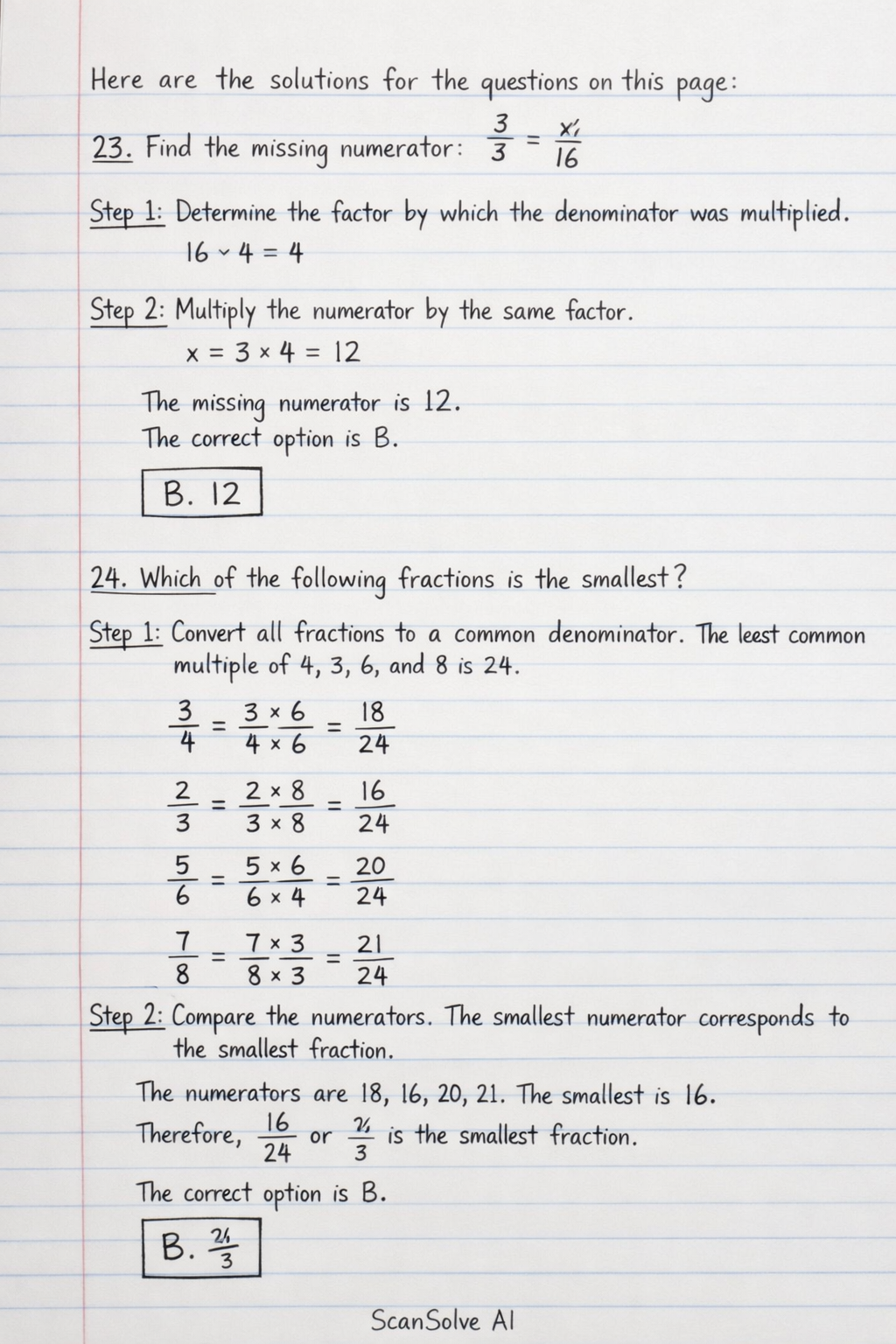
15 stepsHere are the solutions for the questions on this page:
23. Find the missing numerator:
Determine the factor by which the denominator was multiplied.
Multiply the numerator by the same factor.
The missing numerator is 12.
The correct option is B.24. Which of the following fractions is the smallest?
Convert all fractions to a common denominator.
The least common multiple of 4, 3, 6, and 8 is 24.
Compare the numerators.
The smallest numerator corresponds to the smallest fraction.
The numerators are 18, 16, 20, 21. The smallest is 16.
Therefore, or is the smallest fraction.
The correct option is B.25. When the parts of the whole are unevenly divided, they do not form fractions.
Fractions represent parts of a whole that has been divided into equal parts. If the parts are unevenly divided, they do not represent fractions in the mathematical sense.
The statement is True.
The correct option is B.26. Which of the following is a common misconception about place value?
A common misconception about place value is misinterpreting the role or value of zero, for example, thinking that in the number 10, the 0 doesn't hold a place value or that it just means "nothing" without understanding its positional significance.
The correct option is A.27. When teaching HCF, which of the following strategies is effective?
To find the Highest Common Factor (HCF), one needs to identify the factors of numbers, especially their prime factors. Visual aids like factor trees are very effective in breaking down numbers into their prime factors, making it easier to identify common factors and thus the HCF.
The correct option is B.28. What is the product of and ?
To find the product of two fractions, multiply the numerators together and the denominators together.
Perform the multiplication.
The product is .
The correct option is A.29. Which of the following numbers is a prime number?
A prime number is a natural number greater than 1 that has no positive divisors other than 1 and itself.
- A. 51: . Not prime.
- B. 57: . Not prime.
- C. 61: 61 is not divisible by 2, 3, 5, or 7. Since , we only need to check prime divisors up to 7. Thus, 61 is a prime number.
- D. 69: . Not prime. The correct option is C.
30. A student scored 72 out of 90 on a test. What is the student's score as a percentage?
Write the score as a fraction.
Convert the fraction to a percentage by multiplying by 100%.
The student's score is 80%.
The correct option is B.31. The sum of and is
Find the least common multiple (LCM) of the denominators 12 and 18.
The multiples of 12 are 12, 24, 36, 48, ...
The multiples of 18 are 18, 36, 54, ...
The LCM is 36.Convert each fraction to an equivalent fraction with a denominator of 36.
Add the fractions.
The sum is .
The correct option is C.32. Which of the following fractions is closest to 0?
To find which positive fraction is closest to 0, we need to find the fraction with the smallest value. For fractions with a numerator of 1, the fraction with the largest denominator will have the smallest value.
Comparing the denominators: 10, 8, 5, 4. The largest denominator is 10.
Therefore, is the smallest fraction and thus closest to 0.
Alternatively, convert to decimals:- A.
- B.
- C.
- D. The smallest decimal value is 0.1. The correct option is A.
33. What is 20% of 150?
Convert the percentage to a decimal or fraction.
Multiply the decimal by 150.
20% of 150 is 30.
The correct option is B.34. A student answered 84% of the questions correctly on a test. If there were 50 questions, how many did the student answer correctly?
Convert the percentage to a decimal.
Multiply the decimal by the total number of questions.
The student answered 42 questions correctly.
The correct option is B.
Try one yourself
A new problem that tests the same skill.
Still stuck on this one?
Ask a follow-up, and the answer starts from this question.
More Mathematics Questions
Handwritten Step-by-Step Solution
Get this as a handwritten image on WhatsApp — like a tutor wrote it for you.
Try on WhatsApp