We read your photo as:

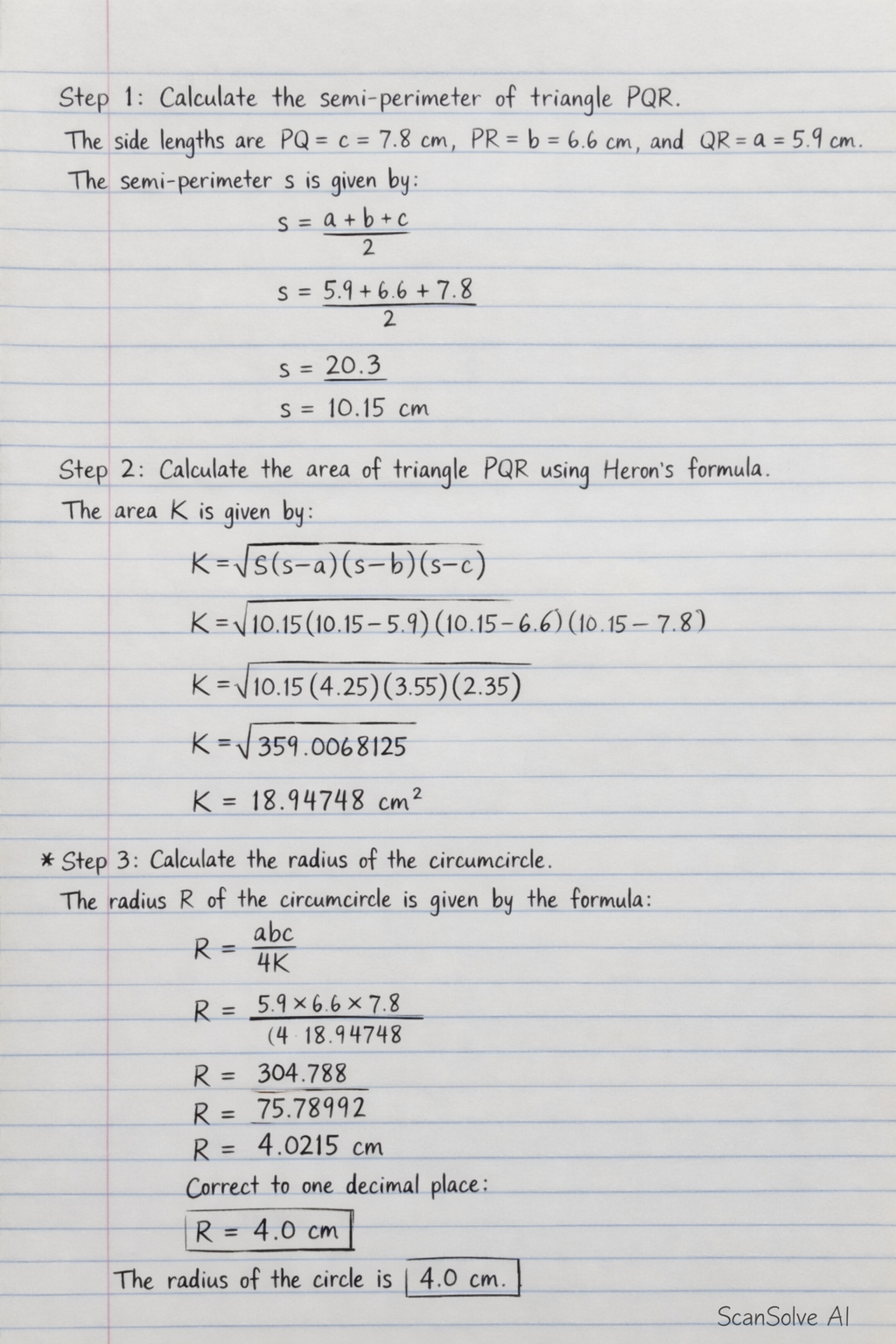
Calculate the semi-perimeter of triangle PQR.

Mathematics

ScanSolve AI Answer

Answers

2 parts
a

4.0 cm4.0 \text{ cm}

b

P≈47.5∘,Q≈55.5∘,R≈77.0∘P \approx 47.5^\circ, Q \approx 55.5^\circ, R \approx 77.0^\circ

Step-by-step solution

2 steps
  1. Calculate the semi-perimeter of triangle PQR.

    The side lengths are PQ=c=7.8PQ = c = 7.8 cm, PR=b=6.6PR = b = 6.6 cm, and QR=a=5.9QR = a = 5.9 cm.
    The semi-perimeter ss is given by:

    s=a+b+c2s = \frac{a+b+c}{2} s=5.9+6.6+7.82s = \frac{5.9 + 6.6 + 7.8}{2} s=20.32s = \frac{20.3}{2} s=10.15 cms = 10.15 \text{ cm}
  2. Calculate the area of triangle PQR using Heron's formula.

    The area KK is given by:

    K=s(s−a)(s−b)(s−c)K = \sqrt{s(s-a)(s-b)(s-c)} K=10.15(10.15−5.9)(10.15−6.6)(10.15−7.8)K = \sqrt{10.15(10.15-5.9)(10.15-6.6)(10.15-7.8)} K=10.15(4.25)(3.55)(2.35)K = \sqrt{10.15(4.25)(3.55)(2.35)} K=359.0068125K = \sqrt{359.0068125} K≈18.94748 cm2K \approx 18.94748 \text{ cm}^2

    a) Step 3: Calculate the radius of the circumcircle.
    The radius RR of the circumcircle is given by the formula:

    R=abc4KR = \frac{abc}{4K} R=5.9×6.6×7.84×18.94748R = \frac{5.9 \times 6.6 \times 7.8}{4 \times 18.94748} R=304.78875.78992R = \frac{304.788}{75.78992} R≈4.0215 cmR \approx 4.0215 \text{ cm}

    Correct to one decimal place:

    R≈4.0 cmR \approx 4.0 \text{ cm}

    The radius of the circle is 4.0 cm\boxed{4.0 \text{ cm}}.

    b) Step 4: Calculate the angles of the triangle using the Cosine Rule.
    For angle P (opposite side a=5.9a=5.9 cm):

    cos⁡P=b2+c2−a22bc\cos P = \frac{b^2 + c^2 - a^2}{2bc} cos⁡P=6.62+7.82−5.922×6.6×7.8\cos P = \frac{6.6^2 + 7.8^2 - 5.9^2}{2 \times 6.6 \times 7.8} cos⁡P=43.56+60.84−34.81102.96\cos P = \frac{43.56 + 60.84 - 34.81}{102.96} cos⁡P=69.59102.96≈0.67599\cos P = \frac{69.59}{102.96} \approx 0.67599 P=arccos⁡(0.67599)≈47.47∘P = \arccos(0.67599) \approx 47.47^\circ

    For angle Q (opposite side b=6.6b=6.6 cm):

    cos⁡Q=a2+c2−b22ac\cos Q = \frac{a^2 + c^2 - b^2}{2ac} cos⁡Q=5.92+7.82−6.622×5.9×7.8\cos Q = \frac{5.9^2 + 7.8^2 - 6.6^2}{2 \times 5.9 \times 7.8} cos⁡Q=34.81+60.84−43.5692.04\cos Q = \frac{34.81 + 60.84 - 43.56}{92.04} cos⁡Q=52.0992.04≈0.56595\cos Q = \frac{52.09}{92.04} \approx 0.56595 Q=arccos⁡(0.56595)≈55.53∘Q = \arccos(0.56595) \approx 55.53^\circ

    For angle R (opposite side c=7.8c=7.8 cm):

    cos⁡R=a2+b2−c22ab\cos R = \frac{a^2 + b^2 - c^2}{2ab} cos⁡R=5.92+6.62−7.822×5.9×6.6\cos R = \frac{5.9^2 + 6.6^2 - 7.8^2}{2 \times 5.9 \times 6.6} cos⁡R=34.81+43.56−60.8477.88\cos R = \frac{34.81 + 43.56 - 60.84}{77.88} cos⁡R=17.5377.88≈0.22509\cos R = \frac{17.53}{77.88} \approx 0.22509 R=arccos⁡(0.22509)≈77.00∘R = \arccos(0.22509) \approx 77.00^\circ

    The angles of the triangle are P≈47.5∘,Q≈55.5∘,R≈77.0∘\boxed{P \approx 47.5^\circ, Q \approx 55.5^\circ, R \approx 77.0^\circ}.

    c) Step 5: Calculate the area of the shaded region.
    The area of the circle is Acircle=πR2A_{circle} = \pi R^2. Using the more precise value of R≈4.0215R \approx 4.0215 cm:

    Acircle=π(4.0215)2A_{circle} = \pi (4.0215)^2 Acircle=π(16.17246225)A_{circle} = \pi (16.17246225) Acircle≈50.806 cm2A_{circle} \approx 50.806 \text{ cm}^2

    The area of

Was this helpful?

Try one yourself

A new problem that tests the same skill.

Still stuck on this one?

Ask a follow-up, and the answer starts from this question.

Got a different question?Ask your own question
Handwritten step-by-step solution preview

Handwritten Step-by-Step Solution

Get this as a handwritten image on WhatsApp — like a tutor wrote it for you.

Try on WhatsApp