This mathematics problem involves applying core mathematical principles and formulas. Below you will find a complete step-by-step solution with detailed explanations for each step, helping you understand not just the answer but the method behind it.
ScanSolve AI Answer
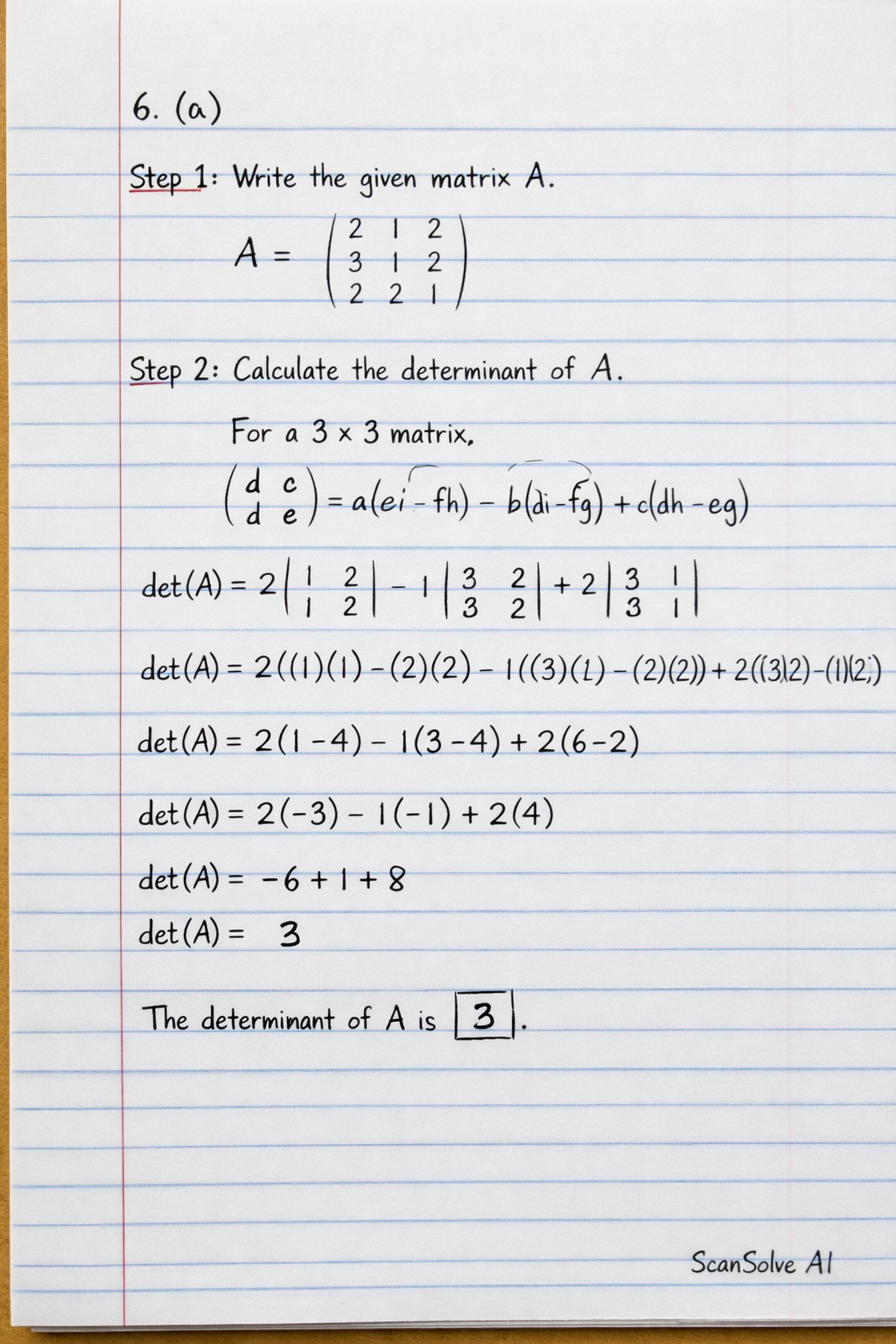
6. (a)
Step 1: Write the given matrix $A$.
$$A = \begin{pmatrix} 2 & 1 & 2 \\ 3 & 1 & 2 \\ 2 & 2 & 1 \end{pmatrix}$$
Step 2: Calculate the determinant of $A$, denoted as $\det(A)$.
For a $3 \times 3$ matrix $\begin{pmatrix} a & b & c \\ d & e & f \\ g & h & i \end{pmatrix}$, the determinant is $a(ei - fh) - b(di - fg) + c(dh - eg)$.
$$\det(A) = 2 \begin{vmatrix} 1 & 2 \\ 2 & 1 \end{vmatrix} - 1 \begin{vmatrix} 3 & 2 \\ 2 & 1 \end{vmatrix} + 2 \begin{vmatrix} 3 & 1 \\ 2 & 2 \end{vmatrix}$$
$$\det(A) = 2((1)(1) - (2)(2)) - 1((3)(1) - (2)(2)) + 2((3)(2) - (1)(2))$$
$$\det(A) = 2(1 - 4) - 1(3 - 4) + 2(6 - 2)$$
$$\det(A) = 2(-3) - 1(-1) + 2(4)$$
$$\det(A) = -6 + 1 + 8$$
$$\det(A) = 3$$
The determinant of $A$ is $\boxed{3}$.
6. (b)
Step 1: Calculate the cofactor matrix of $A$.
The cofactor $C_{ij}$ is given by $(-1)^{i+j} M_{ij}$, where $M_{ij}$ is the minor of the element $a_{ij}$.
$$C_{11} = +\begin{vmatrix} 1 & 2 \\ 2 & 1 \end{vmatrix} = (1)(1) - (2)(2) = 1 - 4 = -3$$
$$C_{12} = -\begin{vmatrix} 3 & 2 \\ 2 & 1 \end{vmatrix} = -((3)(1) - (2)(2)) = -(3 - 4) = -(-1) = 1$$
$$C_{13} = +\begin{vmatrix} 3 & 1 \\ 2 & 2 \end{vmatrix} = (3)(2) - (1)(2) = 6 - 2 = 4$$
$$C_{21} = -\begin{vmatrix} 1 & 2 \\ 2 & 1 \end{vmatrix} = -((1)(1) - (2)(2)) = -(1 - 4) = -(-3) = 3$$
$$C_{22} = +\begin{vmatrix} 2 & 2 \\ 2 & 1 \end{vmatrix} = (2)(1) - (2)(2) = 2 - 4 = -2$$
$$C_{23} = -\begin{vmatrix} 2 & 1 \\ 2 & 2 \end{vmatrix} = -((2)(2) - (1)(2)) = -(4 - 2) = -(2) = -2$$
$$C_{31} = +\begin{vmatrix} 1 & 2 \\ 1 & 2 \end{vmatrix} = (1)(2) - (2)(1) = 2 - 2 = 0$$
$$C_{32} = -\begin{vmatrix} 2 & 2 \\ 3 & 2 \end{vmatrix} = -((2)(2) - (2)(3)) = -(4 - 6) = -(-2) = 2$$
$$C_{33} = +\begin{vmatrix} 2 & 1 \\ 3 & 1 \end{vmatrix} = (2)(1) - (1)(3) = 2 - 3 = -1$$
The cofactor matrix $C$ is:
$$C = \begin{pmatrix} -3 & 1 & 4 \\ 3 & -2 & -2 \\ 0 & 2 & -1 \end{pmatrix}$$
Step 2: Calculate the adjoint matrix of $A$, denoted as $\text{adj}(A)$.
The adjoint matrix is the transpose of the cofactor matrix.
$$\text{adj}(A) = C^T = \begin{pmatrix} -3 & 3 & 0 \\ 1 & -2 & 2 \\ 4 & -2 & -1 \end{pmatrix}$$
Step 3: Calculate the inverse of $A$, denoted as $A^{-1}$.
The formula for the inverse of a matrix is $A^{-1} = \frac{1}{\det(A)} \text{adj}(A)$.
Using $\det(A) = 3$ from part (a):
$$A^{-1} = \frac{1}{3} \begin{pmatrix} -3 & 3 & 0 \\ 1 & -2 & 2 \\ 4 & -2 & -1 \end{pmatrix}$$
$$A^{-1} = \begin{pmatrix} \frac{-3}{3} & \frac{3}{3} & \frac{0}{3} \\ \frac{1}{3} & \frac{-2}{3} & \frac{2}{3} \\ \frac{4}{3} & \frac{-2}{3} & \frac{-1}{3} \end{pmatrix}$$
$$A^{-1} = \begin{pmatrix} -1 & 1 & 0 \\ \frac{1}{3} & -\frac{2}{3} & \frac{2}{3} \\ \frac{4}{3} & -\frac{2}{3} & -\frac{1}{3} \end{pmatrix}$$
The inverse of $A$ is $\boxed{\begin{pmatrix} -1 & 1 & 0 \\ \frac{1}{3} & -\frac{2}{3} & \frac{2}{3} \\ \frac{4}{3} & -\frac{2}{3} & -\frac{1}{3} \end{pmatrix}}$.
Q
Write the given matrix A.
|Mathematics
Write the given matrix A.
ScanSolve AI Answer
6. (a)
Step 1: Write the given matrix A.
A=232112221
Step 2: Calculate the determinant of A, denoted as det(A).
For a 3×3 matrix adgbehcfi, the determinant is a(ei−fh)−b(di−fg)+c(dh−eg).
det(A)=21221−13221+23212det(A)=2((1)(1)−(2)(2))−1((3)(1)−(2)(2))+2((3)(2)−(1)(2))det(A)=2(1−4)−1(3−4)+2(6−2)det(A)=2(−3)−1(−1)+2(4)det(A)=−6+1+8det(A)=3
The determinant of A is 3.
6. (b)
Step 1: Calculate the cofactor matrix of A.
The cofactor Cij is given by (−1)i+jMij, where Mij is the minor of the element aij.
C11=+1221=(1)(1)−(2)(2)=1−4=−3C12=−3221=−((3)(1)−(2)(2))=−(3−4)=−(−1)=1C13=+3212=(3)(2)−(1)(2)=6−2=4C21=−1221=−((1)(1)−(2)(2))=−(1−4)=−(−3)=3C22=+2221=(2)(1)−(2)(2)=2−4=−2C23=−2212=−((2)(2)−(1)(2))=−(4−2)=−(2)=−2C31=+1122=(1)(2)−(2)(1)=2−2=0C32=−2322=−((2)(2)−(2)(3))=−(4−6)=−(−2)=2C33=+2311=(2)(1)−(1)(3)=2−3=−1
The cofactor matrix C is:
C=−3301−224−2−1
Step 2: Calculate the adjoint matrix of A, denoted as adj(A).
The adjoint matrix is the transpose of the cofactor matrix.
adj(A)=CT=−3143−2−202−1
Step 3: Calculate the inverse of A, denoted as A−1.
The formula for the inverse of a matrix is A−1=det(A)1adj(A).
Using det(A)=3 from part (a):
A−1=31−3143−2−202−1A−1=3−33134333−23−230323−1A−1=−131341−32−32032−31
The inverse of A is −131341−32−32032−31.
Need help with your own homework?
Get instant step-by-step solutions to any question. Free to start.